
Travel · Attractions
Let the enclosure reveal the mausoleum
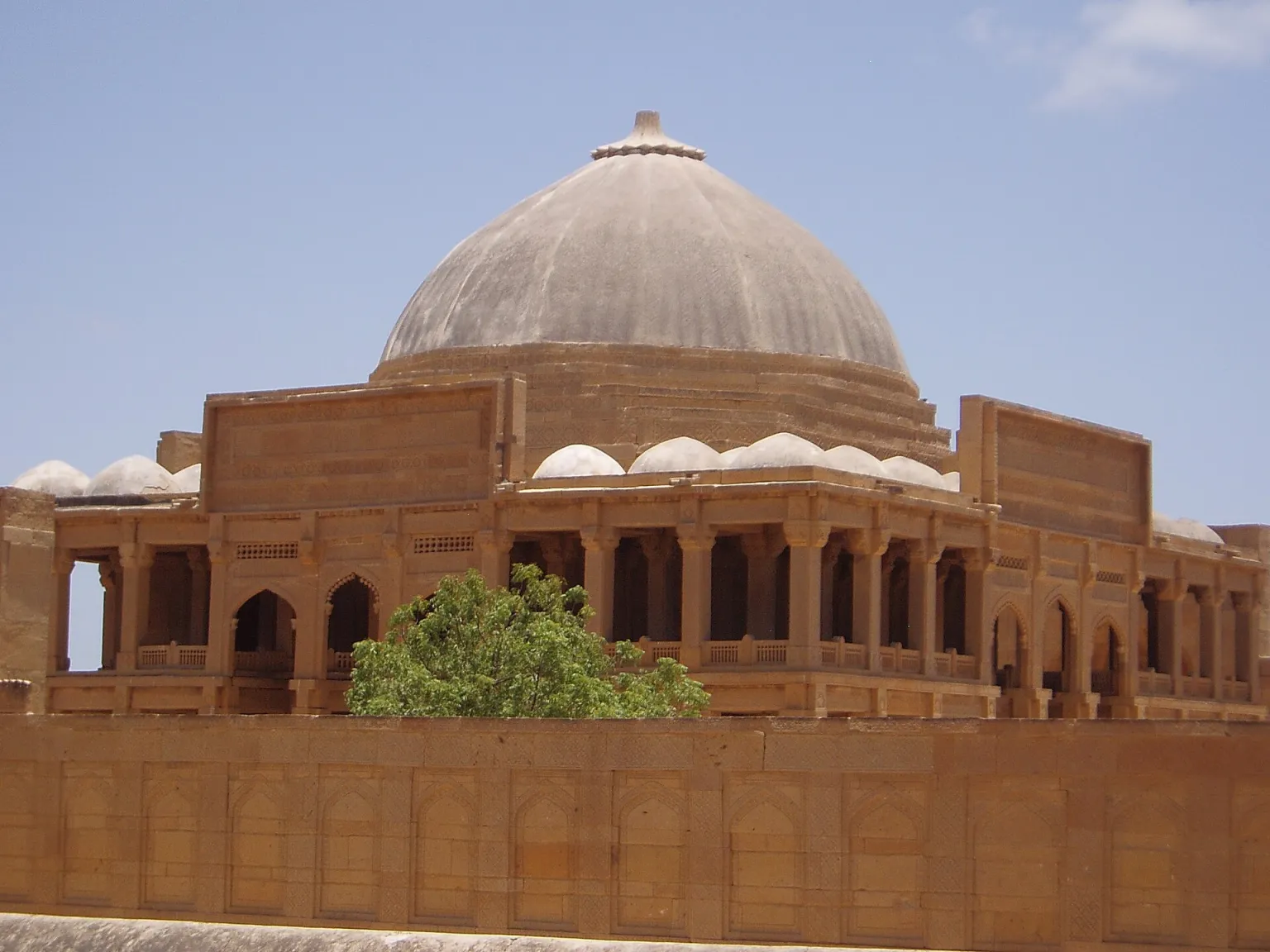
Understand Isa Khan Tarkhan II’s two-storey mausoleum through its raised plinth, columns, great arches and separate enclosure, while avoiding confusion with the elder Isa Khan.
- Read the details
- Plan the approach
- Respect the fabric
Makli, Thatta
Confirm which Isa Khan you are looking at
The name Isa Khan is not enough to identify a tomb at Makli. This guide concerns Isa Khan Tarkhan II, the younger, and the monumental two-storey stone building within its own enclosure. The federal department’s general description gives his death as 1651, while its detailed inventory gives 1644. Those records disagree, so the precise year should not be treated as settled here. Confirm the name on the site sign or with management before interpreting a photograph or following a guide’s directions.
That identification matters because the tomb of Isa Khan the elder is a separate monument. Online descriptions can confuse the two, and a shared family name does not make their plans interchangeable. Start with the building’s broad characteristics: two levels, a raised plinth and a large domed central composition. These give a better foundation for recognition than an isolated carving that might resemble work elsewhere in the cemetery.
Stand back to understand the enclosure
The enclosure is the first architectural space to read. It separates the mausoleum from the wider spread of Makli and provides a foreground in which the main building can be seen. From the authorised approach, compare the boundary’s horizontal extent with the height of the structure beyond. The relationship makes scale legible before you study columns or carved capitals.
Do not assume an enclosure wall is an invitation to walk on it, or that every visible opening is a public entrance. Follow the indicated approach and avoid crossing graves to obtain a centred view. Think of the boundary, open space and building as distinct elements. In a hypothetical comparison, a close photograph taken directly below an arch might emphasise height while concealing the enclosure entirely. A more distant permitted view can explain the arrangement better.
Read the plinth as a change of level
The federal description places the mausoleum on a raised plinth and records entrances on four sides. A plinth establishes a platform below the building, changing the relationship between its floor and the ground around it. Observe where the platform begins, where an authorised ascent is provided, and how the main openings relate to that level. Historic entrance arrangements do not guarantee that all four approaches are available today.
A low camera angle can make the platform vanish from the picture, while a slightly more distant view may show how much it contributes to the composition. Compare those views without leaving safe ground. Anyone with mobility limitations should ask specifically about steps, surface changes and permitted access to the platform. A photograph of an open arch does not establish that a continuous step-free route reaches it.
Compare the two storeys and their supports
The building’s two levels are especially useful for reading rhythm. The Department of Archaeology and Museums describes square columns, Tarkhan capitals and walkways on both levels. Look for vertical correspondences: does an upper support appear above a lower one, and how do the horizontal edges divide the elevation? These are questions for observation rather than an invitation to trace loads with engineering certainty.
The capital is the shaped upper part of a column. Notice its profile from an authorised viewpoint and compare it with the simpler shaft below. Carving can make a structural junction visually prominent. You do not need access to an upper walkway to understand this arrangement. Use permitted ground-level views, and treat stairs or upper passages as closed unless management specifically directs visitors there. Appearance alone cannot establish structural safety.
Let the large arches frame the dome
The federal entry highlights giant arched entrances and a large true dome. Its suggestion that the dome may be among the earliest in stone is explicitly qualified, so it should remain a possibility rather than become a record-breaking claim. The secure point for a visitor is the relationship between a broad arched opening and the domed mass associated with it.
Choose a viewpoint where one arch can be seen clearly, then move only along the permitted route to compare its apparent proportions. An oblique view changes how wide the opening looks; that is perspective, not evidence that two sides were built differently. Watch how shadow separates the recess from the exposed stone. A good photograph can show the arch as a frame without needing a person to stand in a burial space as a scale marker.
Look for ornament at structural junctions
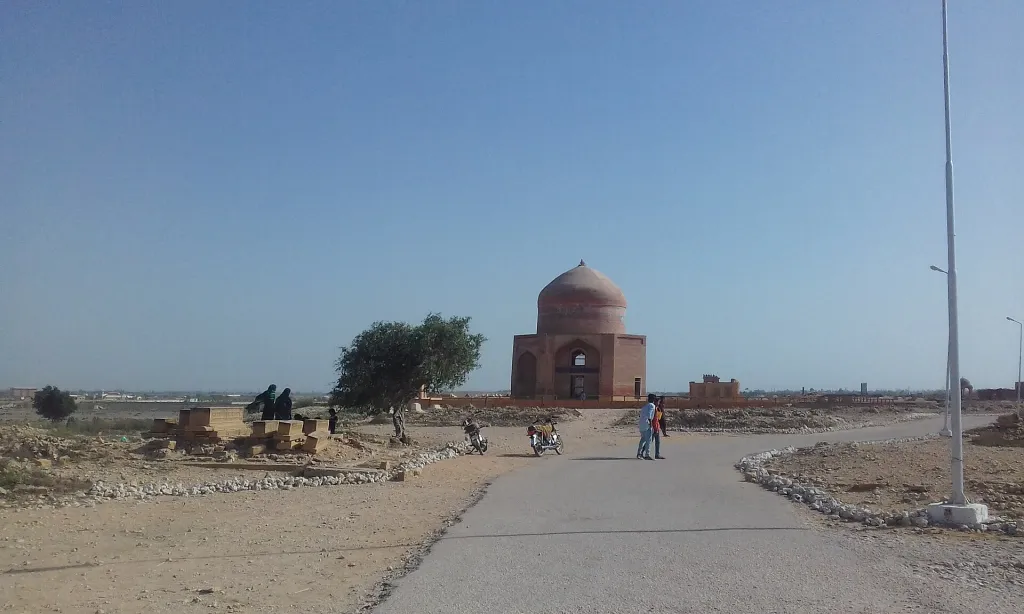
The federal record notes extensive ornamentation across the structure. Rather than trying to describe it all, select a junction between a support and the element above it, or the edge of a large opening. Ask where carving becomes more concentrated and where the surface is left comparatively plain. This is a useful way to see how ornament participates in the larger elevation.
Keep the description tied to the particular face you can actually see. A detail photograph from another Makli tomb is not evidence of decoration here. Neither does a familiar pattern identify an individual artisan without documentation. If lettering is present in your chosen view, avoid inventing a translation or assigning it a date. Photograph only where allowed, then compare with a reliable published record when exact wording or attribution matters.
Understand conservation as part of the view
UNESCO conservation documentation addresses interventions involving Isa Khan Tarkhan II’s mausoleum and the main gate. That makes conservation relevant to the interpretation of the building, but it does not tell a visitor that every exposed surface is original or that a particular repair can be dated by colour. Ask management whether a current information panel explains the work visible from the visitor route.
Observe differences without turning them into accusations or assurances. Newer-looking material may represent a documented intervention; a weathered area is not automatically untouched. Remain outside barriers, do not test a loose joint, and never climb stonework for a higher photograph. A large monument can contain vulnerable small elements. The fact that an upper level survives does not mean it is intended to carry unrestricted visitor traffic today.
Allow time for one mausoleum
A focused visit should leave enough time to see the enclosure, platform and one or two elevations without rushing across Makli. Confirm the authorised approach, opening arrangements and any current restrictions with the antiquities department or site management. This guide does not promise access to internal chambers or upper walkways. Let the day’s permitted route determine how much of the building can responsibly be examined.
Cooler weather is generally more comfortable on the exposed ridge. Carry water, sun protection and suitable footwear; check for heat, rain and route conditions before departure. Families should agree on a meeting point and keep children away from platform edges and burial structures. If anyone cannot manage steps or rough surfaces, ask about specific viewpoints that can be reached safely instead of relying on a general statement that the cemetery welcomes visitors.

Make a record that keeps the buildings separate
An effective set of notes needs only three relationships: enclosure to building, plinth to openings, and lower to upper storey. These distinguish a spatial reading from a collection of unrelated close-ups. Where permitted, photograph a wide view first so that later details remain anchored to the right monument. Give the caption the full name, including Tarkhan II or the younger.
Makli’s World Heritage status belongs to the wider property, inscribed in 1981, and should not flatten the history of its individual structures. Resist adding the elder Isa Khan’s dates or plan to this building because a search result uses a similar title. You can leave with a strong understanding of arches and scale while still acknowledging unanswered questions about construction phases. Clear identification is the beginning of a useful architectural visit.
Frequently Asked Questions
Is this Isa Khan the elder’s tomb?
No. This guide concerns Isa Khan Tarkhan II, the younger. Confirm the monument with site signage or staff.
Can visitors use the upper walkways?
Their historic existence does not establish current access. Use only routes specifically opened by management.
Is the stone dome certainly the first of its kind?
No. The federal description uses qualified language; an absolute priority claim would overstate the evidence.
What should I photograph first?
Where photography is allowed, begin with the enclosure and whole building before taking details of columns or arches.
How we know this
- Type Practical guide
- Sources 4 (4 official/academic)
- Reviewed November 2026
- Disputed points None
Rules and fees change, confirm with the official links below before you act.
4 sources
- Tomb of Isa Khan Tarkhan-II, Department of Archaeology and Museums, Pakistan
- Tomb of Isa Khan Tarkhan-II: Sindh inventory entry, Department of Archaeology and Museums, Pakistan
- Historical Monuments at Makli, Thatta, UNESCO World Heritage Centre
- Historical Monuments at Makli: State of conservation documentation, UNESCO World Heritage Centre
Photo credits (2)
- Tomb of Mirza Esa Khan Turkhan Makli Thatta Sindh.JPG, Ghazi, CC BY-SA 4.0, via Wikimedia Commons
- Makli Necropolis near Thatta province of sindh pakistan.jpg, Nadirkhanbrahui, CC BY-SA 4.0, via Wikimedia Commons
