
Travel · Attractions
Follow the water and the sightlines
Read Sheikhupura’s Mughal hunting complex through its tower, tank, causeway and pavilion, with a careful distinction between surviving fabric and conflicting dates.
- Read the details
- Plan the approach
- Respect the fabric
Hiran Minar, Sheikhupura
Begin with three connected elements
Hiran Minar becomes more interesting when the tower stops being the whole destination. The tank, the pavilion within it and the approach across water organise a much larger architectural experience. Begin from a permitted viewpoint that allows you to compare their positions. Ask which element marks the site vertically, which controls movement and which provides a place to pause. These questions turn a souvenir photograph into an architectural reading.
Sheikhupura’s district administration describes the place as a Mughal hunting complex. That context matters: this was a designed landscape associated with imperial recreation, animals and water, rather than simply a tower planted beside an ornamental pool. A useful visit follows the connections between structures without assuming that every part was designed or completed at precisely the same moment. Carry the site’s layered history into the route you choose.
Keep the antelope story separate from a precise chronology
The federal Department of Archaeology and Museums records that Jahangir commissioned the tower in memory of his pet antelope, Mansraj. The district account gives 1606 for the tower and attributes the central pavilion to Shah Jahan’s reign. UNESCO’s Tentative List description instead attributes the pavilion to Jahangir in 1620. These official descriptions do not agree on a simple construction sequence.
The responsible approach is to name that disagreement rather than combine the dates into an apparently certain timeline. The memorial association and Mughal hunting setting are useful starting points; a detailed chronology needs further specialist evidence. If a guide tells an additional story about the animal’s death or the emperor’s exact movements, ask what supports it. A memorable anecdote is not automatically an inscription, contemporary record or securely dated construction phase.
Read the tower from ground level
The tower’s tapering brick body provides a strong vertical contrast with the tank’s broad surface. UNESCO’s submitted description notes regularly arranged exterior holes, projecting mouldings between tiers and internal openings for light and air. Instead of trying to count every feature, choose one band and see how repetition creates order around a circular surface. Examine from a distance whether shadow makes the openings and mouldings more legible.
The federal record describes former lime plaster on the exterior. This is an important correction to the assumption that exposed brick always represents the intended finished appearance of a Mughal building. Look for differences between masonry and any surviving surface treatment without touching or scraping them. An internal staircase recorded in a historical description does not establish that tower access is available or appropriate during your visit.
Let the tank explain scale and water management
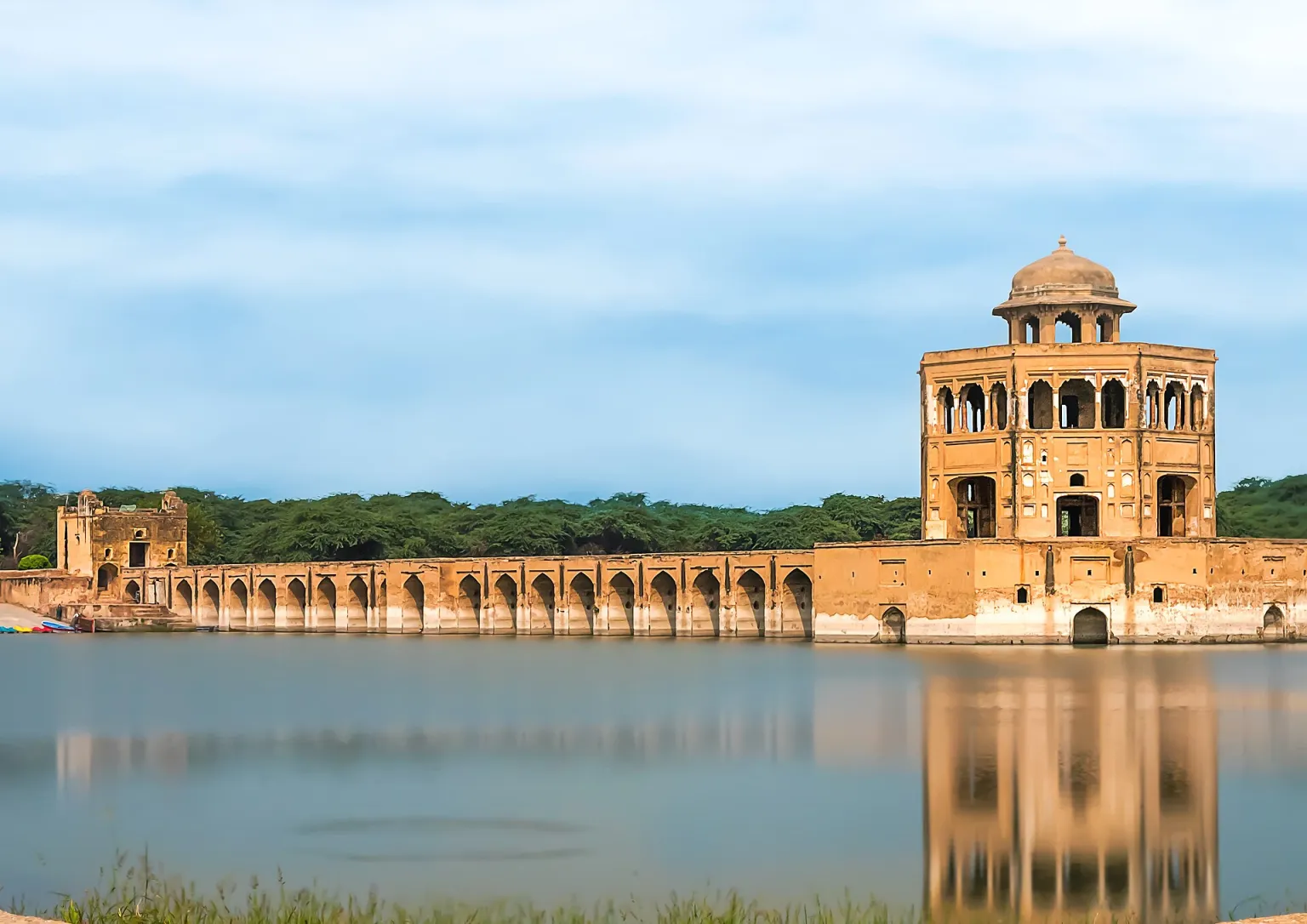
The tank is an architectural space as well as a water container. Its edge frames the central pavilion and gives the tower an open foreground. UNESCO’s account records a historic channel from the Aik rivulet and a system for collecting rainwater from the catchment. The district description highlights ramps descending at the centres of the sides, associated with access for animals.
Look across the enclosure before approaching the edge. Identify ramps, stairs and parapets as different ways of negotiating a change in level. Do not infer that visible water today is supplied by the complete historic system, or that a dry area proves the original design failed. A present water level is a condition at one moment. The older descriptions establish design intentions and recorded arrangements, not the operational state of every channel now.
Follow the causeway with your eyes first
A causeway changes the relationship between the visitor and the central pavilion. From the edge, the pavilion is an object across water; on the approach, its openings and platform become larger and more immediate. This is a useful interpretive observation rather than a claim about exactly how every imperial visitor experienced the site. Compare the view straight ahead with the view back towards the gateway.
UNESCO’s description records pointed arches supporting the causeway and an octagonal platform and pavilion. Watch how the shift from a rectangular tank to an eight-sided central form creates different angles of view. Photograph from authorised standing areas and keep the passage clear. Do not move onto an unprotected ledge to obtain a symmetrical picture. If the crossing is restricted, the long view still explains the route and its central emphasis.
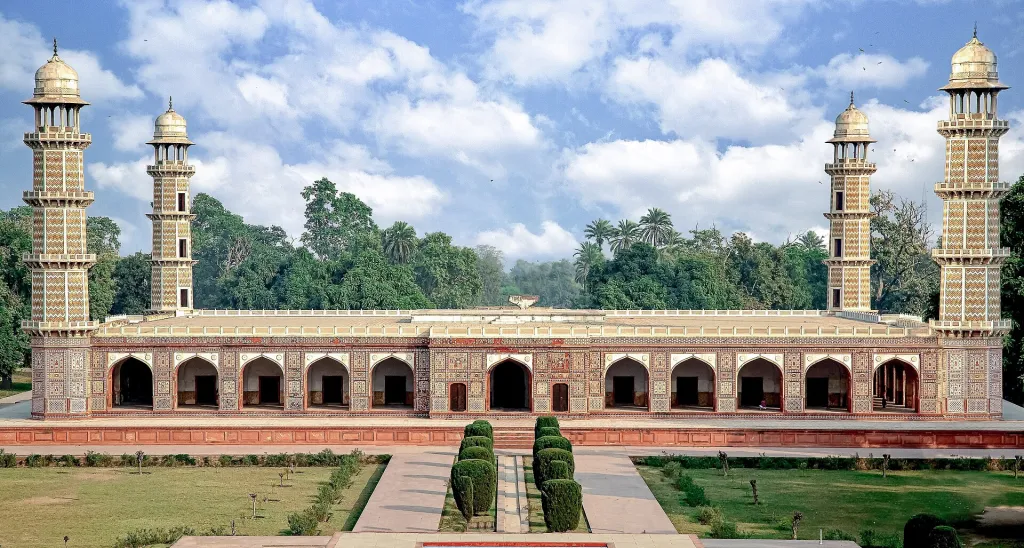
For wider Mughal context, compare the discipline of identifying a structure’s patronage here with a separately researched visit to Jahangir’s tomb at Shahdara. The tomb is a different destination; its photograph does not document the surfaces or plan of Hiran Minar.
Notice surfaces rather than searching for untouched perfection
Mughal architecture is often introduced through its grand outline, but details reveal how a space was finished and inhabited. At Hiran Minar, the submitted UNESCO description records recessed niches, plaster and decorative treatments in the gateway and pavilion complex. Use those categories as observation prompts, not a promise that every recorded feature will be visible in the same condition.
Compare a sheltered recess with an exposed surface. Differences may raise questions about weathering, repair or lost finishes, but an unaided glance cannot date a patch of plaster. Avoid calling a brighter area new or a darker one original without evidence. Where interpretive signs identify work, note the wording and date. Conservation is part of the building’s continuing history, and treating every irregularity as damage can obscure both earlier craftsmanship and later care.
Build a visit around the group’s actual mobility
Before departure, confirm current admission arrangements, any separate permissions, the available walking route and whether the causeway or pavilion is restricted. Ask specifically about steps, distance from drop-off, seating and toilets if those determine whether someone can participate. A photograph of a broad courtyard cannot establish an accessible route from the entrance to every viewpoint.
Choose a shorter circuit with deliberate stops if young children, older relatives or someone with limited stamina is coming. Carry drinking water and sun protection, and keep children close beside the tank and changes in level. Cool weather often makes exposed heritage walking more comfortable, but check the day’s heat, visibility and rain rather than treating a calendar month as a guarantee. Wet masonry and edges deserve extra caution. Leave enough daylight to return to transport without rushing.
Try a short observation exercise
Consider this hypothetical visit: a family has time for three unhurried stops. At the first, they sketch the tower, tank and pavilion as simple shapes in a blank notebook. At the second, they compare the gateway view with the diagonal view across the tank. At the third, they identify one material distinction, such as brick structure and plaster finish. This is a suggested learning exercise, not a report of an observed family.
The exercise works without entering every building or reciting a list of dimensions. Children can mark what they actually see and put a question mark beside uncertain details. Adults can record which historical account supplied a date. Keep the notebook separate from the monument: there is no need for rubbing, tracing directly on masonry, collecting loose fragments or arranging props against historic surfaces.

Leave with a connected reading
At the end, describe the place in one connected sentence: a memorial tower stands within a hunting landscape whose water enclosure, gateway and pavilion organise movement and views. Then add one uncertainty that remains, such as the differing official attributions of the pavilion. This produces a more accurate memory than a confident but unsupported date attached to every structure.
Hiran Minar appears on Pakistan’s UNESCO Tentative List; that status is different from inscription on the World Heritage List. It also says nothing by itself about today’s opening arrangements. Before sharing practical advice, separate what you personally checked from what the historical sources describe. A careful visitor can enjoy the composition, recognise the importance of water and acknowledge unresolved chronology without diminishing the attraction’s appeal.
Frequently Asked Questions
Was Hiran Minar built for an antelope?
The federal archaeology record associates Jahangir’s tower with his pet antelope Mansraj. More elaborate stories should be identified and sourced separately.
Who built the central pavilion?
Official accounts differ: the district account places it under Shah Jahan, while the UNESCO Tentative List description names Jahangir and 1620. A single uncontested attribution should not be asserted.
Can visitors climb the tower?
A recorded staircase is not confirmation of current access. Ask site management about the permitted route before visiting.
Is Hiran Minar a UNESCO World Heritage Site?
It is on Pakistan’s Tentative List. Tentative listing is a separate status from World Heritage inscription.
How we know this
- Type Practical guide
- Sources 3 (3 official/academic)
- Reviewed November 2026
- Disputed points None
Rules and fees change, confirm with the official links below before you act.
3 sources
- Hiran Minar and Tank, Sheikhupura, UNESCO World Heritage Centre
- Hiran Minar and Tank, Department of Archaeology and Museums, Pakistan
- Important Places: Hiran Minar, District Administration Sheikhupura
Photo credits (2)
- Octagonal Pavilion in Water Tank at Hiran Minar.jpg, Shaguftakarim, CC BY-SA 4.0, via Wikimedia Commons
- Tomb of Emperor Jahangir.jpg, Tahsin Shah, CC BY-SA 4.0, via Wikimedia Commons
