
Places to visit
Frere Hall: a practical visitor guide
Visit Frere Hall: what to see, historical context, getting there, a realistic plan, families and official access checks.
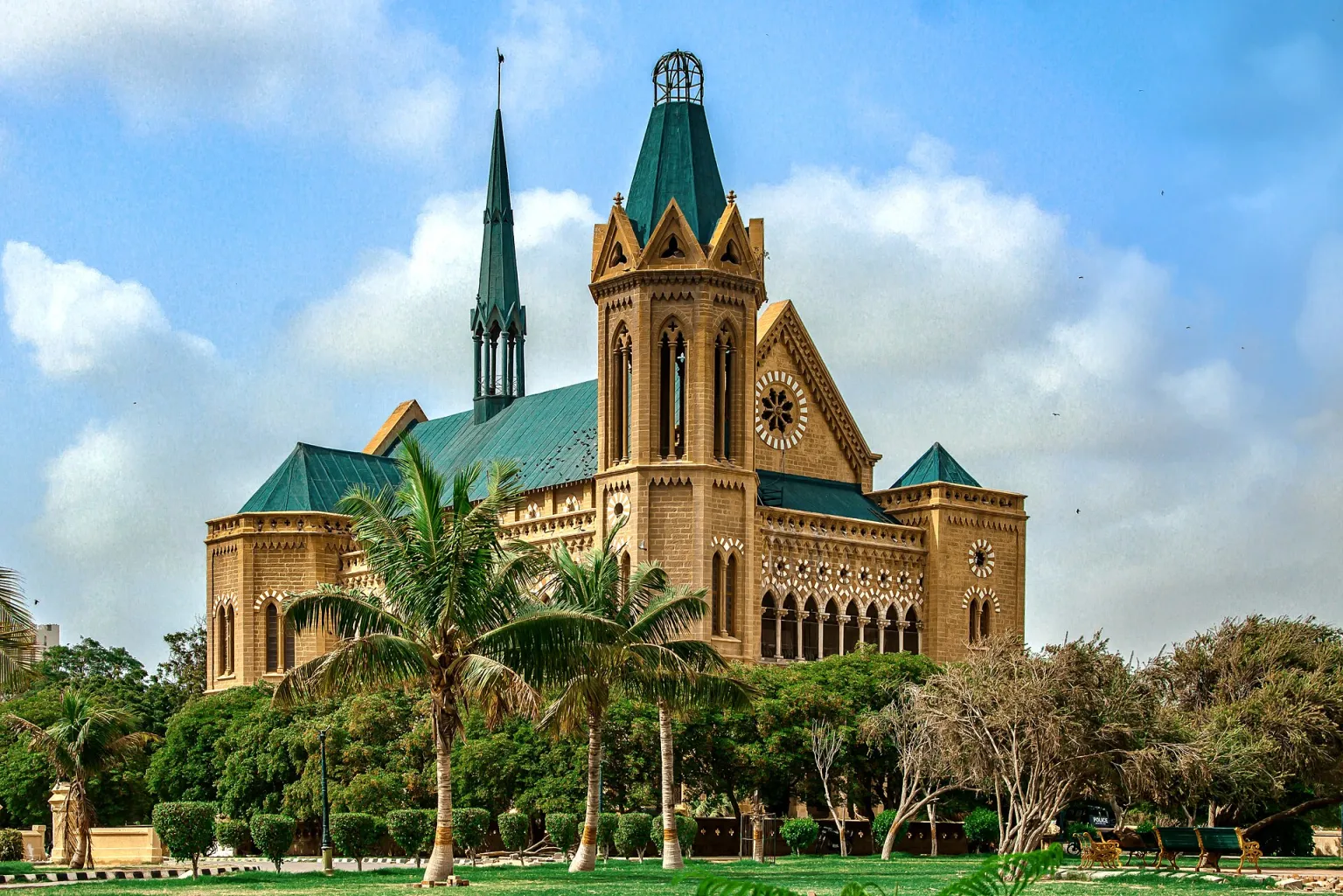
The Venetian-Gothic Frere Hall surrounded by lawns in Karachi
A civic landmark that rewards looking slowly
Frere Hall is a central Karachi architectural stop, useful for visitors who want to read a historic building rather than move immediately from one enclosed museum to another. Its pale stone, pointed openings, tower and surrounding open setting make the exterior a substantial part of the attraction. Allow around forty-five minutes to an hour for an exterior-focused visit, as an editorial estimate. Add time only after confirming any gallery, library or event access you want. A public-looking facade does not establish unrestricted entry to every floor, and an old photograph is not a current opening notice.
The colonial context belongs in the story
The federal heritage inventory describes the hall as commemorating Bartle Frere's administration and identifies its Venetian Gothic style and Jungshahi limestone. Rather than celebrating the building in isolation, recognise that its name and function arose within colonial government and civic culture. Architectural interest does not require adopting the commemorative viewpoint of the original patrons. Look at what the building says about public prestige, imported forms and local materials. The site's layered history also includes its relationship to the National Museum, whose official history records its early premises here before its move to Burns Garden.
Reading the exterior in three stages
First, stand at a permitted distance and see how the tower, main roof and lower verandahs balance each other. Then choose a closer public viewpoint for the arches, columns and stone details. Finally, look for how the building meets the ground and surrounding paths: entrances and stairs show which spaces were intended to be approached formally. Avoid describing an exterior observation as proof of an interior feature. A visitor can learn a great deal from form and material without inventing a floor plan or assuming the tower itself is open to the public.
Explore the places and guides mentioned
Photographs show the linked places or guide subjects. Open each page for its own visiting and planning information.


Jungshahi stone and an imported architectural label
The federal description's identification of Jungshahi limestone is a useful corrective to treating Venetian Gothic as if the building had simply been transported from Europe. A style label describes a set of visual relationships; a material source points towards the labour, supply and building conditions of the place where construction happened. Look at the stone from public areas and consider how colour and weathering contribute to the hall's appearance. Do not identify a repair merely because a block looks different.
The tower and wide verandahs also do different visual work. One establishes a vertical landmark, while the others create a repeated rhythm closer to the scale of a person. Looking at both makes the building more understandable than concentrating only on the most recognisable spire. It gives an exterior visit enough substance without inventing guaranteed access to an upper room or repeating an unverified story about what happened inside.
Interior interests need separate confirmation
Frere Hall is often approached for cultural activities as well as architecture, but this guide does not promise a current exhibition, library visit or access to an upper hall. Ask the responsible site staff what is open that day and whether photography or events affect the route. If an artwork or particular room is the main reason for coming, obtain a direct answer before travelling. The federal inventory's description of an upper hall is evidence of building form, not a visitor-service guarantee. An exterior-only visit should be a deliberate choice, not a disappointment created by assuming every door would be open.
A sensible central-city arrival
Use Frere Hall as the exact destination and confirm the current public approach. The surrounding road system may make the best drop-off different from the nearest mapped point. Arrange a legal pickup place and avoid stepping into traffic to obtain a symmetrical photograph. If pairing the hall with Quaid-e-Azam House Museum, check the actual route and crossings. Nearby on a map does not automatically mean comfortable on foot for a family or wheelchair user. Resolve bags and luggage elsewhere unless a specific storage arrangement has been confirmed; the hall is not an assumed left-luggage facility.
A relaxed first-visit plan
Begin with the building's main exterior view, then walk a permitted route that lets you compare at least two sides. Read available interpretation before making assumptions about dates or commemorations. If an interior space is open, visit it as a separate stage, following staff directions and keeping access paths clear. Leave ten minutes for a pause outside and a final look at a detail that was not obvious at first. This plan works without an elaborate programme. Families can make it shorter by choosing three visible features rather than expecting children to study an architectural style in detail.
Access, fees and events
No dependable current daily timetable, admission tariff or event programme is established here. Check before making a dedicated journey, especially if hoping for indoor access. Ask whether any grounds or building section has different opening arrangements and whether an event limits ordinary visitors. For mobility needs, clarify the path from the entrance, stairs to desired rooms and accessible toilets. Do not infer step-free upper-floor access from an accessible outdoor approach. If photographing, observe the current rules and seek consent before making visitors or event participants the subject of close images. The building can be documented without intruding on someone else's activity.
Use the official attraction information as your starting point for the enquiries above.
What to combine and what to leave for another day
The National Museum offers a useful follow-on because it has an institutional connection to Frere Hall while providing a very different collection visit today. Give it its own transport and time allowance. Read the Karachi city guide before planning a longer Saddar or central heritage route. With children, compare the hall's stone civic architecture with another building seen that day and ask how each signals its purpose. Avoid a rushed chain of facade photographs if the group would rather spend time at one place. Frere Hall can be a satisfying short outing on its own when its architectural interest is the clear aim.
For related planning, read Colonial heritage of Pakistan.
Continue planning your trip
Frequently Asked Questions
Is the National Museum still here?
No. The museum’s official history records its move to the Burns Garden premises in 1970. Frere Hall and the National Museum are separate visitor destinations today.
Can I enter the tower or every upper room?
No such public access is verified here. Confirm the specific rooms open on your date with site staff.
Is an exterior visit worthwhile?
Yes, if architecture is your interest. The stonework, arches, verandahs and overall form support a focused forty-five-minute-to-one-hour editorial plan.
Are exhibitions or events guaranteed?
No. Obtain current information for a particular exhibition, library visit or event, and ask whether it affects ordinary access.
How we know this
- Type Travel guide
- Sources 2 (2 official/academic)
- Reviewed October 2026
- Disputed points None
Rules and fees change, confirm with the official links below before you act.
2 sources
- Frere Hall — official information, Government of Pakistan
- National Museum of Pakistan institutional history, Department of Archaeology and Museums, Government of Pakistan
Photo credits (3)
- Frere Hall Karachi. Pakistan.jpg, Asim Iftikhar Nagi, CC BY-SA 4.0, via Wikimedia Commons
- Karachi Skyline 1.jpg, Ktownboy103, CC0, via Wikimedia Commons
- PK Karachi asv2020-02 img36 Empress Market.jpg, A.Savin, FAL, via Wikimedia Commons
