

Places to visit
Empress Market: a practical visitor guide
Visit Empress Market: what to see, historical context, getting there, a realistic plan, families and official access checks.
The clock tower of Empress Market in Saddar, Karachi
An attraction that remains a place of work
Empress Market is a Saddar landmark best visited with the understanding that a working market and a heritage building occupy the same place. The clock tower and stone architecture provide the visitor attraction, while the surrounding commercial activity has its own priorities. Allow roughly forty-five minutes to an hour for an exterior-and-market introduction as an editorial estimate. Stay longer only if you actually intend to shop and the relevant stalls are operating. A visit is not a right to photograph people at close range, interrupt transactions or use a shop entrance as a staging point.
What the official inventory establishes
The federal heritage inventory dates construction to 1884–89 and explains that the market was named for Queen Victoria as Empress of India. Its description records galleries built to accommodate shops and stalls. These are useful facts for understanding a purpose-built colonial market rather than mistaking the building for a palace or town hall. The name itself is part of the colonial history, not a neutral label that needs no explanation. The present neighbourhood has continued to change, so do not treat a nineteenth-century capacity figure as a count of today's active businesses or an old inventory condition report as a current inspection.
Look at how the architecture supports trade
Begin with the facade and tower from a place where you can stand safely without blocking pedestrians. Then examine how entrances, openings and covered areas relate to the movement of people and goods. A market is designed for circulation and exchange, and that function is more interesting than a photograph of the clock alone. Where access is public and shops are open, move with the normal flow rather than stopping a group in a narrow passage. If a section is closed or restricted, do not assume another stallholder can grant access to the entire building.
Explore the places and guides mentioned
Photographs show the linked places or guide subjects. Open each page for its own visiting and planning information.

A market plan is an architectural clue
The official inventory describes four galleries arranged for shops and stalls. Use that original commercial purpose as a clue when viewing openings and circulation, but do not convert its historical capacity into a present shop count. A building can retain its overall form while the way people occupy and manage it changes. The most useful observation is how the surviving architecture accommodates movement and exchange today.
If shopping is part of the visit, keep a separate small allowance of time and money for it. Ask whether a quoted price is per item, per weight unit or per package, and check what has been agreed before paying. This is ordinary market clarity rather than a claim that a particular vendor or product is endorsed. A heritage visit can involve buying something, but spending is not required to appreciate the building and does not replace permission for photographs.
Plan the Saddar approach carefully
Save Empress Market as the exact destination and ask the driver for an appropriate legal drop-off. A map pin beside the building does not establish where a vehicle can wait. Agree a clear pickup landmark in advance, particularly if mobile reception, crowds or traffic make a last-minute call awkward. Wear shoes suitable for an active commercial area and carry only what you can manage comfortably. For a first visit with children or an older relative, the shortest safe approach may be more valuable than a wider architectural walk. The surrounding streets should be assessed as a real route, not a straight line between map markers.
An hour with a coherent purpose
Use the first portion of the visit for the exterior and a brief explanation of the building's original function. If market areas are open, choose one short route through them without trying to inspect every stall. If shopping, ask a price and unit clearly before agreeing to buy, and check the item rather than relying on a general assumption about market bargains. Finish with another exterior view that makes sense of the internal route. This sequence gives the visit a beginning and end and avoids turning a compact stop into aimless wandering when the group is already tired.
Photography and shopping etiquette
Ask before making an individual vendor, customer or shop interior the subject of an image. A wide architectural view and a close commercial interaction are different situations. Do not move produce or merchandise to improve a composition. If someone declines a photograph, continue without argument. Buying something does not purchase unrestricted rights over a person's image or workspace. Families can give children a simple observation task, such as identifying how goods are displayed, without touching items. This turns the working setting into an educational encounter while preserving the difference between a public attraction and someone else's business.
Opening, access and present conditions
No current unified opening timetable or admission arrangement is verified here. Individual businesses can keep different hours, and access to a public-facing market does not imply public tower access or an interior heritage tour. Confirm any special architectural visit with the relevant authority before travelling for it. Visitors with mobility needs should assess the actual approach, kerbs, surfaces, crowding and available toilets rather than assume a street-level market is fully accessible. A shorter exterior-focused visit can be a good option if the interior route is unsuitable. Do not rely on an old photograph to judge today's circulation or works.
Use the official attraction information as your starting point for the enquiries above.
Where it fits in a Karachi day
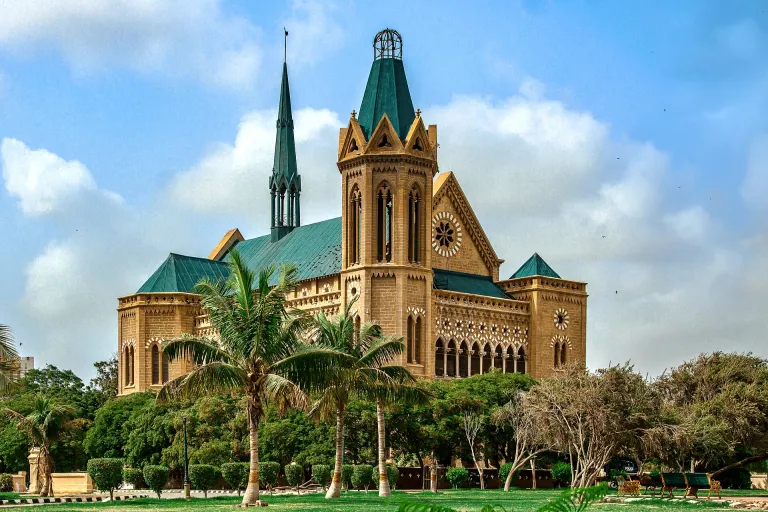
Read the Karachi city guide before building a wider Saddar route, and keep meals and rest stops explicit. Frere Hall and the National Museum offer different kinds of heritage experiences, but neither should be added without checking current access and the actual journey. With children, discuss the difference between preserving a building and freezing the activity inside it. A market continues to function and adapt. That is part of why Empress Market is worth visiting, and it is also why a considerate visitor changes pace to fit the place rather than expecting the place to behave like a controlled museum gallery.
For related planning, read Colonial heritage of Pakistan.
Continue planning your trip
Frequently Asked Questions
Was Empress Market built as a market?
Yes. The official inventory describes its nineteenth-century construction and galleries intended for shops and stalls.
Can I climb the clock tower?
No public tower access is verified here. Do not assume that a working market entrance also grants access to upper or restricted areas.
Can I photograph vendors freely?
Ask before close photographs of people or shop interiors, keep paths clear and respect a refusal. An architectural visit does not override working routines.
What time should I arrive?
Confirm the activity you want to see. This guide does not establish one reliable timetable for every business, building section or possible heritage visit.
How we know this
- Type Travel guide
- Sources 1 (1 official/academic)
- Reviewed October 2026
- Disputed points None
Rules and fees change, confirm with the official links below before you act.
1 sources
- Empress Market — official information, Government of Pakistan
Photo credits (3)
- PK Karachi asv2020-02 img36 Empress Market.jpg, A.Savin, FAL, via Wikimedia Commons
- Karachi Skyline 1.jpg, Ktownboy103, CC0, via Wikimedia Commons
- Frere Hall Karachi. Pakistan.jpg, Asim Iftikhar Nagi, CC BY-SA 4.0, via Wikimedia Commons
