
Travel · Attractions
Read the desert wall before entering
Understand Derawar’s bastions, brick patterning and desert setting while preparing a realistic Cholistan approach with separately confirmed interior access.
- Read the details
- Plan the approach
- Respect the fabric
Derawar Fort, Cholistan
Let the outline establish the question
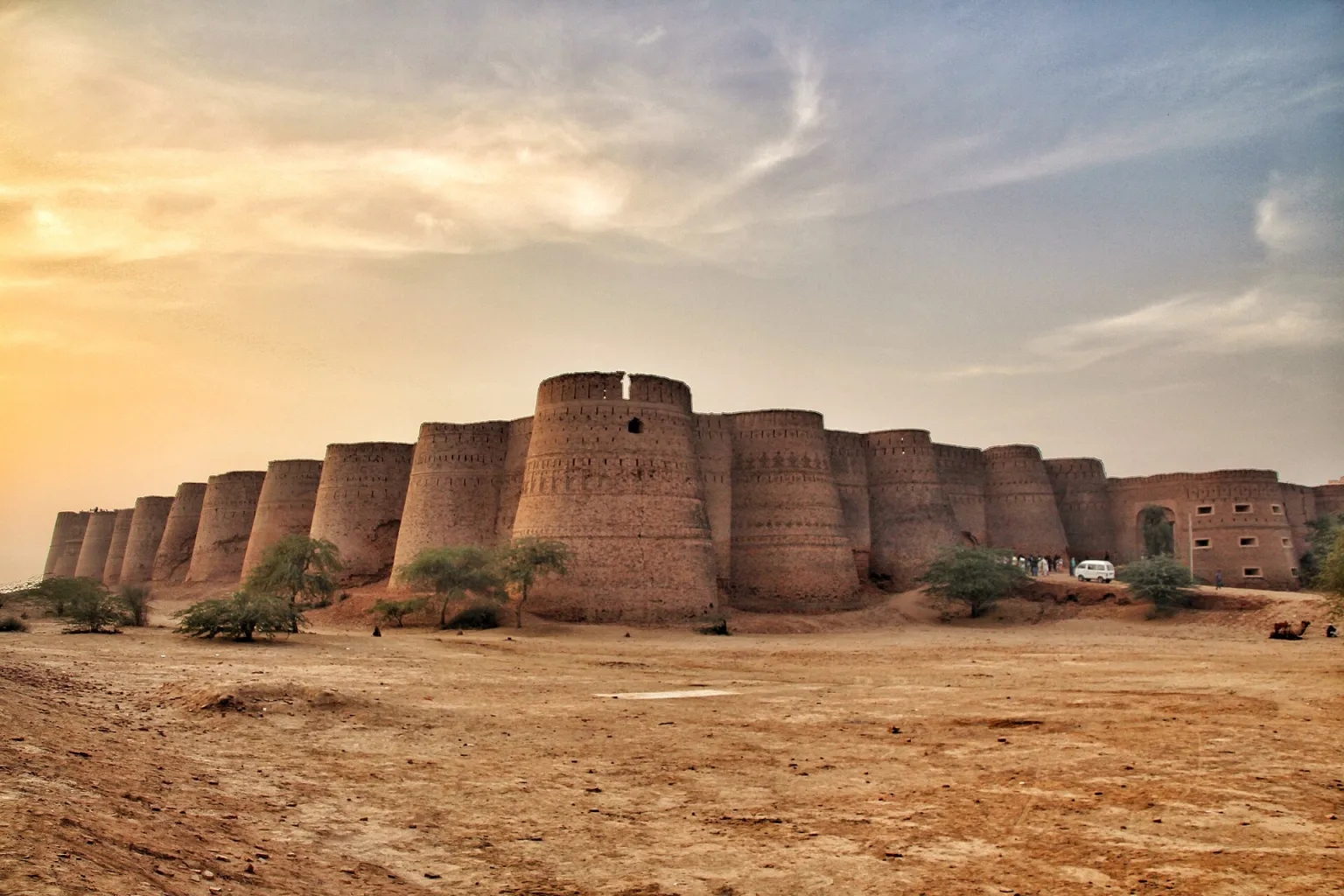
Derawar’s repeated bastions make an unusually strong silhouette against Cholistan’s open landscape. Before thinking about entry, look at the relationship between the curved towers, the connecting wall and the flat ground around them. The best first question is how repetition changes the appearance of a single enclosure. From one viewpoint the bastions seem separate; from another they read as a continuous protective edge.
Choose a safe permitted stopping place and keep vehicles clear of routes used by other visitors and residents. A distant view can be a substantial part of the visit, especially if interior permission is unavailable. This approach does not reduce Derawar to a photograph: the outer wall contains information about material, defence, display and the importance of a fortified stopping place in an exposed desert setting.
Separate early origins from documented later control
UNESCO’s Tentative List submission repeats an early foundation attributed to Rai Jajja Bhatti in the ninth century. The federal archaeology description is more cautious, noting how little is known of the early history before the first Nawab of Bahawalpur captured the fort in 1733. Present these as different levels of historical confidence rather than an uninterrupted, precisely documented biography.
The eighteenth-century Bahawalpur connection is central to understanding the surviving place, but an early origin story does not mean that every visible brick is that old. Forts change through rebuilding and continued use. When a guide attributes a wall, room or decorative treatment to a ruler, ask whether the claim comes from a record, an inscription or a general local tradition. It is entirely possible to enjoy the story while keeping its evidential status clear.
Read the bastions as a repeated system
Both the UNESCO submission and the federal record associate Derawar with forty bastions. The Tentative List description identifies a square brick enclosure with circular towers and cut-brick decoration. Use those established characteristics to organise your observations. Compare a frontal view of one bastion with a diagonal view where several overlap. Notice how shadow makes a curved surface appear more or less solid.
Do not assume that the number alone explains the defensive system. A visitor can observe spacing, curvature and visible openings, but assigning a precise weapon or construction date to each feature requires additional evidence. Avoid climbing fallen material or moving close under unstable masonry for a detailed photograph. A longer lens from permitted ground can reveal texture without turning the wall base into a route or suggesting that the interior is open.
Look for pattern in the brick surface
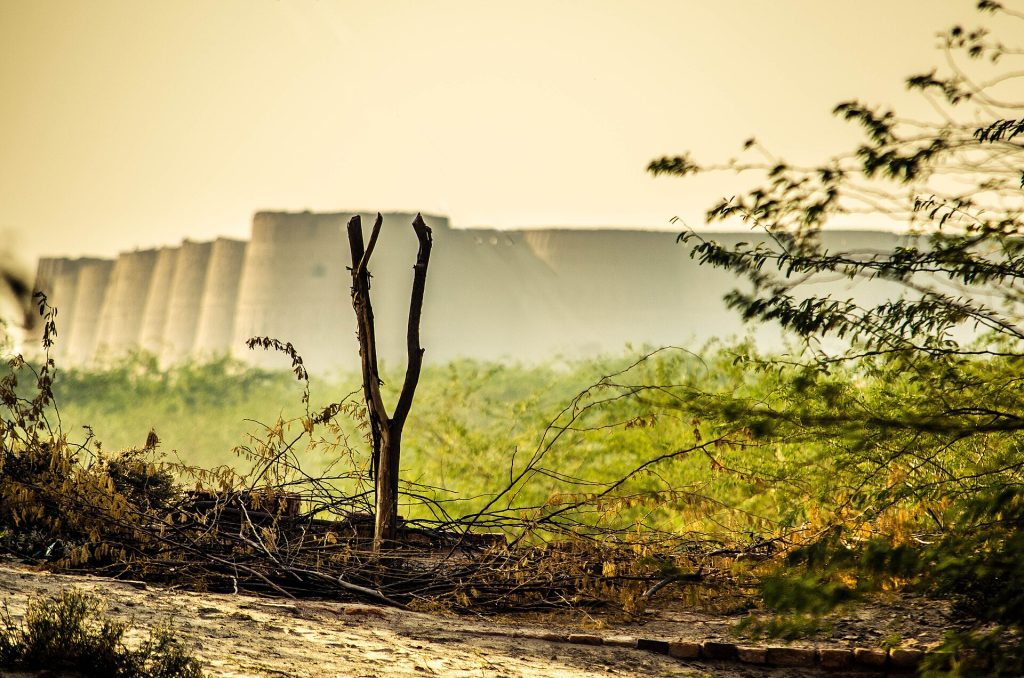
At a suitable distance, compare the large structural rhythm with the smaller pattern of brickwork. The UNESCO description specifically identifies cut-brick patterns on the bastions. Such detail helps explain why Derawar works at several scales: the outline is visible across the landscape, while the surface rewards slower attention nearby. Both scale and texture belong in an architectural reading.
Record only what you can actually distinguish. A change in colour may reflect lighting, weathering, material or repair; it does not prove a separate dynasty built that section. Do not pick at mortar, remove a fragment or wet a surface to intensify its colour. For photographs, take one whole-bastion view and one contextual detail so that the close-up remains identifiable. Decorative brickwork should be connected to its place on the structure rather than reduced to an anonymous texture.
Use water and routes to understand the setting
The Tentative List places Derawar within a wider network of Cholistan forts connected with caravan movement and the control of scarce water. The federal record also mentions a historic well within the fort and a large tank outside. That context changes the desert view: an apparently isolated enclosure belonged to systems of movement, supply and authority.
Do not expect to trace an ancient caravan road simply by following a visible vehicle track. Nor should the broad historical association with the Hakra landscape become a claim that every depression is an old river channel. Look at the openness around the fort and consider what a reliable stopping point could mean for travellers. Keep the explanation at the scale supported by the sources unless you have a specialist map or interpretation that identifies a specific surviving feature.
Confirm the approach and interior arrangements separately
Plan from a recognised base such as Bahawalpur with a driver or operator who can verify the current approach and return. Discuss the actual vehicle, pickup, fuel, communications, weather and contingency plan. An ordinary map route does not establish current surface conditions or justify driving off established roads. Obtain local route advice close to departure instead of relying on photographs of another season.
Separately confirm whether the fort interior can be visited, who authorises entry and any restrictions affecting your party or date. Do not treat arrival at the exterior as a guarantee of admission. Build an exterior-focused plan that remains worthwhile if entry is unavailable. A guide’s historical knowledge and a driver’s route familiarity are different skills; establish who provides each service and what the agreed visit includes before leaving your base.
Treat heat, daylight and supplies as part of the itinerary
A cooler, clear day often makes exposed desert viewing more comfortable, but there is no calendar window that guarantees suitable weather. Check current heat, wind, visibility and local road advice. Schedule adequate daylight for the return and make the driver’s assessment part of the departure decision. Sunset photography should not quietly turn into an unplanned journey after dark.
Carry sufficient drinking water for the whole party, food appropriate to the outing, sun protection and essential personal supplies. Verify rest and toilet opportunities rather than assuming they will be available beside the fort. Children and people who tire easily need shade and breaks arranged in the actual plan. A water bottle in a photograph is not a provision calculation. Keep a reserve appropriate to the journey and agree what would trigger turning back before conditions become uncomfortable.
Visit neighbouring sacred places with a separate etiquette plan
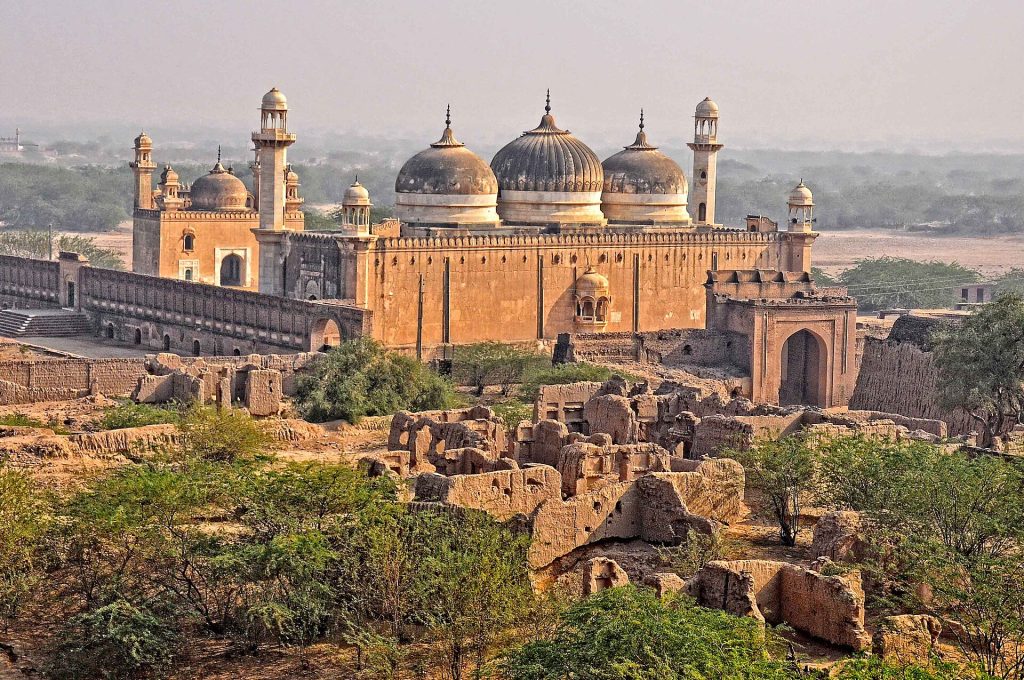
The UNESCO submission notes a nearby mosque and the cemetery associated with the Nawabs of Bahawalpur. Proximity does not make either an automatically accessible extension of a fort ticket or a photography location without conditions. Ask separately about entry, prayer activity, photography and any permission needed, particularly at burial places.
Dress and behave with consideration, give worshippers priority and avoid standing on graves or blocking circulation for a group picture. If entry is declined, accept the boundary without negotiation through a camera lens. A hypothetical thoughtful itinerary might combine an exterior fort study with a respectfully viewed mosque exterior, leaving the cemetery out because permission has not been established. That is an example of planning, not a report of current admission rules or an assurance that particular areas will be open.
Leave with evidence of both architecture and preparation
A useful set of memories includes a distant silhouette, a contextual brickwork photograph and an understanding of why water and movement mattered in Cholistan. Note which historical claims came from the federal record and which came from the Tentative List submission. Keeping the early foundation story qualified is more informative than presenting uncertain chronology as settled fact.
Derawar and the Desert Forts of Cholistan form a UNESCO Tentative List entry, rather than an inscribed World Heritage property. That distinction matters when sharing the destination. So does the difference between a successful exterior visit and confirmed interior access. Before recommending your route to someone else, date the practical advice and explain what you actually verified. The desert approach is part of the attraction’s meaning and part of the responsibility of planning it well.
Frequently Asked Questions
Is the fort interior always open?
Do not assume entry. Confirm current permission and restrictions separately from the road journey, and retain a worthwhile exterior plan.
How many bastions does Derawar have?
Official heritage descriptions associate the fort with forty bastions, arranged as part of its square enclosure.
Was the visible fort built in the ninth century?
An early foundation is attributed to Rai Jajja Bhatti in the Tentative List submission; the federal record cautions that early history is poorly known. Visible fabric should not all be dated to that origin.
Is Derawar a UNESCO World Heritage Site?
Derawar and the Desert Forts of Cholistan are on Pakistan’s Tentative List, which is separate from World Heritage inscription.
How we know this
- Type Practical guide
- Sources 3 (3 official/academic)
- Reviewed November 2026
- Disputed points None
Rules and fees change, confirm with the official links below before you act.
3 sources
- Derawar and the Desert Forts of Cholistan, UNESCO World Heritage Centre
- Derawar Fort, Department of Archaeology and Museums, Pakistan
- Historical Landmarks: Derawar Fort, Government of Punjab
Photo credits (3)
- Derawar Fort, Bahawalpur I.jpg, Fassifarooq, CC BY-SA 4.0, via Wikimedia Commons
- The Mighty Derawar Fort.jpg, Kofmjn, CC BY-SA 4.0, via Wikimedia Commons
- Abbasi mosque - View from Derawar Fort.jpg, Naveedulfatkhan, CC BY-SA 3.0, via Wikimedia Commons
