
Travel · Attractions
Read Baltit through its rooms
A room-by-room way to understand Baltit Fort’s domestic spaces, later palace additions and conservation, with practical questions for an accessible visit.
- Architecture and context
- Confirm visiting arrangements
- Plan the approach
Baltit Fort · Gilgit-Baltistan, Pakistan
Begin below the fort
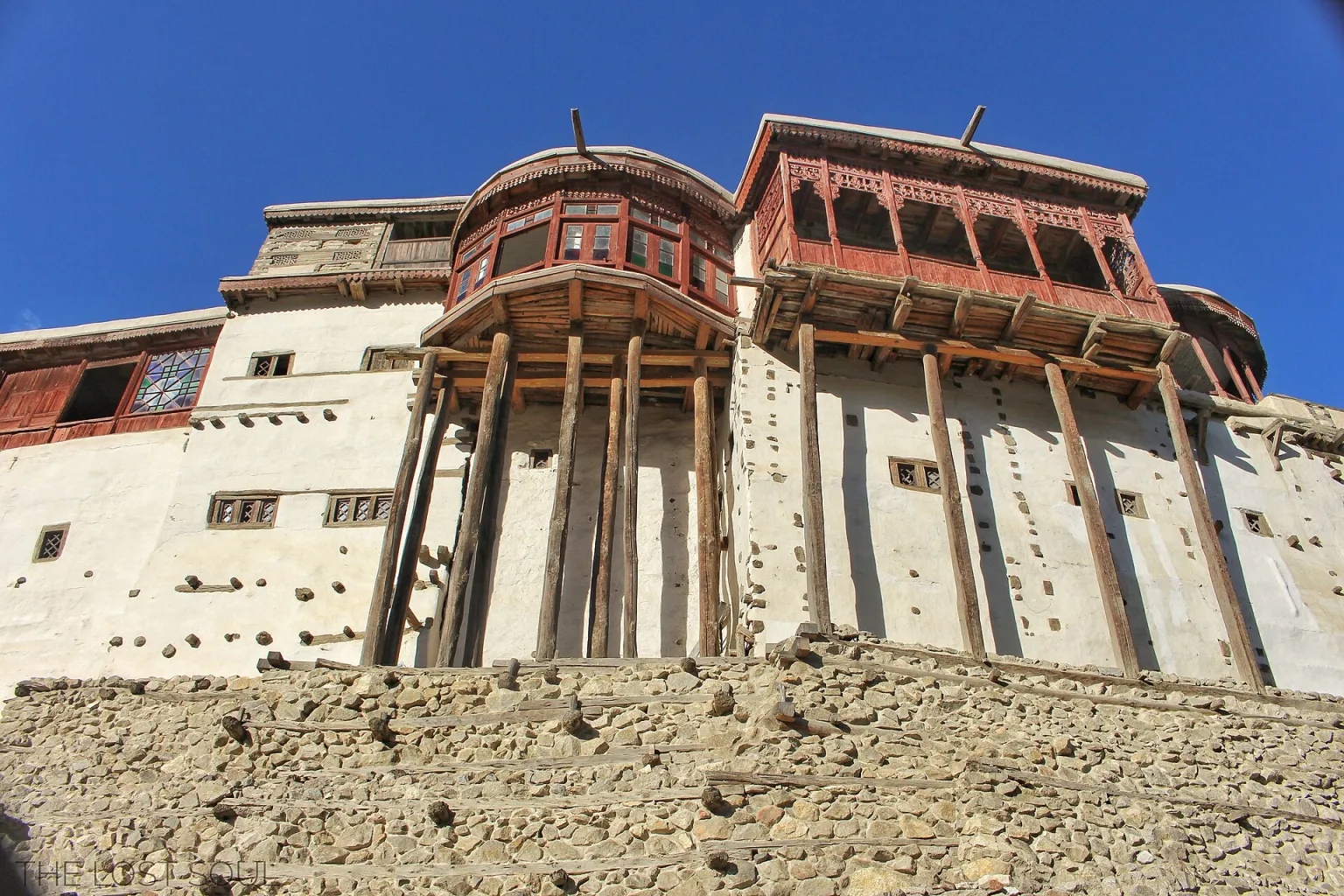
Baltit Fort is easiest to misunderstand when the entire visit is reduced to its familiar white exterior. Approach it as a sequence of spaces: the settlement below, the threshold, working rooms, reception areas and the outlook over Hunza. Each changes the question you ask. Who carried supplies uphill? Which spaces were intended for visitors? Where did household work take place? This is an observation framework, rather than a guaranteed route through every room.
The Department of Archaeology and Museums places Baltit in Karimabad and stresses its complicated building history. Its broad fourteenth–fifteenth-century chronology should not be read as a construction date for every wall. Ask your guide to identify an early core and a later alteration before collecting names of rulers. Leave enough energy for the pedestrian approach; arriving breathless makes it harder to listen and move carefully through confined interiors.
At the threshold, look for changes
Before entering a small room, notice the transition: door height, thickness of the wall, light level and whether people can pass each other. Stand aside while the guide brings a group through. A doorway is useful evidence about movement, but its size alone cannot prove that it was a defensive trap, an earthquake measure or a deliberate social signal. Those explanations need documentation.
Choose one junction where materials or wall lines differ and ask whether it records an extension or a conservation repair. The distinction matters because a restored fort is both inherited fabric and a modern act of care. Avoid touching plaster, rubbing a timber joint to reveal its grain or opening an unmarked door. Take a note or permitted photograph instead. A modest record of one explained feature is more useful than a speculative story attached to every irregularity.
Kitchen and storage: read the household
The national archaeology inventory identifies a royal kitchen, guard room, winter rooms, storage and a guest room on a lower residential level. These names offer a way into the building’s ordinary demands. In any accessible working room, compare where light enters with where a person might have sat or worked, while keeping the actual historic use anchored to the guide’s explanation or a display label.
Ask what survives in place and what has been installed to explain daily life. A vessel or textile in a museum room does not automatically belong to the household that occupied that room. For families, a useful hypothetical exercise is to imagine bringing a basket through the doorway without touching the walls. This helps children think about circulation and labour without pretending that today’s visitor can reconstruct a complete royal day from the room alone.
Upper rooms tell a later story
The same inventory describes personal quarters, reception spaces and a colonial-influenced living room with a projecting veranda on an upper floor. It connects changes under Mir Muhammad Nazim Khan with a stronger palace character. Treat this as a reminder that the fort did not remain frozen in a single medieval form. Display and hospitality could become as important to a ruler as protection.
Where access permits, compare an enclosed room with a more outward-looking reception area. What changes in light, visibility and the way a group can assemble? These are observations you can make without declaring every decorative element Tibetan, Kashmiri or British. If a guide identifies an influence, ask which feature supports that reading. Do not seek an occupied staff room or closed gallery merely because an older plan includes it; the public route may change for maintenance or visitor management.
Read the view as part of the building
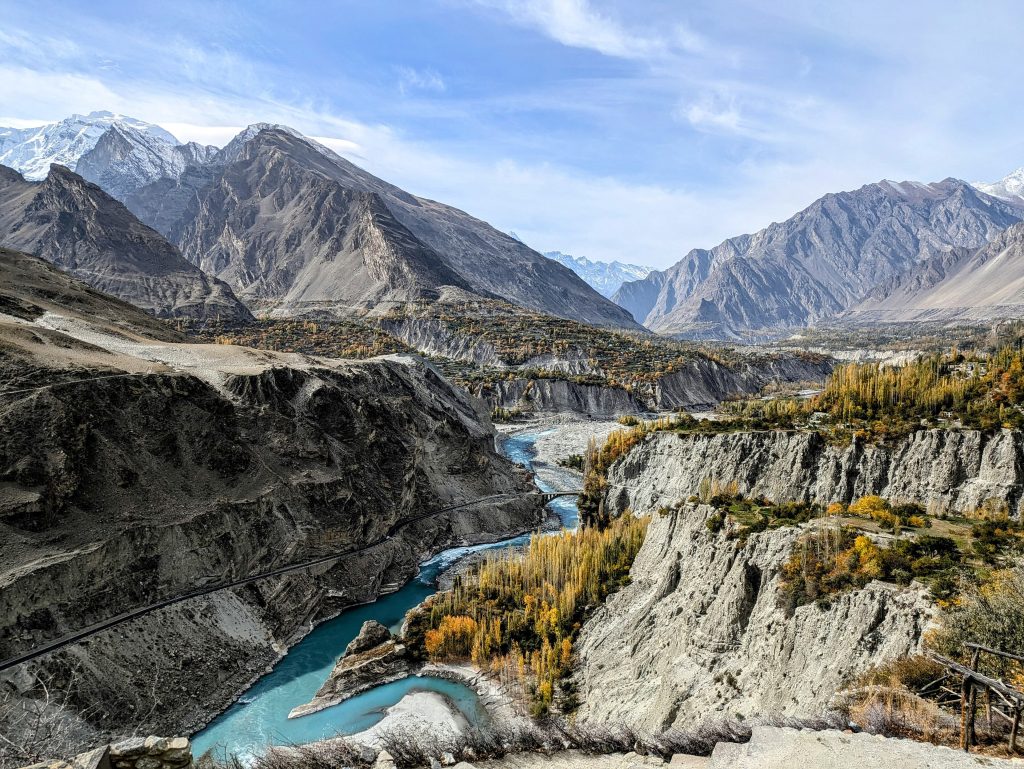
At an authorised outlook, turn your attention from the distant peaks to the nearer settlement. How does the fort sit above paths, roofs and cultivated ground? This makes its elevated position legible without turning the landscape into a fantasy battlefield. The archaeology department describes its dominant position and west-facing observation role; the precise historical field of view is a separate question from the panorama visible today.
Take one wide photograph if allowed, then put the camera down and trace a near-to-far sequence with your eyes. Do not lean over a parapet or step beyond barriers for a cleaner frame. Wind, glare and competing groups can make a short pause more sensible than a long photo session. A view that is partly obscured by weather can still reveal the relationship between the fort and the town immediately beneath it.
Conservation did more than repaint walls
The restoration case study hosted by MIT records surveys in the 1980s, early retaining-wall work and conservation from 1992 to 1996, followed by a museum opening in September 1996. It describes structural stabilisation, roof drainage improvements and a waterproof membrane, with some new interventions deliberately distinguishable. This is a useful counterweight to thinking that restoration simply makes a building look old and tidy.
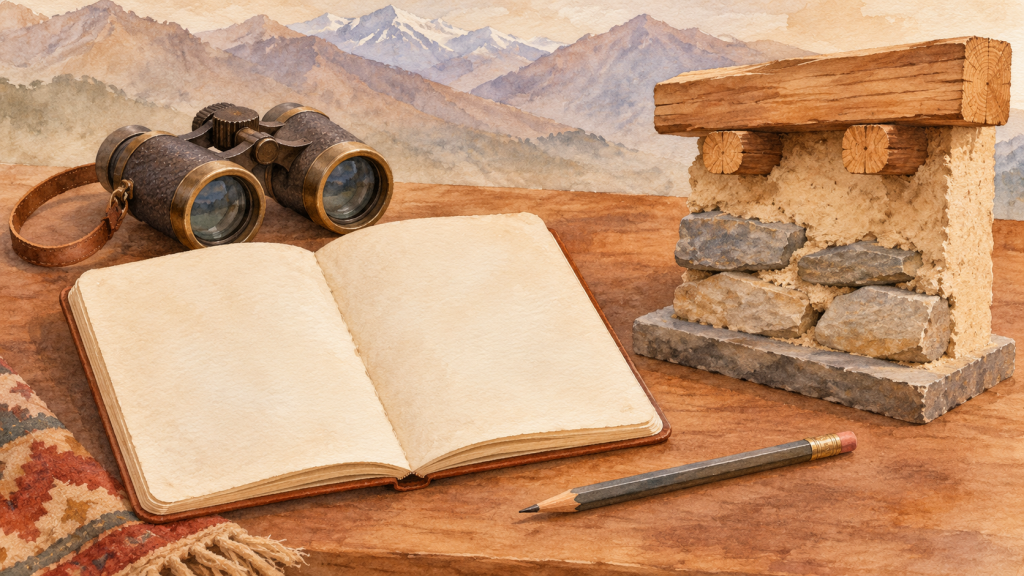
Look for a feature the guide can confidently identify as an intervention, and ask what problem it addressed. Keeping rain out, supporting a wall and enabling safe public circulation are different tasks. The illustration here is a contemporary arrangement of observation tools and a generic material sample; it is not a reconstruction or a construction diagram. Use the actual fort, documented photographs and guided interpretation for architectural evidence, rather than inferring real joinery dimensions from the illustration.
The village belongs in the conservation story
AKDN describes Baltit’s conservation together with rehabilitation of the historic Karimabad neighbourhoods, including water and sanitation. That wider work is worth considering on the descent. The approach is not merely an attractive corridor leading to a monument: it is a place where people live, trade, receive deliveries and maintain homes. A visitor can appreciate the relationship without entering private courtyards.
Keep clear of doorways when stopping to discuss a photograph. Ask before including residents prominently, and accept a refusal without negotiation. If buying a craft, ask about its material and maker rather than assuming everything on sale was made in the restored settlement. A thoughtful purchase and payment for an authorised guide are concrete transactions; they are not proof that every household benefits equally from tourism. Distinguish what the conservation programme reports from what a brief visit can establish.
Plan the climb and the interior separately
Ask the fort team about the current entrance, distance and gradient from vehicle drop-off, steps, handrails, seating and toilets. Describe the person’s actual needs: a wheelchair, difficulty descending steps, low vision, fatigue or a child who needs carrying. The fact that a vehicle reaches Karimabad does not establish that it reaches the public entrance or that interior levels are step-free. Request a partial-visit option if necessary.
Confirm opening days, last admission, guide arrangements, photography rules and the current ticket price directly. Archnet’s older visitor-management description includes pedestrian access and winter restrictions, but it should not be treated as today’s timetable or capacity rule. Wear shoes with reliable grip and carry a layer that leaves your hands free. If someone waits below, agree on a clear meeting place and time before the climbing group leaves.
Give Hunza travel some breathing room
Choose a daylight visit with enough margin to walk up, wait for the next permitted group and descend without haste. Blossom or autumn colour may influence a wider Hunza itinerary, but neither guarantees comfortable steps, quiet galleries or an open road. In colder periods, ask about ice and operating arrangements before committing to the approach. In rain, seek current advice about the route rather than assuming a short walk is unaffected.
For the journey into the region, check current advisories as well as local road information. On 7 November 2026, the UK FCDO advised against all travel on the Karakoram Highway between Mansehra and Chilas via Battagram, Besham City, Dasu and Sazin up to the N15 junction. This route-specific UK advice does not cover all of Gilgit-Baltistan. Its regional guidance also noted unreliable northern flights and seasonal road restrictions. Review the exact route and your own country’s advice before booking; this article does not establish any road as open. Avoid tying an essential onward departure to the same day as an uncertain mountain transfer.
Frequently Asked Questions
Is Baltit Fort one medieval building?
No. The archaeology inventory describes successive additions and alterations; a broad early date does not date every room.
Is every room on an old plan open?
Do not assume so. Ask about the current public route and any conservation closures.
Can I visit without climbing interior stairs?
Ask the fort team for the exact approach and a partial route suitable to your needs; step-free access is not established here.
Are old online ticket prices dependable?
Confirm prices, guide arrangements and last admission directly before visiting.
How we know this
- Type Practical guide
- Sources 5 (2 official/academic)
- Reviewed November 2026
- Disputed points None
Rules and fees change, confirm with the official links below before you act.
5 sources
- Baltit Fort, Department of Archaeology and Museums, Pakistan
- Restoration and Adaptive Reuse of the Baltit Fort, Pakistan, Aga Khan Program for Islamic Architecture, MIT
- Baltit Fort Restoration, Archnet / Aga Khan Trust for Culture
- Conservation and development in Gilgit-Baltistan, Aga Khan Development Network
- Pakistan travel advice: Regional risks, UK Foreign, Commonwealth & Development Office
Photo credits (1)
- Baltit Fort, Karimabad, Hunza, Gilgit Baltistan.jpg, Fassifarooq, CC BY-SA 4.0, via Wikimedia Commons
