
Travel · Attractions
Understand the fort within its boundaries
Understand the elevated mass, rebuilding history and masonry of Peshawar’s controlled fort through authorised records and permitted public observation.
- Study the architecture
- Check current advice
- Confirm permission
Bala Hisar, Peshawar, Peshawar
Begin with the boundary and the current advisory
Bala Hisar is a historic fort in Peshawar whose outline can help explain how height, mass and enclosure communicate authority. It must also be approached as a controlled site, where an architectural interest provides no entitlement to enter or photograph. For UK audiences, the FCDO advises against all travel to Peshawar, including the city, as checked on 7 November 2026. This guide supports historical study and permitted observation; it does not recommend a leisure visit against that advice.
The focus is on reading the fort from lawful public positions where stopping is allowed and from authorised published images. No viewpoint in this article is a guarantee of a clear sightline or permission to use a camera. Instructions from the responsible authorities and restrictions around the site take precedence over any architectural observation exercise.
Understand a history of rebuilding
The federal archaeology inventory describes Bala Hisar as a fort repeatedly destroyed and rebuilt. Its account brings together Mughal and Durrani associations, Sikh rebuilding and later British changes to the walls. That layered record is more defensible than assigning the whole visible fort to one founder and one year.
A name can remain attached to a location while its buildings change substantially. In studying Bala Hisar, separate the history of the fortified place from the date of a surviving wall or parapet. Do not use the age of an earlier occupation to date every element in a modern photograph. When accounts disagree over the patron of a rebuilding phase, preserve the uncertainty instead of selecting the more familiar ruler. A concise timeline with its sources is preferable to a seamless story that conceals those differences.
Department of Archaeology and Museums, Pakistan: Bala Hisar Fort.
Read elevation before architectural ornament
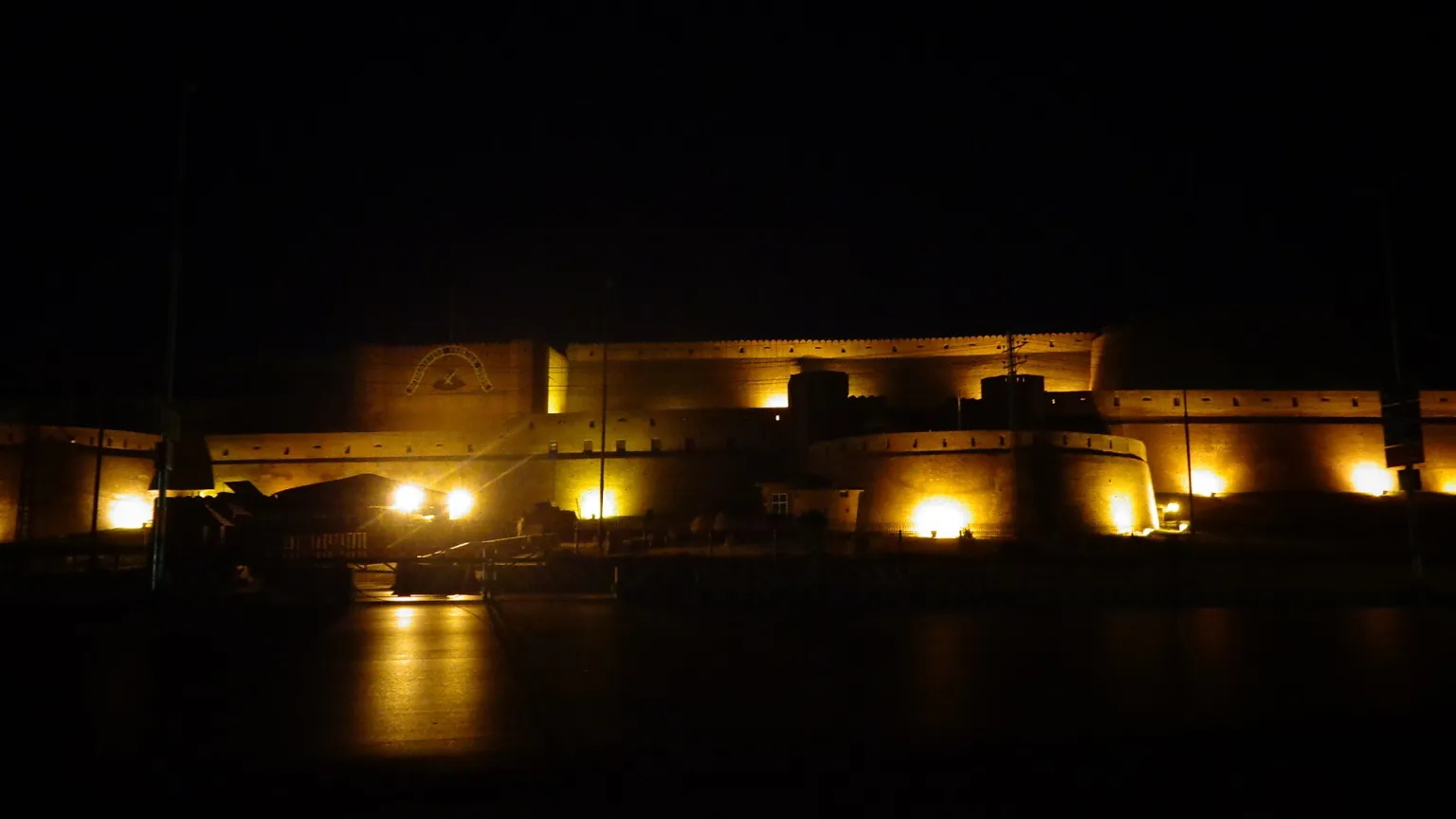
The fort's elevated position is a major part of how it appears in the city. Study an authorised broad view before looking for individual details. Notice the relationship between the lower approach level and the continuous mass above it; then distinguish the wall silhouette from the buildings that appear beyond.
These are visual relationships rather than a military assessment. There is no need to seek elevated private roofs, climb barriers or approach a controlled entrance to understand them. A distant photograph may compress foreground and background, making a wall look steeper or taller than it would in another view. Record the vantage and lens information when available, and avoid calculating dimensions from an uncalibrated picture. The purpose is to understand an architectural presence in the urban landscape, with the limits of the image made explicit.
Distinguish earth construction from later brick descriptions
The federal record describes an earlier fort largely built with unburnt bricks and later British replacement of mud walls with brick masonry. This is a construction-history statement, not a licence to identify every visible patch as a particular period. Earth-based and fired masonry require different forms of maintenance, and a later skin can conceal earlier work.
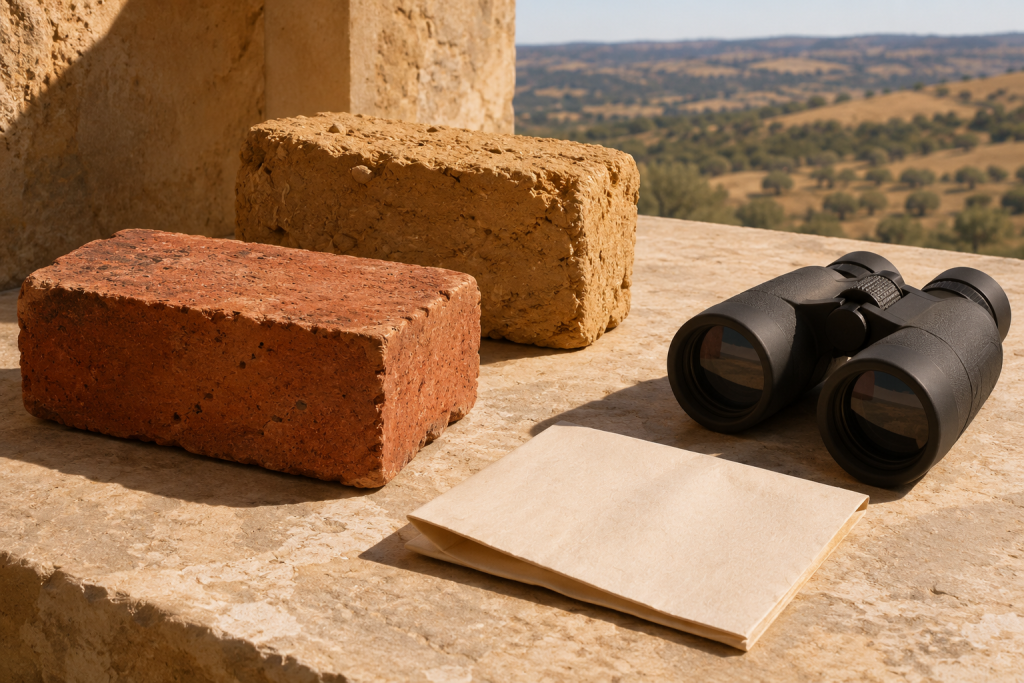
The accompanying illustration uses modern brick samples as a material comparison. It is not fabric removed from Bala Hisar and should not be treated as a record of its wall composition. In photographs, look at the scale of units and the pattern of joints only where the resolution permits. Whitewashed, rendered or distant surfaces may make those features unreadable. The correct note in that case is that the material cannot be identified from the available view, rather than an elaborate guess about original masonry.
Treat parapets and repeated forms as visible evidence
A fort's skyline often becomes its emblem, but the repeated forms along an upper edge deserve a slower look. In an authorised image, describe the rhythm, interruptions and changes of height. Ask how repetition gives a long wall a recognisable profile without claiming that every surviving detail has retained its earliest shape.
Avoid converting this exercise into a survey of current security positions, installations or operational entrances. Historic architectural reading needs neither those details nor a close approach to them. If a published image is cropped, do not assume the repeated pattern continues unchanged beyond the frame. The best description might be very simple: a visible run of wall with an alternating upper outline, interrupted by a taller mass. Precision about what can be seen is more useful than technical terminology used without reliable evidence.
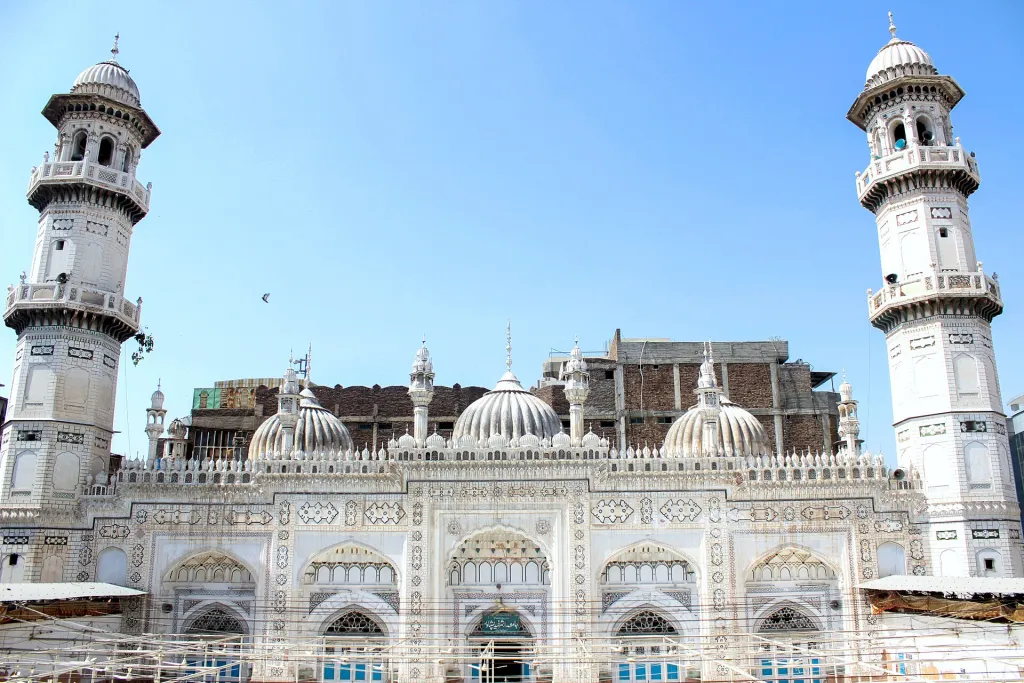
The separate mosque photograph provides Peshawar context: its courtyard-led religious architecture poses different questions from the fort’s enclosing walls. It supplies no evidence about Bala Hisar’s interior.
Keep old court descriptions in their historical setting
The federal account includes a description of Shah Shuja's court with water and an elevated audience setting. Read that passage as evidence for an earlier interior arrangement reported in the historical narrative. It should not become an itinerary promising that a present visitor will encounter the same pond, throne setting or decorative programme.
This is a common difficulty in fort writing: an evocative textual description is silently projected onto the buildings still standing. Instead, label the account by its period and distinguish it from current condition. A simple notebook can use separate columns for historical description and present documented evidence. Where no reliable modern evidence is available, leave the second column blank. The absence of a present photograph does not prove a feature survives, and the lack of visitor access does not make imaginative reconstruction an acceptable substitute.
Do not turn an organised visit into general admission
Pakistan Broadcasting Corporation reported on 21 August 2026 that university students participating in an ISPR summer internship visited Bala Hisar and its museum and met Frontier Corps officials. This is evidence of a particular organised visit within a controlled setting. It does not establish ordinary public admission, open museum hours or a general right to arrange a similar visit.
The distinction matters when old blog posts circulate fixed visiting days or suggest that simply bringing identification guarantees entry. This guide makes no such claim. A person with a legitimate authorised purpose needs current instructions from the responsible authority, including whether photography or particular equipment is permitted. Historical interest and past examples of access are not substitutes for that confirmation. A refusal or restriction should be accepted immediately, without attempts to negotiate an alternative entry point or enlist an unofficial intermediary.
Pakistan Broadcasting Corporation: Students from KP Universities visit Bala Hisar Fort in Peshawar.
Read conservation through records rather than distance
Repeated rebuilding is itself a conservation question: how should older fabric, later strengthening and continuing occupation be understood together? From a public position, one may see a generally continuous wall while knowing very little about its internal structure or repairs. Apparent neatness does not establish structural condition or authenticity.
The federal inventory is a useful introduction, but it is not a current engineering survey. A specialist study would need reliable measured records, descriptions of interventions and dates for individual elements. For a general reader, the responsible task is narrower: retain the source of a construction-history claim and avoid diagnosing cracks, bulges or mortar from a compressed online image. The fort's current custodial setting also limits ordinary observation. Those limits are part of an accurate account, not an obstacle to be bypassed in pursuit of a more dramatic travel story.
Peshawar Development Authority: Peshawar Development Authority: Bala Hisar landmark.
Choose remote study or strictly permitted observation
For UK readers, review the FCDO's current Pakistan advice before making any travel decision; Peshawar was under an all-travel warning on 7 November 2026. Published official records and authorised general views allow study without visiting. A map can explain the fort's relationship to the city without marking operational details or inventing a visitor route.
For someone independently entitled to be locally present, remain in lawful public areas where stopping is permitted, obey signs and instructions, and obtain the relevant permission before photographing. Do not block traffic or stand near a controlled gate for a better angle. If there is no suitable permitted position, end the observation. No admission fee, opening time, guaranteed viewpoint or interior route is stated here. The meaningful takeaway is a sourced understanding of rebuilding, elevated mass and material change, all achievable without a claim to military access.
Frequently Asked Questions
Can everyone enter Bala Hisar?
No general admission entitlement is established. Reports of organised visits do not confirm ordinary public access.
Can the fort be photographed from outside?
Only where standing and photography are permitted. Public visibility does not override restrictions or official instructions.
Does the whole fort date from one ruler?
The federal inventory describes repeated destruction, rebuilding and changes to wall construction across several periods.
Is a leisure visit recommended for UK travellers?
No. FCDO advises against all travel to Peshawar as checked on 7 November 2026.
How we know this
- Type Practical guide
- Sources 4 (3 official/academic)
- Reviewed November 2026
- Disputed points None
Rules and fees change, confirm with the official links below before you act.
4 sources
- Bala Hisar Fort, Department of Archaeology and Museums, Pakistan
- Students from KP Universities visit Bala Hisar Fort in Peshawar, Pakistan Broadcasting Corporation
- Peshawar Development Authority: Bala Hisar landmark, Peshawar Development Authority
- Pakistan travel advice: warnings and insurance, UK Foreign, Commonwealth & Development Office
Photo credits (2)
- Bala Hisar-Peshawar.JPG, Ammad Malik-101, CC BY-SA 3.0, via Wikimedia Commons
- Masjid Muhabat Khan.jpg, Hafeezburki, CC BY-SA 4.0, via Wikimedia Commons
