
History & heritage · Reading the evidence
Gandharan Sculpture: ProvenanceMaterials and Museum Context
Read a Gandharan sculpture label by separating material, religious subject, place of production, excavation context and later ownership history.
- Read the original source
- Check context and version
- Separate fact and inference
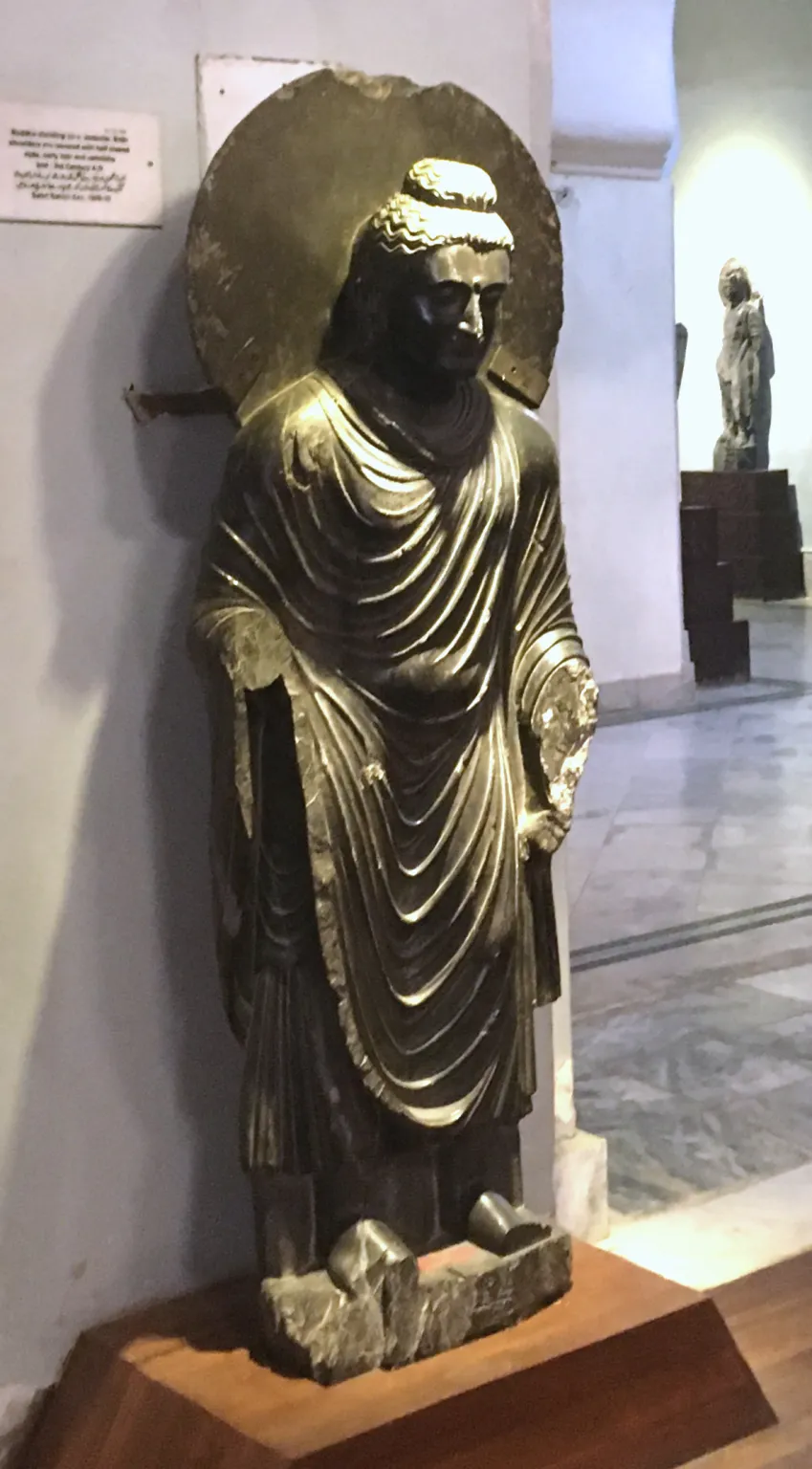
Gandharan Buddha · Peshawar Museum
A sculpture has more than one history
A Gandharan sculpture can be a devotional object, a fragment of architecture and a museum acquisition at different moments in its life. Looking closely means asking about all three. A graceful face or deeply carved robe should lead to questions about material, use and the circumstances in which the object entered a collection.
Gandhara was an ancient region extending across areas of present-day Pakistan and Afghanistan. Museum descriptions often use a modern country alongside an ancient regional attribution. Those labels serve different purposes. Neither a modern border nor a single stylistic resemblance can explain the whole history of a work. Begin with the collection record and its qualifications, then use broader scholarship to interpret what the object might tell us about religious and artistic exchange.
Read the date as an attribution with a basis
Museum dates may be expressed as a century, a range or an approximate year. The Metropolitan Museum’s Gandhara essay, published in 2012, presents works spanning several centuries and different media. That variety makes it unwise to treat all Gandharan art as a single moment or workshop.
Ask whether the date comes from an inscription, a documented excavation context or comparison with other works. A label saying approximately the third century does not identify the exact year of carving. Copy the approximation into your notes. A later catalogue may revise an earlier attribution; record both the publication date and the date assigned to the object. This helps distinguish a change in scholarly interpretation from an actual change in the object’s historical age.
Material tells a different story from colour
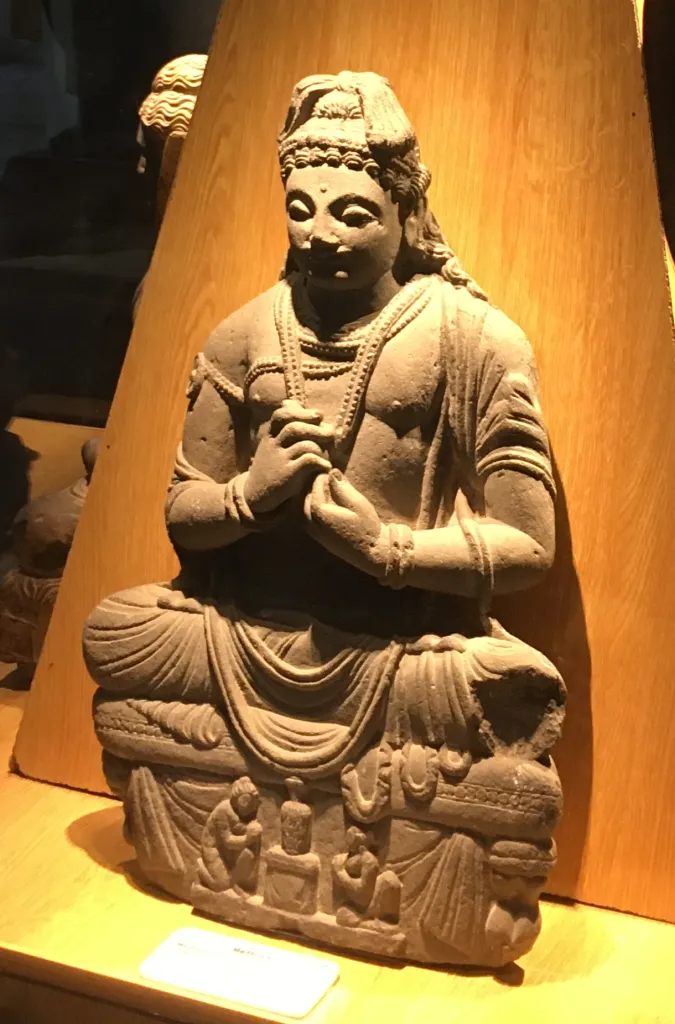
Schist is strongly associated with many Gandharan stone sculptures, but Gandharan production also includes stucco, metal and other materials. A grey surface in a photograph is not a dependable mineral identification. Museum records are a better starting point than the colour settings of a phone screen.
Material affects technique, scale and placement. Stone carving and modelled stucco involve different processes, while traces of paint can complicate the assumption that an ancient sculpture always looked like its present surface. For a practical comparison, select one catalogued schist work and one stucco work. Note the recorded material, dimensions and surviving condition before describing their visual differences. Do not test an object by scratching, wetting or touching it during a visit.
Provenance and findspot are related but different
A findspot identifies where an object was discovered, when known. Provenance generally concerns its documented ownership and movement through collections. An object may have a long ownership history but an uncertain archaeological origin, or a secure excavation history with a complicated later journey.
Look for language such as possibly, attributed to and probably. The Met record for one Buddha identifies a possible connection to Takht-i-Bahi; the word possible must survive your retelling. Do not silently turn a qualified attribution into an excavated fact. Missing provenance is also not proof of a specific illegal act. It is a gap requiring investigation. A careful account can raise ethical questions about collecting without making an unsupported accusation against an individual or institution.
Recover the architectural and devotional setting
A relief fragment now displayed at eye level may once have formed part of a larger religious structure. A detached figure may no longer preserve the relationships that originally helped viewers understand it. Museum display makes close observation possible while changing the viewing context.
Ask whether the object is a narrative panel, architectural component, reliquary or freestanding image. Read the recorded subject and compare identifying features with other catalogued examples. Avoid diagnosing the subject from one familiar gesture alone. A broken hand, missing attribute or modern restoration can change what is visible. If the original location within a monastery or stupa complex is unknown, describe plausible functions as possibilities rather than inventing a precise position, ritual or audience.
Discuss cultural exchange without reducing local agency
Gandharan sculpture has often been discussed through connections with Mediterranean, Iranian, Central Asian and South Asian artistic traditions. Those connections are useful historical questions, but a robe resembling a classical convention does not make a sculpture merely a foreign copy.
The Met essay emphasises the region’s multi-ethnic character and the synthesis of styles with Indian forms. Patrons, workshops and Buddhist communities selected and transformed visual languages for local purposes. Explain the feature being compared and the evidence for the proposed relationship. Avoid ranking traditions as more advanced or authentic. A fair account recognises both movement across regions and the agency of the people who commissioned, made and used these works in their own religious and social settings.
Write a museum comparison readers can check
Choose two objects with accessible collection records. Make a small table of accession number, title, attributed place, date, medium, dimensions, subject and provenance notes. Use unknown rather than leaving an empty cell that might be mistaken for certainty. Then compare one question, such as how the material affects surviving detail.
Conclude by identifying what the display cannot answer: original colour, complete setting or an undocumented excavation history. Use photographs only under the relevant licence, and keep object credits separate from the copyright in a modern photograph. A museum’s public access does not automatically mean every image is unrestricted. Your strongest contribution is a readable chain from observable feature to documented record to cautious interpretation, allowing another visitor to assess the same evidence.
Use accession numbers to prevent mistaken comparisons
An accession number is often a better identifier than a generic title such as Standing Buddha. Several institutions can use the same title for different objects, while photographs may circulate without full captions. Put the collection name and accession number on every research image. If comparing a relief with an essay illustration, open the linked object record and confirm that the photograph, medium and dimensions match. A workshop attribution in an essay may be more qualified in the collection record, or vice versa. Record the wording and date of the source rather than silently selecting the most definite version. This small administrative step prevents an argument about one sculpture from accidentally relying on the provenance or date of another.
Compare a narrative panel with a detached figure
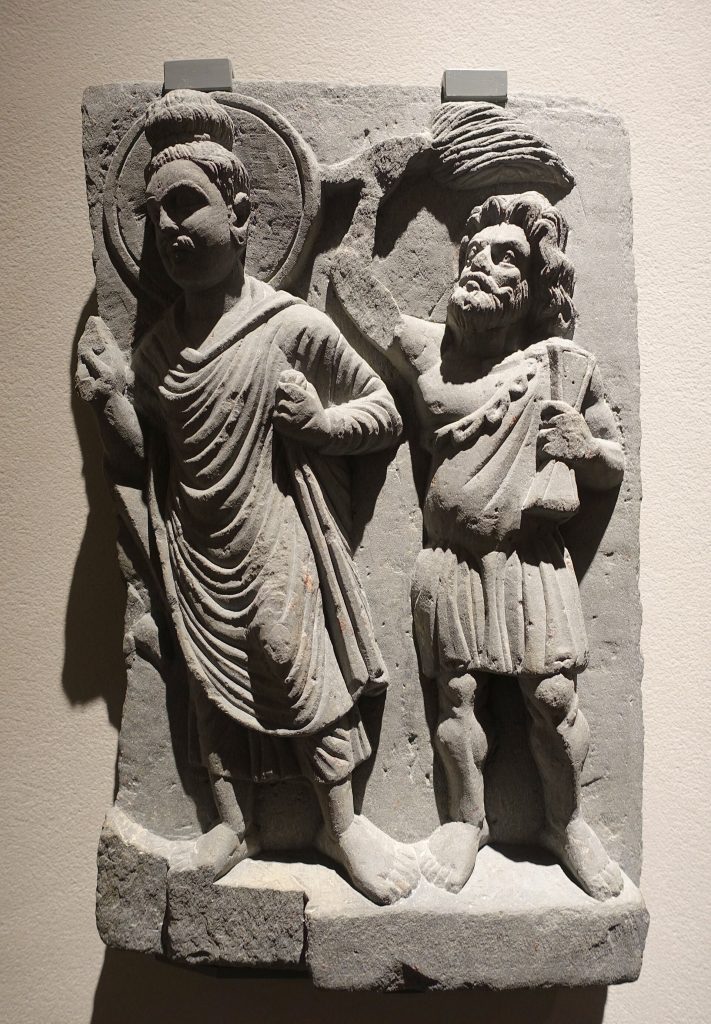
A useful museum exercise places a catalogued narrative relief beside a freestanding image. Ask how each guides attention: several figures and gestures may organise an episode in a relief, while a detached statue may concentrate attention on posture, attributes and presence. Record these as visual observations before identifying a ritual function.
Next, check what survives. A fragment can lose the figure that originally clarified the scene; a statue can lose an attribute needed for confident identification. A museum reconstruction may help viewers understand a larger arrangement, but it should be labelled as a reconstruction. Do not treat modern display height, lighting or wall colour as evidence of the original setting. Note how the collection record identifies the subject and whether the label expresses uncertainty. Your comparison can explain how different formats communicate without claiming that every ancient viewer interpreted them identically. It also gives the visitor a concrete reason to consult provenance and excavation information: those records may reveal relationships that the isolated display no longer preserves, while an undocumented object leaves some of those relationships unavailable.
Frequently Asked Questions
Is Gandhara the name of a modern country?
No. It is an ancient regional designation spanning parts of modern Pakistan and Afghanistan; collection labels may use both kinds of geography.
Is every grey Gandharan statue schist?
No. Check the recorded medium. Photographs and surface colour are insufficient to identify a material confidently.
What does provenance mean?
It concerns documented ownership and movement. Keep that separate from the archaeological findspot and the place where a work was made.
Can I omit possibly from a museum label?
No. The qualification conveys uncertainty in the attribution and should remain in your account.
How we know this
- Type Historical & cultural research
- Sources 4
- Reviewed November 2026
- Disputed points None
4 sources
- Kurt Behrendt: Gandhara, metmuseum.org
- Collection record: Buddha and qualified origin, metmuseum.org
- Collection record: Garland Holder, metmuseum.org
- Collection record: Parinirvana, metmuseum.org
Photo credits (3)
- Peshawar Museum - Standing Buddha (cropped).jpg, Batool Nasir, CC BY-SA 2.0, via Wikimedia Commons
- Peshawar Museum Seated Bodhisattva.jpg, Batool Nasir, CC BY-SA 2.0, via Wikimedia Commons
- Buddha and Vajrapani, Gandhara, 1st century AD, schist - Ethnological Museum, Berlin - DSC01644.JPG, Daderot, CC0, via Wikimedia Commons
