
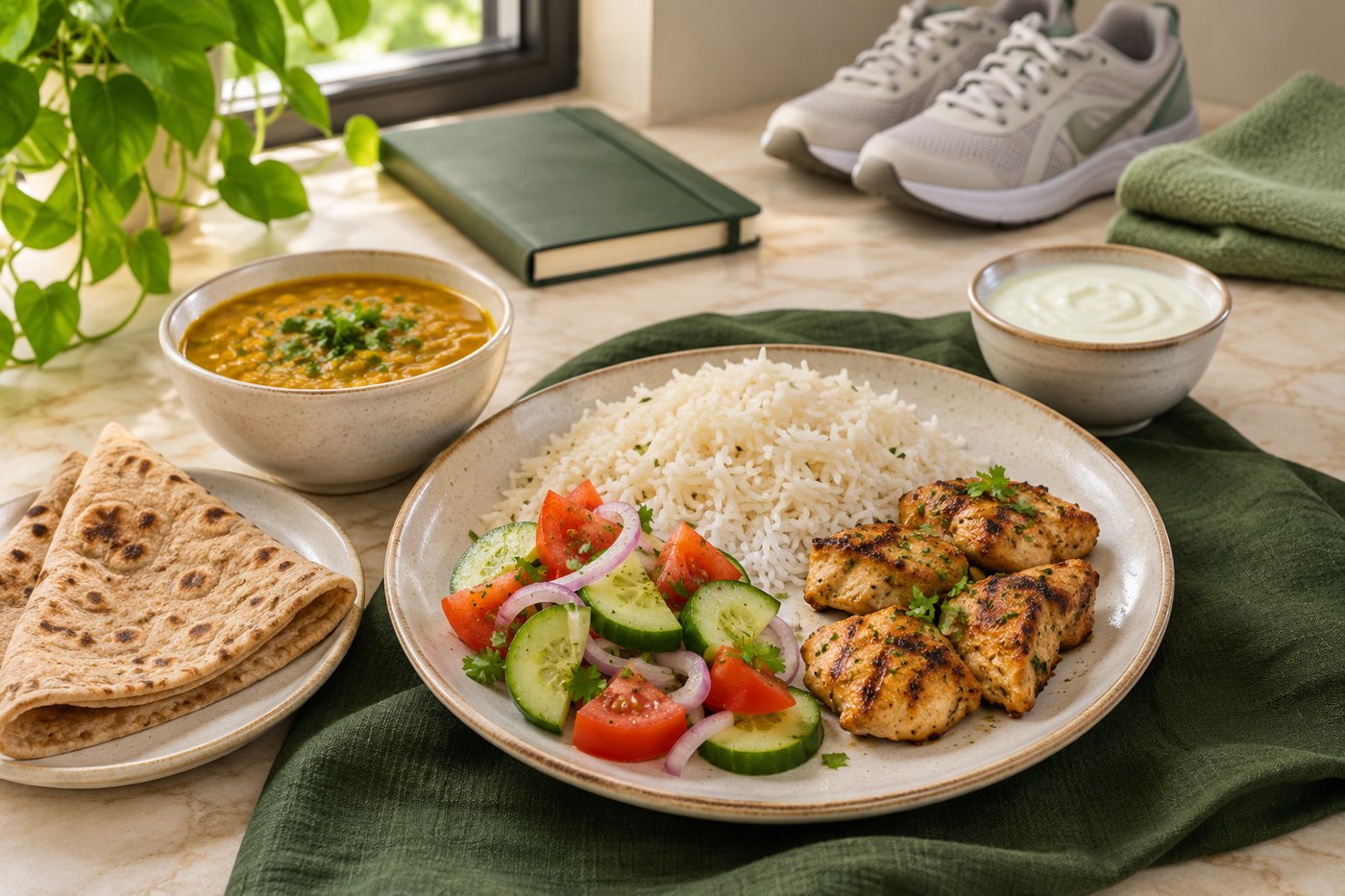
Food, movement and everyday progress
Eat thoughtfully.
Move with confidence.
Understand Pakistani food portions, plan your meals and build an activity routine that fits your day.
43 source-backed recipe estimates · Illustrated exercise guides · Optional tracking on this device
Your pace, your priorities
Your day at a glance
Browse every guide without tracking. If you choose to log meals or activity, your entries stay in this browser.
There is no account or cross-device sync. Export before clearing browser data. Existing Recipe Companion shopping lists and saved recipes are separate.
See what you are counting
A visual guide to Pakistani portions
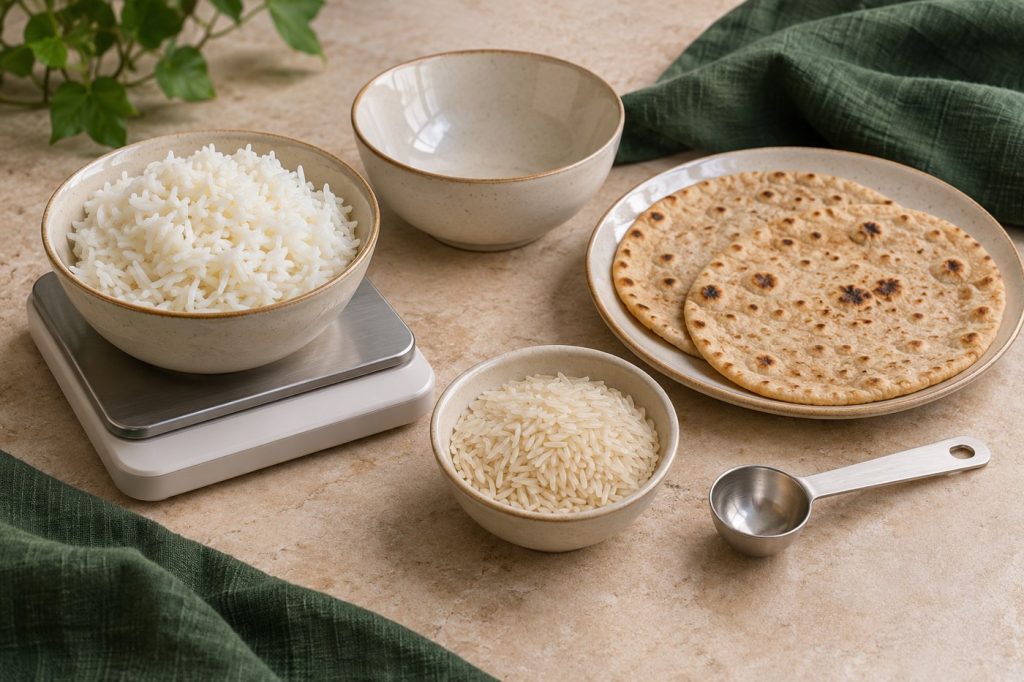
Weigh the food in the state you log
- Put an empty bowl on the scale and set it to zero.
- Add your cooked food and record its weight.
- Use a matching cooked-food record, or divide your measured recipe batch into portions.
Dry rice and cooked rice are different entries. Added water changes weight without adding calories. A “cup” or “roti” can vary in size.
A recipe serving here means one equal share of the stated batch. It does not automatically mean one chapati, one kebab or one bowl.
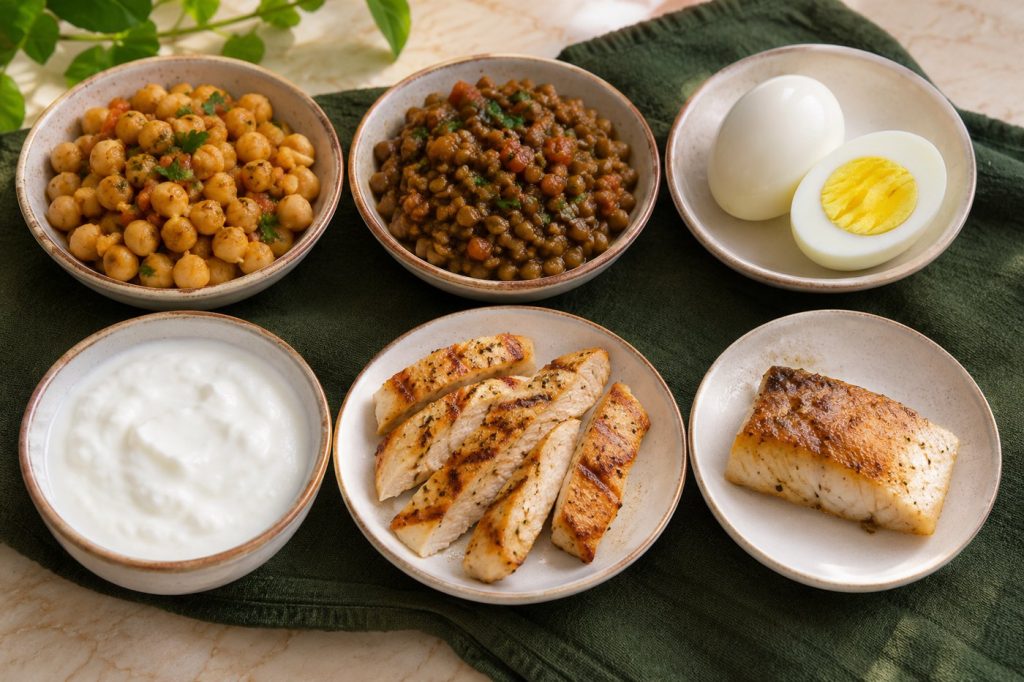
Build variety into your plate
Combine vegetables or fruit, a starchy food such as rice or roti, and a protein food such as daal, chickpeas, eggs, fish or chicken. Include suitable dairy or alternatives across your day.
Balance is about your overall day or week, not making every plate identical. Foods such as daal contribute both protein and carbohydrate.
| Quantity | What it means | What to do |
|---|---|---|
| Recipe serving | One equal fraction of the recipe batch | Use 0.5 for half that portion or 1.5 for one and a half. |
| Cooked weight | The finished batch after cooking, without the pot | Weigh it to calculate nutrition per 100 g. |
| Family servings | All portions prepared for everyone | Do not log the entire family batch as your personal intake. |
Optional personal tracking
What did you eat?
Choose a calculated recipe and the fraction of one recipe serving you ate. Add unlisted foods from a package label using the custom entry fields.
Add food from a package label or another source
Enter values for the portion you ate, not automatically for 100 g. Leave unavailable nutrients blank; blank does not mean zero.
Incomplete nutrients are identified in your totals. This diary does not diagnose nutritional adequacy or automatically subtract exercise calories.
Familiar foods, flexible meals
Build a seven-day meal outline
Choose a starting point, then edit portions to match your appetite, preferences and individual advice. The outline uses the calculated recipe set; it is a menu suggestion, not a prescribed diet or a promise to hit your targets.
For gradual weight change: use a target agreed with your dietitian, and compare portions rather than removing whole food groups. For training: the protein-focused option helps you find protein-containing dishes, without requiring supplements.
Preference labels apply to the stated calculation baseline. Substitutions can change suitability. Exclusions use ingredient-name matching and are not an allergy-safety check. The pantry option is not a live price comparison.
Sending replaces the weekly plan on this device after confirmation. Fractional personal portions are rounded up for family shopping; the diary keeps exact fractions. Cook fresh or freeze suitable portions for later days.
Read the masala, then adjust the heat
Compare moisture and texture with the written recipe. Colour varies with tomatoes, spices, pan and lighting; this picture does not prove a safe cooking temperature.
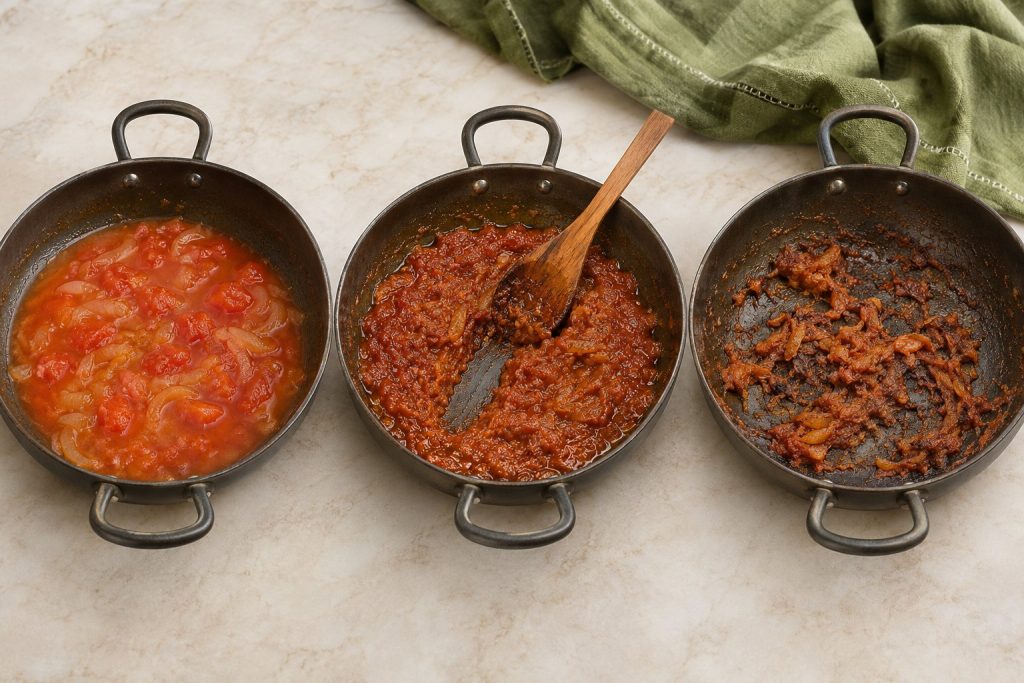
Still watery
The sauce flows back quickly into a spoon trail. If the recipe calls for reduction, keep it uncovered and stir as the excess moisture evaporates.
Reduced and glossy
The masala holds a brief spoon trail and small oil beads appear. Follow your recipe for the next ingredient; bhunai does not mean burning the spices.
Too dry or catching
Lower the heat. If it has only begun to stick, loosen it with a little water as the recipe allows. If it smells burnt or tastes bitter, start the masala again rather than mixing scorched patches through it.
Understand the assumptions
Explore a recipe’s nutrition
Adjust counted ingredient weights to compare a variation. This changes the estimate only; it does not rewrite the recipe or validate a new cooking method.
A starting estimate, not a prescription
Energy and protein planning
Your needs vary with body size, activity, health and life stage. Set your own targets, or explore an adult maintenance estimate below. A maintenance estimate is not a weight-loss or muscle-gain prescription.
These tools are for general adult wellness. Children, pregnancy, breastfeeding, eating-disorder recovery and medical diet requirements need individual qualified guidance.
Estimate adult maintenance energy and protein ranges
Method: Mifflin–St Jeor resting-energy equation multiplied by your selected activity factor. The displayed ±10% is an illustrative planning band, not a validated confidence interval; individual error can be larger. Activity factors are informed by NIDDK’s adult planning guidance. Protein references: 0.8 g/kg for the general adult reference, and ACSM’s 1.2–1.7 g/kg example range for regular training. These are reference ranges, not a requirement for every reader.
Age, weight and height are used for this calculation only and are not saved in your tracker.
Supported entry bounds are software limits, not recommended intake ranges. Targets are optional; eating less than a target is not automatically better.
Learn the movement first
Illustrated home and gym routines
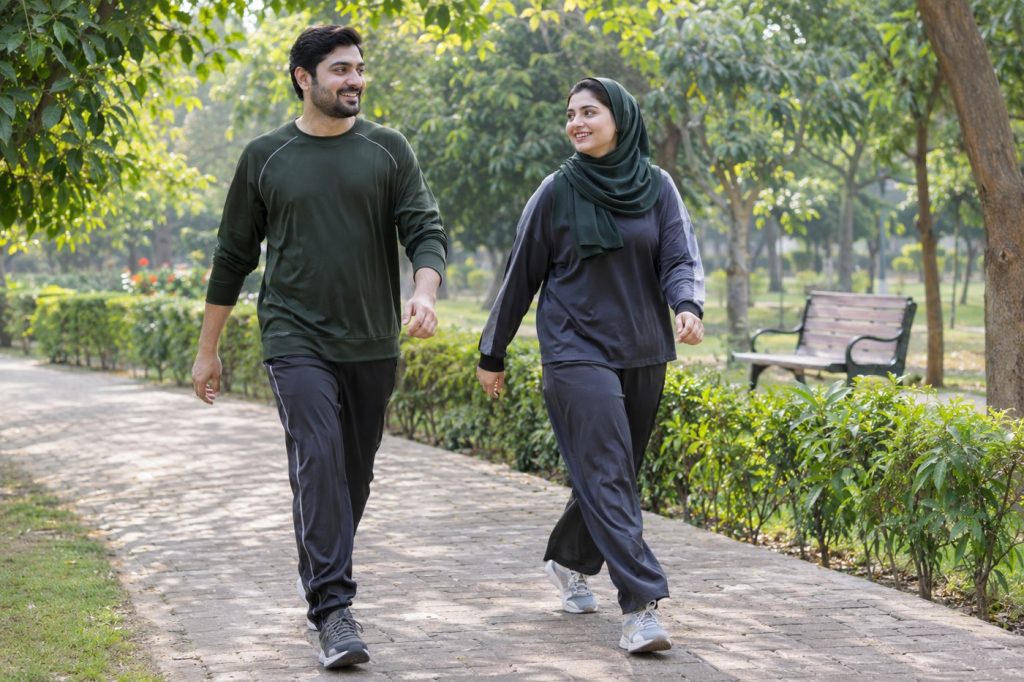
Begin with a manageable amount and build gradually. WHO’s adult reference is 150–300 minutes of moderate activity per week plus strength work for major muscle groups on at least two days. Short bouts count.
These are introductory examples, not rehabilitation or a complete tailored training programme. Ask a qualified trainer to check unfamiliar weighted movements. Stop for sharp pain, dizziness, chest discomfort or unusual breathlessness; seek medical help for concerning symptoms.
Exercise picture library
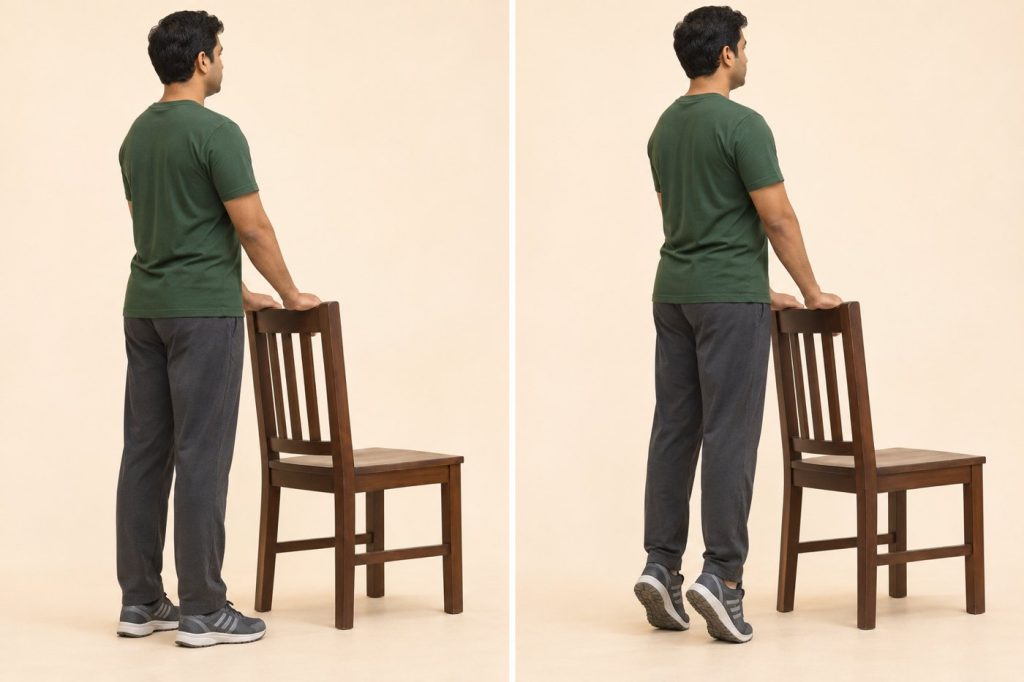
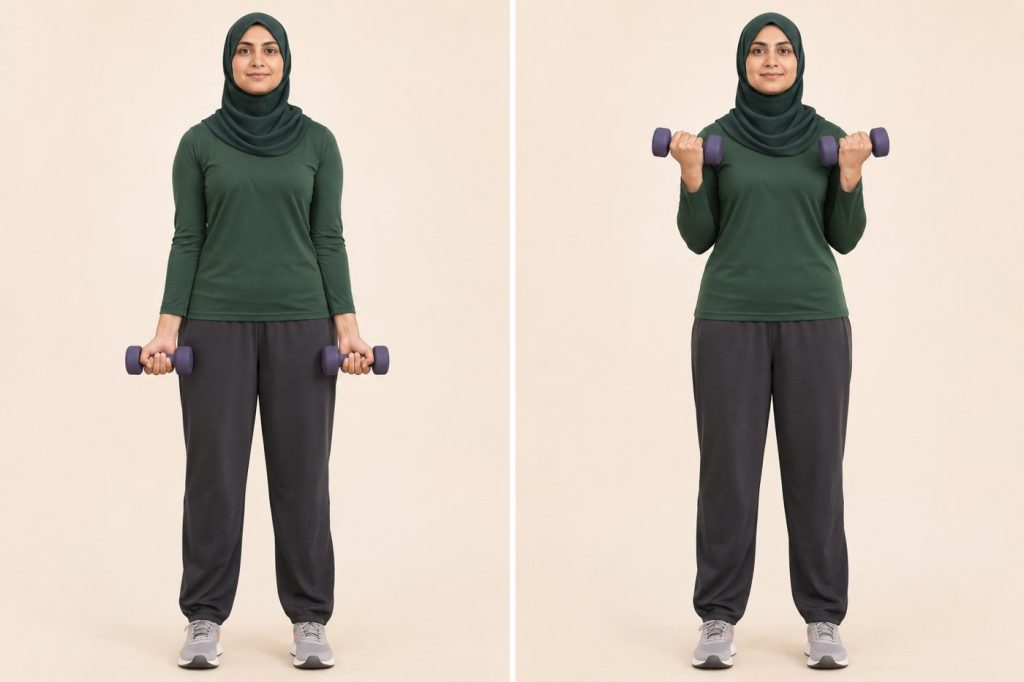
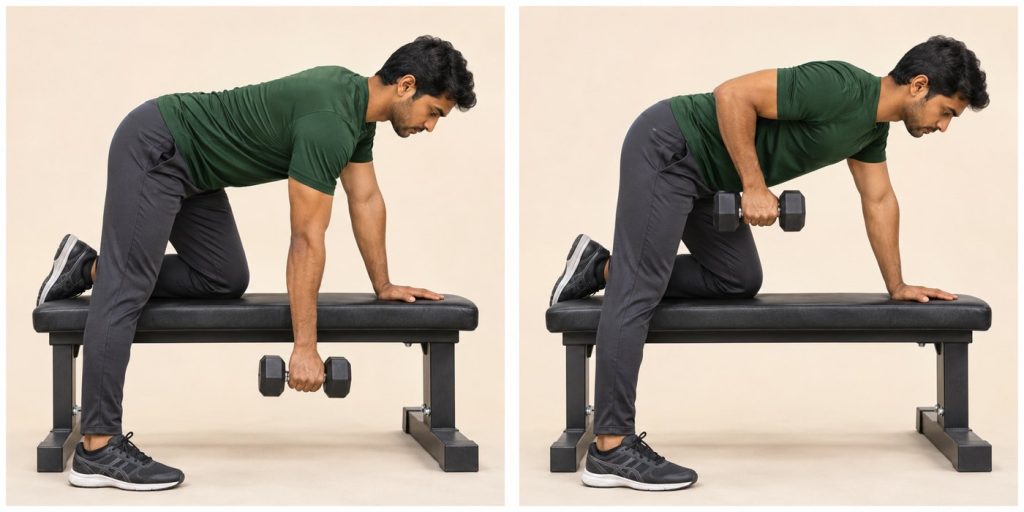
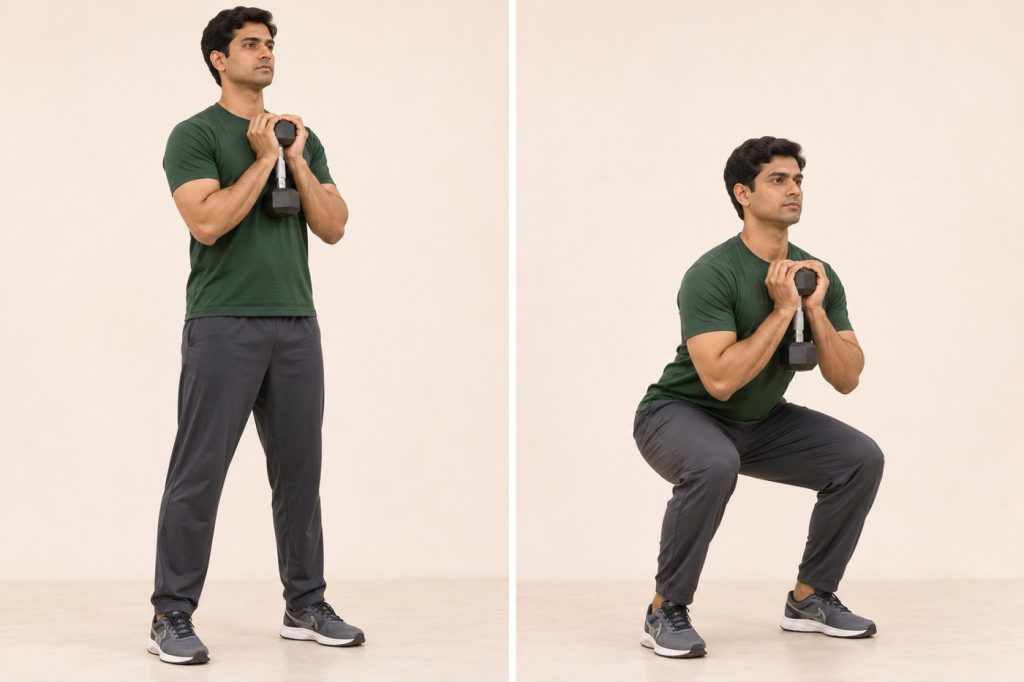
For the two-panel pictures: left shows the starting position, right shows the movement position. Return slowly to the start. Pictures are references; your comfortable range may differ.
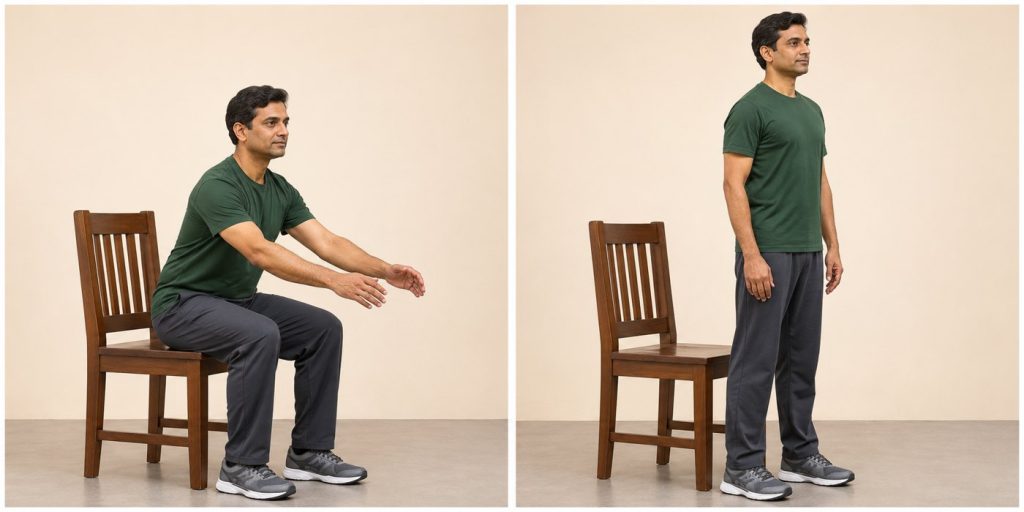
Gentle start
Sit to stand
Stable armless chair
- Start seated near the chair’s front with feet flat.
- Lean forward slightly and stand using your legs.
- Sit down slowly; use your hands for support when needed.
Use a solid non-wheeled chair on a non-slip surface.
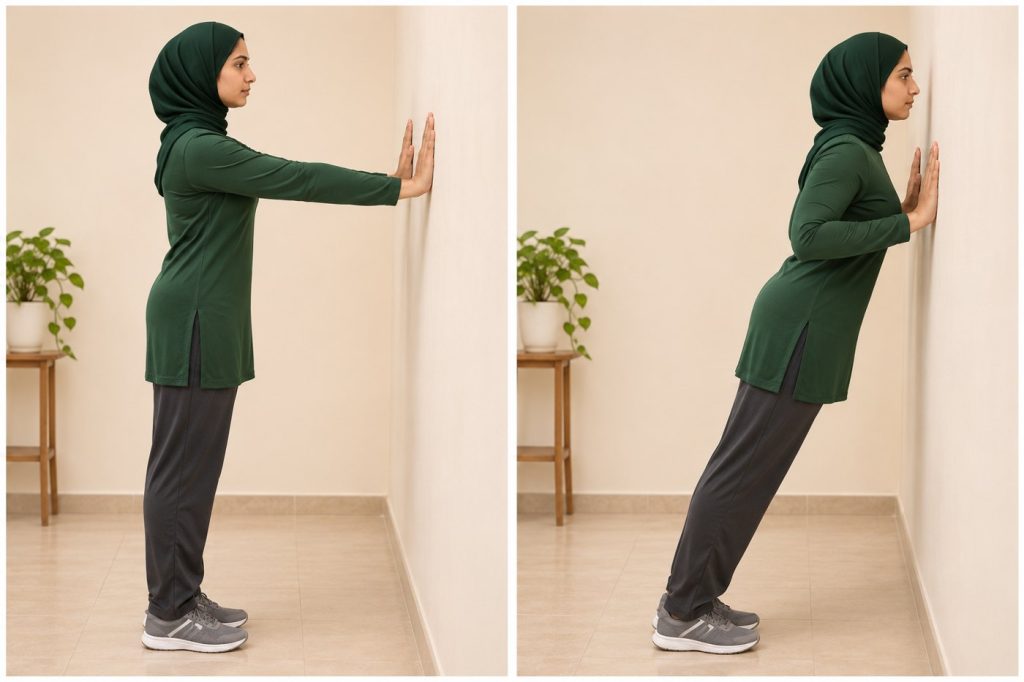
Gentle start
Wall press-up
Solid wall
- Place hands at chest height, feet a comfortable distance away.
- Bend elbows and move your straight body toward the wall.
- Push back gently without bending at the waist.
Begin closer to the wall to make it easier.
Gentle start
Supported calf raise
Stable chair for balance
- Stand tall with fingertips on a stable support.
- Raise both heels slowly, keeping your weight over your feet.
- Lower with control; keep support available.
Keep the movement small if balance is uncertain.
Gentle start
Light biceps curl
Light dumbbells or secure water bottles
- Hold light weights beside your body.
- Bend the elbows while keeping upper arms still.
- Lower slowly with straight wrists.
Choose a load you can control without swinging.
Learn the technique first
Supported one-arm row
Stable bench and light dumbbell
- Support one knee and the same-side hand on a stable bench; the opposite foot stays grounded.
- Keep your back neutral and draw the free elbow toward the hip.
- Lower the weight under control, then repeat on the other side.
Have a qualified trainer demonstrate the setup; avoid twisting or rounding your back.
Learn the technique first
Light goblet squat
One light dumbbell
- Hold a light dumbbell close to your chest with both hands.
- Bend hips and knees through a comfortable range, keeping heels grounded and knees following toes.
- Stand back up smoothly without holding your breath.
Start with sit-to-stand if this movement is unfamiliar. Depth and load must suit your mobility.
Build gradually
Comfortable walking
Comfortable footwear and a suitable route
- Choose a comfortable route and start at an easy pace.
- Build duration gradually; a moderate pace lets you talk but makes singing difficult.
- Slow down before finishing. Short activity breaks count.
Start with a duration that feels manageable; the weekly guideline is a longer-term reference, not a first-day requirement.
Notice what you can do
Workouts, habits and progress
Record a manageable session, movement breaks or a night’s sleep if it helps you. There is no weight score or mandatory streak. A rest day can be part of progress.
