
Kitchen equipment guide
SievesStrainers, Colanders and Mixing Bowls: A Practical Guide
Match mesh, holes, bowl shapes and salad tools to rice, daal, flour and vegetables, with practical checks for capacity, draining, cleaning and food hygiene.
DailyLife.pk kitchen equipment collection
Choose the opening size around the food
A sieve, a colander and a mixing bowl can look like simple accessories, but their shapes determine whether food drains neatly or escapes down the sink. Start with the ingredient: rice needs openings small enough to retain the grains, pasta needs easy drainage, and a smooth sauce may need fine mesh. A tool that holds coriander leaves comfortably may be inconvenient for a large pot of cooked noodles.
Local sellers may call several mesh products a chhanni or strainer. Explain the job and examine the openings rather than ordering by name alone. A tea strainer, flour sieve and deep draining basket are related ideas, but their capacity and support arrangements differ substantially.
Compare sieves, strainers and colanders
| Tool | Useful jobs | Buying check |
|---|---|---|
| Fine mesh sieve | Flour, sauces and fine particles | Secure mesh, cleanable rim and suitable support |
| Handled strainer | Small rinsing or straining tasks | Balanced handle and resting hook |
| Perforated colander | Pasta and larger vegetables | Stable base and openings that retain food |
| Over-sink basket | Larger draining tasks | Secure fit across your sink |
| Salad spinner | Removing surface water from washed greens | Cleanable lid and storage footprint |
Do not assume all mesh is equally fine because the packaging says strainer. If buying for rice or small daal, examine the actual holes and consider the smallest ingredients you use. A removable support should lock securely before it carries a load.
Measure the bowl, sink and cupboard together
A strainer needs a recipient bowl or pot that supports it without tipping. A long handle can interfere with a cupboard door even when the mesh bowl fits neatly. Check total dimensions, not only the diameter. As a verified product example, OXO lists its 6-inch strainer as 14 inches long overall. That difference illustrates why measuring the drawer matters.
For a household planning example, compare a small sieve for sauce with a larger colander for the quantity of pasta or vegetables you normally drain. These are separate functions, so buying a very large sieve does not necessarily remove the need for a colander. Check lifting comfort with a realistic load and leave room to hold both handles without contacting the sink or nearby taps.
Choose mixing bowls for mixing, not just capacity
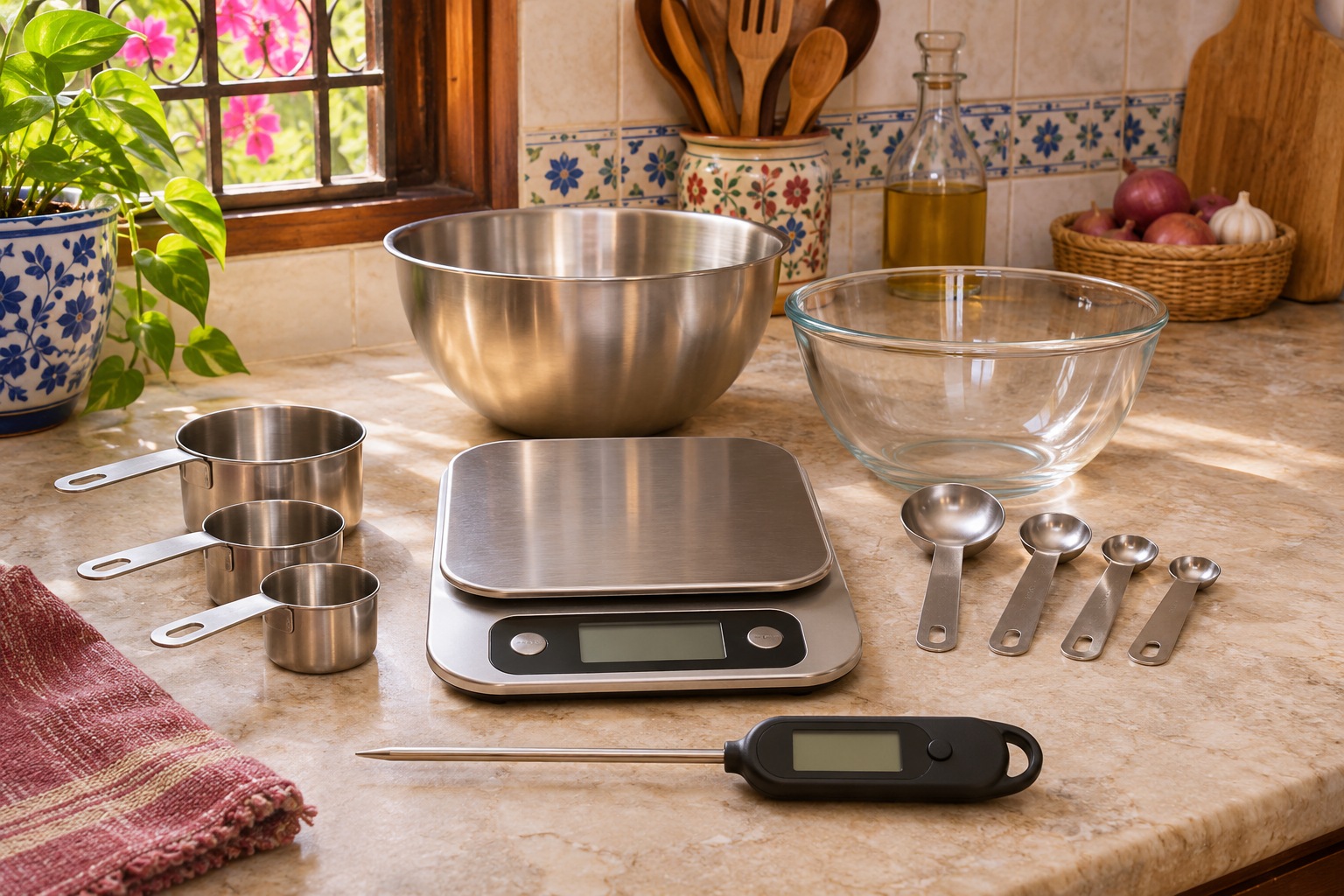
A deep bowl contains splashes from whisking; a wider bowl gives hands room for mixing vegetables or kneading a small batch. Rounded corners are easier to scrape than elaborate ridges. Stainless steel can be practical for handling and storage; glass lets you see through the sides but needs careful handling. Suitable plastic can be lighter. Choose the material according to the actual maker's permitted uses.
Do not infer microwave, oven, freezer or dishwasher compatibility from appearance. A mixing bowl is not automatically heatproof cookware. Rubber bases and attached handles may have different limits from the bowl body. Nesting sets save shelf space but should separate easily. A lid is useful for covering ingredients, though the label should confirm whether it is intended for secure transport rather than merely covering the bowl.
A spinner dries greens; it does not sanitise them
A salad spinner uses a rotating basket to move water from leaves into an outer bowl. It can help when wet lettuce dilutes dressing or damp coriander is awkward to handle. It does not replace washing, and it does not make contaminated produce safe. A clean towel is a workable drying alternative if a spinner would crowd the cupboard.
OXO describes a spinner with a basket that doubles as a colander and a lid that separates for cleaning. Those are useful design features to look for, not promises shared by all spinners. Check whether the basket, bowl and mechanism are individually washable under the stated instructions. Test the brake and locking arrangement, and make sure a loaded basket can be lifted without catching on the lid.
Use clean running water and clean equipment
FDA advises washing produce under running water and does not recommend soap, detergent or commercial produce wash. Wash before peeling so the knife does not carry surface contamination inward. Clean the sink area and keep produce away from raw meat and its juices. Do not treat a basin of reused wash water as equivalent to a clean rinsing process.
FDA also recommends drying produce with a clean cloth or paper towel. A colander supports draining but should not sit where dirty sink water can flow through it. Use its raised base or a clean support as appropriate. For greens, loosen trapped soil gently and avoid crushing delicate leaves simply to force them through an overloaded basket.
Clean mesh promptly and drain hot food carefully
Food dried inside mesh can be troublesome to remove. Rinse promptly after use and wash according to the manufacturer's instructions, using a suitable brush rather than pushing fingertips against fine wires. Inspect the rim, handle welds and underside for trapped residue. Replace a sieve with loose wires or a colander with cracks that are difficult to clean. Dry fully before nesting in a cupboard.
When draining hot food, set up the destination first. Keep handles secure, direct steam away from your face and hands, and pour gradually within your control. An over-sink design needs a dependable fit before it supports anything hot. For a heavy pot, lifting food with a suitable skimmer can be an alternative to pouring the entire pot into a colander.
Keep building your kitchen
Return to the Pakistani kitchen equipment directory for related tools, cookware, appliances and practical buying guides. Then choose a dish from the recipe collection and check its equipment list before buying another gadget.
Frequently Asked Questions
Can one sieve handle tea, flour and rice?
It may be physically possible, but capacity, mesh size and flavour carryover can make separate small and large tools more convenient. Inspect the openings before relying on one tool for tiny grains.
Do I need a salad spinner?
It is useful if you often wash leafy greens and want to remove surface water. A clean cloth or paper towel can also dry produce without another large storage item.
How we know this
- Type Explainer
- Sources 4 (2 official/academic)
- Reviewed November 2026
- Disputed points None
4 sources
Photo credits (1)
- Kitchen scale, measuring cups and spoons, probe thermometer and mixing bowls on a kitchen counter., DailyLife.pk, All rights reserved
