
Kitchen equipment guide
ServingwareDinnerware and Tea Trays: A Practical Buying Guide
Choose everyday plates, serving bowls, cutlery and tea trays with practical checks for storage, food contact, washing, comfortable handling and replacements.
DailyLife.pk kitchen equipment collection
Start with everyday meals and tea
A workable serving collection handles daily daal, rice, roti, curry and tea without requiring a cupboard full of occasion sets. Begin by counting regular diners, the dishes usually served together and the space beside the sink. Add guest pieces according to how you actually host. The quantities and arrangements suggested here are editorial planning examples, not hospitality rules.
For a four-person household, one plate, bowl, cup, spoon and fork per person is a starting inventory, with a small working spare chosen around washing habits. If meals are served in shared dishes, two useful bowls and a rice platter may matter more than extra side plates. If everyone eats at different times, individual covered bowls may be the more practical addition.
Compare materials without relying on labels alone
| Material | Practical appeal | What to verify |
|---|---|---|
| Glazed ceramic | Many shapes and colours for daily plates and bowls. | Food-use documentation, glaze condition and washing instructions. |
| Glass | Contents are visible; useful for dessert and salad bowls. | Chips, stated heat use and handling limitations. |
| Stainless steel | Useful for robust bowls, plates, cutlery and trays. | Smooth edges, stable base and maker’s care advice. |
| Earthenware | Distinctive serving appearance and handmade character. | Specific food-contact suitability and glaze information. |
| Melamine or other plastic | Lightweight serving pieces where that is useful. | Exact heat and microwave restrictions on the product. |
Appearance cannot establish food-contact suitability. The FDA’s traditional pottery guidance explains that some pottery can release lead into food and that decorative ware should not be assumed suitable for serving. Ask the seller for the actual maker and intended use, especially for an unlabelled handmade bowl. An attractive piece can be kept for display while food is served in a documented food-use vessel.
Likewise, a clear bowl is not automatically ovenware. Pyrex’s use and safety instructions are specific to its products and include precautions against sudden temperature changes. Apply the instructions belonging to your own glassware. A cold dessert bowl, a baking dish and a stovetop vessel should not be treated as interchangeable merely because they are transparent.
Choose shape by portion and storage
Carry a tape measure when replacing a plate that must fit an existing rack. The overall diameter matters for cupboard depth, but the usable centre matters for food. A broad rim can make a plate look generous while leaving little room for rice and curry. Stack two sample plates and see whether their feet sit securely without scraping decorated surfaces.
For serving bowls, compare filled weight and the space needed to reach a spoon into the bottom. A narrow mouth can make a large-capacity bowl inconvenient for ladling daal. A shallow platter suits arranging kebabs; a deeper dish may be easier for gravy. These are task-based preferences, not claims that a material improves the food.
Before buying lidded serving dishes, check where the lid will rest during dinner. Test whether the knob can be held comfortably and whether the serving spoon prevents proper closure. If a lid is essential, ask whether a replacement can be ordered separately. A plain bowl with a suitable separate cover may be easier to maintain than a unique ornate set.
Cutlery and serving utensils should feel usable
Hold a table spoon as if eating and as if serving. An excessively deep spoon can feel awkward for rice; an unusually shallow one may be poor for soup. Check fork tips for roughness and the back of the handle for sharp stamped edges. For children or anyone with grip difficulties, select size and weight according to the person rather than matching the adult pattern.
Keep dedicated serving utensils with the relevant dishes: a ladle for daal, a broad rice spoon, tongs for fried snacks and a small spoon for chutney. A cake server earns its place if cakes are served often; an ordinary suitable spatula can cover occasional use. Do not test serrated knives with a finger. Inspect join quality and ask how mixed-material handles should be washed.
Tea service and trays: test the loaded arrangement
A tea tray needs a comfortable grip, a stable base and enough room around cups to lift them. Arrange your actual cups, milk jug, sugar bowl and teaspoon pot on a measured paper outline before ordering online. The outside tray dimension may include handles that add no carrying space. A high rim can help contain small spills but can also obstruct lifting a short cup.
Check whether a tray fits through your serving route and whether it can rest fully on the side table. Make two lighter journeys when the loaded tray is difficult to control. Choose cup handles that admit a comfortable finger grip and a saucer or coaster suited to the surface beneath. An insulated tea flask should have a pour mechanism you can dismantle and clean according to its maker.
Keep serving and storage roles clear
Wash new pieces before use, inspect rims routinely and retire chipped food-contact pieces from service. Dry cutlery before storing it, and avoid letting decorative metal pieces sit wet unless their care instructions permit it. Use a soft separator where stacked pieces scratch one another. Open-stock patterns, in which individual pieces are sold separately, deserve consideration when replacements matter more than a presentation box.
A serving dish is not a reason to leave perishable food on the table. FoodSafety.gov advises prompt chilling of leftovers. Transfer leftovers into appropriate containers and label them, leaving the display bowl free for its next meal. Buy the next serving piece only after confirming where it will be washed, dried and stored.
Keep building your kitchen
Return to the Pakistani kitchen equipment directory for related tools, cookware, appliances and practical buying guides. Then choose a dish from the recipe collection and check its equipment list before buying another gadget.
Frequently Asked Questions
Is all traditional pottery suitable for food?
No. Identify its intended use and ask for credible food-contact information. Use uncertain decorative pieces for display rather than assuming their glaze is suitable for food.
Should all dinnerware match?
Matching is optional. Prioritise comfortable daily pieces, useful serving shapes and replacements that fit your storage and washing routine.
How we know this
- Type Explainer
- Sources 3 (2 official/academic)
- Reviewed November 2026
- Disputed points None
3 sources
- Questions and Answers on Lead-Glazed Traditional Pottery, US Food and Drug Administration
- Product Warranties Safety and Usage, Pyrex
- 4 Steps to Food Safety, FoodSafety.gov
Photo credits (1)
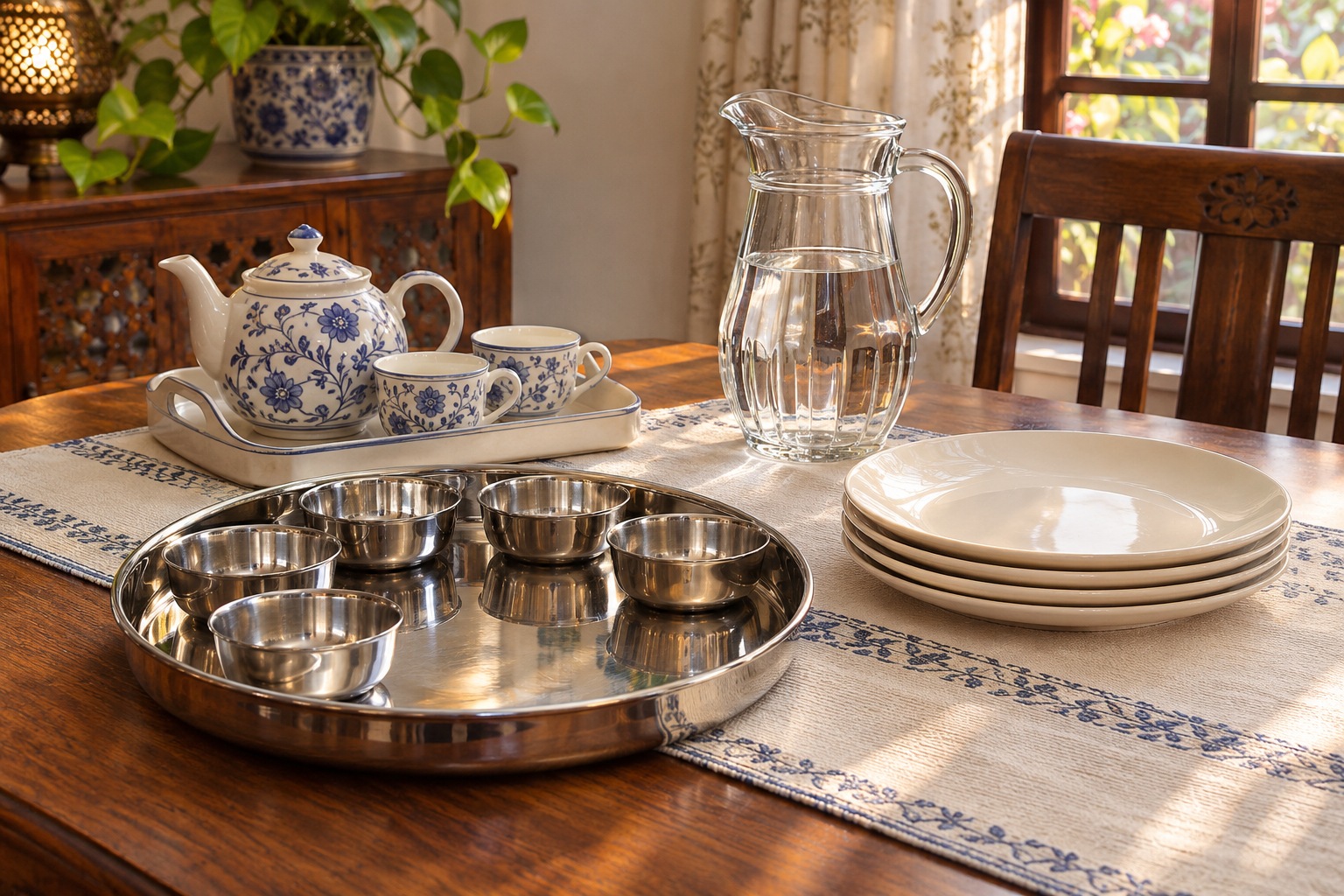
- Steel thali, ceramic dinner plates, glass jug and a teapot with cups on a Pakistani dining table., DailyLife.pk, All rights reserved
