
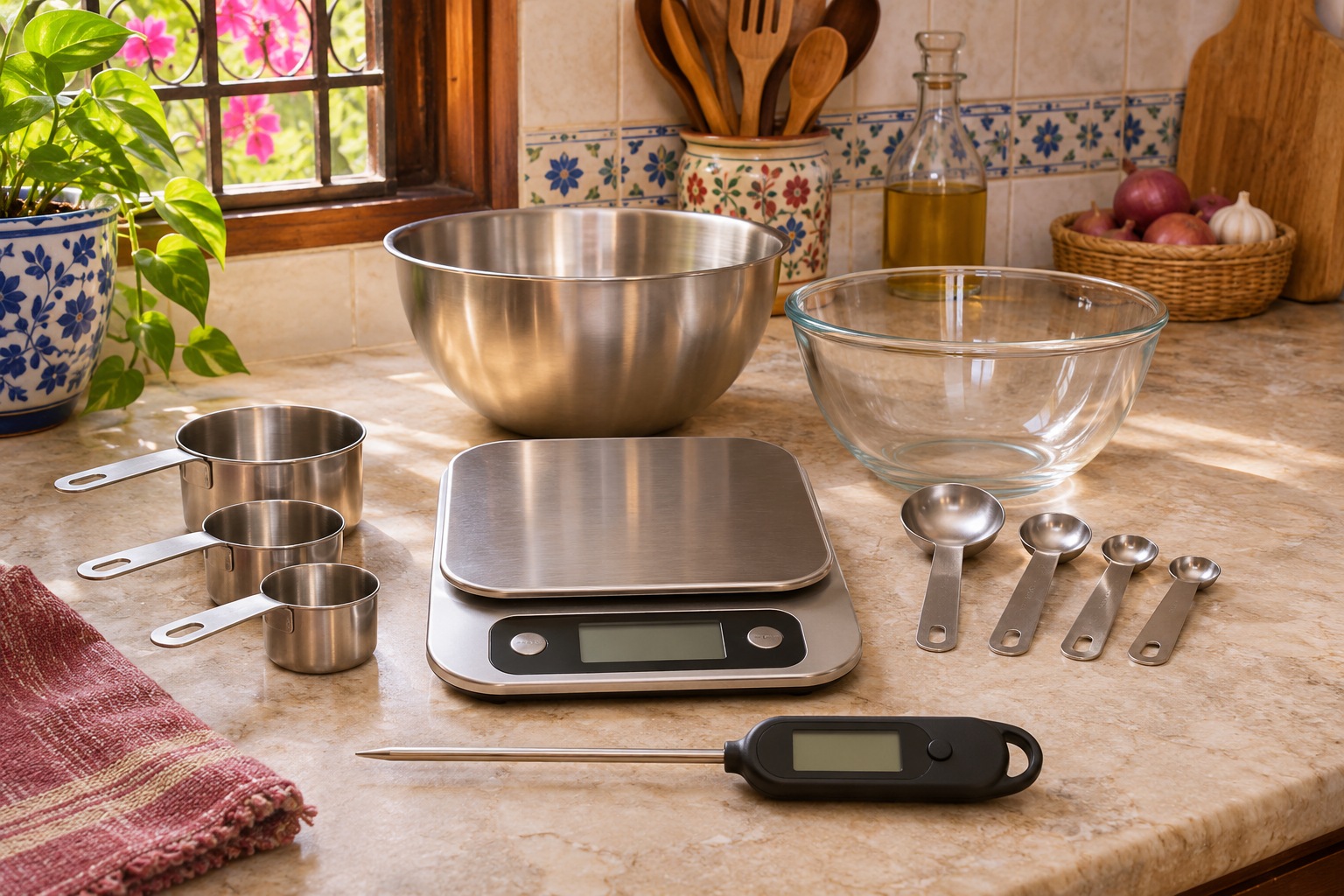
Kitchen equipment guide
Kitchen ScalesMeasuring Cups and Thermometers: Measure with Confidence
Choose scales, cups, spoons and food, fridge or oven thermometers for more consistent cooking, with practical buying checks and clear limits for each tool.
DailyLife.pk kitchen equipment collection
Separate recipe measurement from temperature checking
Measuring tools solve different problems. A scale helps repeat the quantity of flour in a cake or atta mixture; a spoon measures a recipe's small volume; a food thermometer checks temperature inside food. A fridge thermometer tells you about the appliance's storage environment, while an oven thermometer helps you observe oven air temperature. None replaces all the others.
Begin with the uncertainty that causes trouble in your kitchen. Inconsistent cake texture may justify weighing flour. An oven that browns unevenly needs observation of heat distribution as well as temperature. Meat safety requires the right food-temperature check, not a more accurate measuring cup. Choose a readable, maintainable tool before adding connected features or decorative displays.
What each measuring tool can tell you
| Tool | What it measures | Important limitation |
|---|---|---|
| Kitchen scale | Ingredient mass | Capacity and resolution are different |
| Dry cup or spoon | Volume when filled as directed | Packing and ingredient texture affect mass |
| Liquid jug | Volume at marked lines | Read on a level surface |
| Food probe | Temperature at its sensing area | Placement and insertion depth matter |
| Fridge thermometer | Storage air temperature | One reading does not show food history |
| Oven thermometer | Oven air at its location | It does not measure food's centre |
A mixed set of specialised tools is often simpler than trying to interpret one multipurpose gadget's modes.
Check capacity, resolution and the tare button
Capacity is the maximum load; resolution is the smallest displayed step. Neither alone proves accuracy. Include the bowl's mass when assessing the maximum load. As an example buying brief, a household might compare a scale rated around 5 kg with one displaying 1 g increments, then check whether its actual recipes need smaller measurements. These are selection examples, not required specifications. Tiny yeast or spice quantities may need a different tool.
King Arthur explains using the tare function to zero a bowl before adding flour. Look for a platform that leaves the display visible under your largest bowl, easy battery access and a shutoff delay that suits gradual mixing. Do not assume a scale's millilitre mode gives the correct volume for every ingredient.
Use the units stated by the recipe
A tea mug and a formal measuring cup are not interchangeable. Recipes may come from different measurement traditions, so check their stated cup size or use supplied gram weights. A cup of flour and a cup of sugar do not have the same mass. A conversion requires the specific ingredient and measurement method; there is no universal grams-per-cup number.
King Arthur distinguishes liquid-cup measurement and its method for filling flour cups. Follow the recipe developer's instructions rather than switching between scooping and loosely filling. Choose durable, readable markings, flat rims for levelling and spoons narrow enough for your spice jars. A nesting set should separate easily without thin handles twisting under normal filling.
Choose and position a food thermometer correctly
A fine-tipped instant-read probe is useful when checking smaller pieces. An oven-safe probe or dial stem may be designed for longer insertion and continuous cooking, but you must confirm that from the manual. Never leave an ordinary instant-read thermometer in an oven merely because its probe is metal. Check the stated temperature range, sensing area, water-resistance limits and calibration procedure.
USDA advises checking the thickest part of food, avoiding bone, fat and gristle. Compare the result with an authoritative safe-temperature chart for that food. Check more than one location when pieces vary. USDA recommends hot, soapy cleaning and notes that most thermometers should not be immersed. Clean between checks as needed to avoid transferring raw-food residue.
Fridge and oven thermometers answer different questions
FDA recommends refrigerator storage at 40°F or below and freezer storage at 0°F, approximately 4.4°C and minus 17.8°C. Choose an appliance thermometer with a clearly readable scale covering the intended range. Check it regularly, particularly when adjusting controls. The numbered control knob may not show actual temperature.
An oven thermometer can help compare the setting with observed temperature after preheating. Position it securely as instructed, away from contact with heating elements. Expect the reading to vary through the thermostat cycle; a single glance does not describe the whole bake. In Pakistan, where a household may experience power interruptions, follow official food-storage guidance using both elapsed time and temperature rather than assuming a cold-looking fridge kept everything safe.
Make readings easy to trust
Store scales level and keep spills out of buttons and battery compartments. Wash removable cups and spoons according to their material instructions, then dry before nesting. Replace measuring tools whose markings have worn away if you can no longer identify the quantities reliably. Keep a spare suitable battery if the device is important to your routine.
For thermometers, use the manufacturer's checking or calibration method and replace damaged probes or cracked housings. A readable display and straightforward cleaning can be more useful than a very long feature list. Keep the instructions available so everyone in the household knows which thermometer can enter the oven and which is only for taking a quick reading.
Keep building your kitchen
Return to the Pakistani kitchen equipment directory for related tools, cookware, appliances and practical buying guides. Then choose a dish from the recipe collection and check its equipment list before buying another gadget.
Frequently Asked Questions
Can I replace measuring spoons with a kitchen scale?
Only when the scale can reliably resolve the quantity and the recipe provides a suitable mass. A large-capacity scale may be unsuitable for a very small dose.
Does an oven thermometer tell me chicken is cooked?
No. It measures oven air, while a food probe checks temperature inside the chicken. Use appropriate placement and the safe-temperature guidance for that food.
How we know this
- Type Explainer
- Sources 5 (3 official/academic)
- Reviewed November 2026
- Disputed points None
5 sources
- How to Measure Flour, King Arthur Baking
- Recipe Success Guide, King Arthur Baking
- How to use a food thermometer, USDA FSIS
- Proper food thermometer cleaning, USDA FSIS
- Refrigerator Thermometers, FDA
Photo credits (1)
- Kitchen scale, measuring cups and spoons, probe thermometer and mixing bowls on a kitchen counter., DailyLife.pk, All rights reserved
