
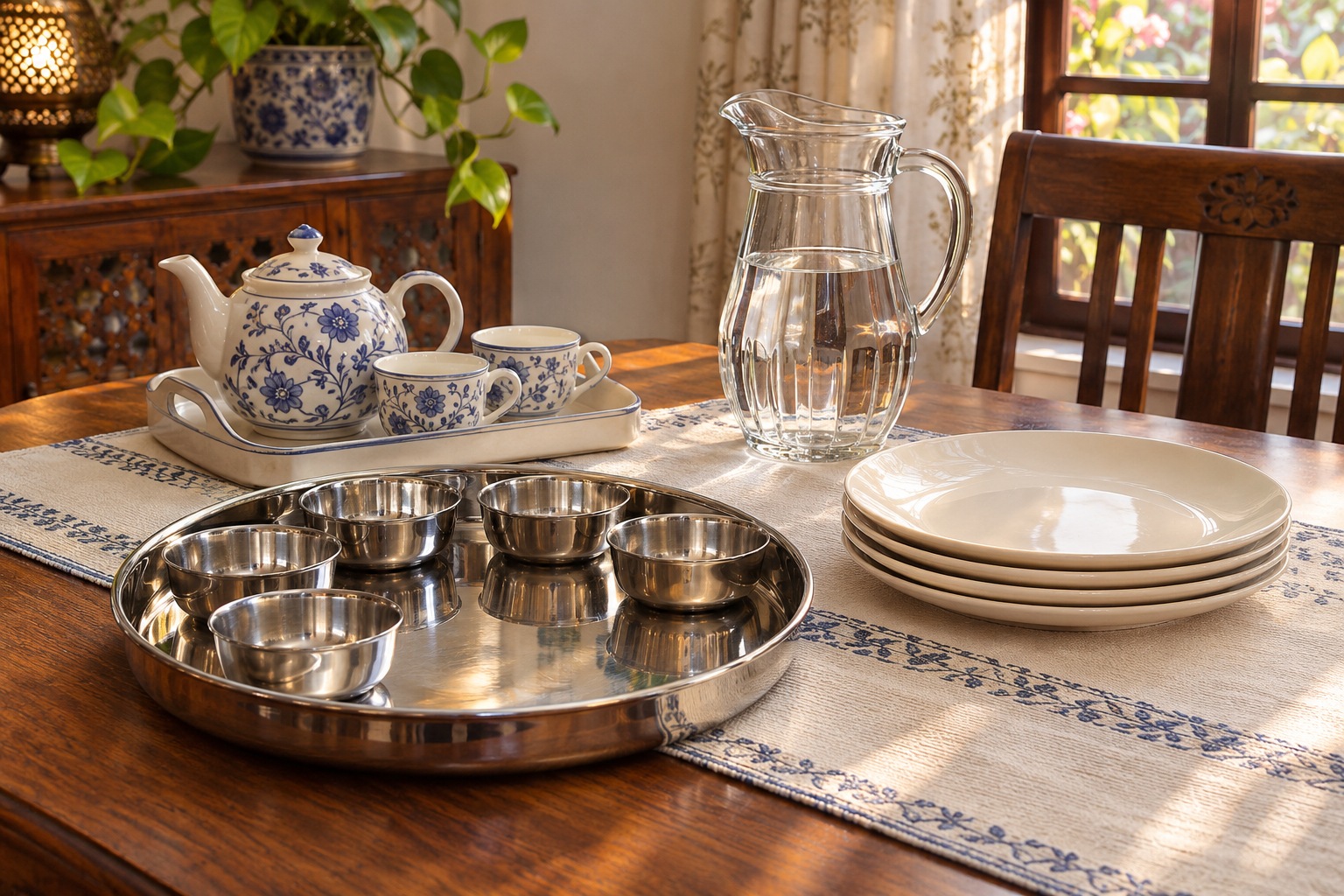
Kitchen equipment guide
KettlesTea and Coffee Tools, Water Filters and Dispensers
Build a practical tea, coffee and drinking-water station with the right kettle, brewer, filter and dispenser, considering cleaning, replacement parts and energy use.
DailyLife.pk kitchen equipment collection
Separate brewing, heating and water treatment
A beverage station can contain several tools with different jobs. A kettle heats water, a tea strainer catches leaves, a coffee brewer extracts a drink, and a dispenser makes stored water convenient to serve. A filter removes only the contaminants its design and verified claims cover. Treat these as separate decisions so a convenient appliance does not become an unsupported promise about water quality.
Begin with a day's routine: how many cups are prepared at once, whether chai is simmered with milk, whether coffee is occasional, and who refills or lifts water containers. Mark a counter area away from crowded cooking work. Allow a stable landing place for hot vessels and a clear route to the sink for emptying, rinsing and descaling.
Choose tools for the drink
| Tool | Useful role | What to check |
|---|---|---|
| Electric kettle | Heating measured water | Minimum fill, pouring control, base and local electrical rating |
| Stovetop kettle or saucepan | Water heating or a suitable chai method | Hob compatibility, handle and cleaning access |
| Teapot and strainer | Steeping and serving loose-leaf tea | Spout control, lid fit and easy cleaning |
| Pour-over cone or French press | Small manual coffee batches | Filter supplies, cleaning and serving volume |
| Moka pot | Stovetop coffee brewing | Approved hob, seal parts and manual procedure |
| Electric coffee machine | Repeatable preferred brewing style | Consumables, descaling, voltage and local service |
| Water dispenser | Convenient serving of supplied water | Bottle handling, cleaning, hot-tap safeguards and actual treatment function |
A water-only kettle should not be assumed suitable for boiling milk, simmering chai or cooking noodles. Check its instructions. For milk chai, an appropriate saucepan may be simpler to clean. For coffee, select the brewing style you enjoy before buying a machine with programmes you will rarely use.
Size the kettle and check electrical details
Use illustrative serving arithmetic: four 200 ml cups require 800 ml before allowing for the preparation method. This is a planning example, not permission to ignore minimum or maximum fill lines. A larger kettle may be useful for visitors but need not be filled for every cup. Compare a secure grip and controlled pour as carefully as nominal capacity.
A verified local example is the Dawlance DWEK 7100, listed at 1 litre, 1200 W and 220–240 V, 50 Hz, with boil-dry protection. Those specifications apply to that model. Confirm the actual rating plate and manual for any unit offered, especially an imported variant. A plug adaptor changes the connection shape, not the voltage required by the appliance.
Ask an electrician to assess the outlet and circuit if suitability is uncertain. Keep cables where they will not be pulled or sit in water. Consider the combined load when the kettle and other kitchen heaters run together. Follow the appliance placement and filling instructions, and treat boil-dry protection as a backup feature rather than a normal operating method.
Choose filtration against a defined problem
CDC guidance says filter selection should match the contaminants you need removed and the relevant certification claims. Clear appearance or pleasant taste does not establish microbiological or chemical safety. Start with reliable information about your water source and any testing or public-health advice, then choose treatment for the identified issue. Do not assume every cartridge marked carbon, RO or UV provides the same treatment performance.
Ask the supplier for the exact model, independently verifiable certification and covered contaminant reductions. Check replacement-cartridge availability, service intervals, installation conditions and the continuing cost of filters or lamps. For a membrane system, ask about feed-water requirements, reject-water management and maintenance. A low purchase price can hide expensive consumables or parts that are difficult to obtain locally.
CDC notes that boiling does not make water containing harmful chemicals or radioactive material drinkable. Heating and filtration therefore cannot be treated as interchangeable cures. If a local authority issues water instructions, follow those instructions for the specific incident. A kettle's normal automatic shutoff cycle should not be assumed equivalent to a prescribed disinfection process.
Inspect dispensers as storage equipment
For a bottled-water dispenser, compare top loading with bottom loading in terms of who must lift the bottle and how the compartment can be cleaned. Confirm whether the appliance only heats and chills or includes a documented treatment system. A dispensing tap does not establish filtration, and a hot-water setting does not prove the entire stored supply has been disinfected.
Ask for the cleaning and sanitising procedure for reservoirs, bottle contact points and taps. Check access to removable drip trays and whether replacement taps, pumps and seals can be ordered. Position hot outlets away from easy accidental contact and assess the specific product's child-safety arrangement. Do not infer that a small lower compartment is approved food refrigeration unless the manual says so.
Calculate the continuing cost
Electricity cost equals measured kWh multiplied by your applicable energy rate. Illustratively, a 1.2 kW kettle operating continuously for five minutes uses 0.1 kWh; actual time depends on water volume, starting temperature and the appliance. A dispenser may cycle throughout the day, so measure over a representative period rather than assuming its heating wattage is a constant draw.
Add cartridges, paper filters, coffee consumables, descaling products and service to the purchase price. Follow the manual for descaling agents and rinsing, since seals and coatings differ. Clean strainers and coffee parts after use, dry them appropriately and replace worn gaskets with approved parts. For occasional coffee, a manual brewer and a supported kettle can provide a useful station with fewer parts to maintain.
Keep building your kitchen
Return to the Pakistani kitchen equipment directory for related tools, cookware, appliances and practical buying guides. Then choose a dish from the recipe collection and check its equipment list before buying another gadget.
Frequently Asked Questions
Does a dispenser purify bottled or tap water?
Only if its documented treatment system does so for the relevant contaminants. Many dispensers are principally storage, heating and cooling appliances.
Should I buy the largest kettle available?
Choose for normal serving volume, safe handling and minimum fill. Extra capacity is useful only when it suits your routine.
How we know this
- Type Explainer
- Sources 3 (2 official/academic)
- Reviewed November 2026
- Disputed points None
3 sources
- DWEK 7100 specification, Dawlance Pakistan
- Choosing home water filters, US CDC
- Household water treatment, US CDC
Photo credits (1)
- Steel thali, ceramic dinner plates, glass jug and a teapot with cups on a Pakistani dining table., DailyLife.pk, All rights reserved
