
Kitchen item guide
Steel tiffin dabba: A Practical Pakistani Kitchen Guide
Choose a steel tiffin dabba that stacks securely, fits your meal and works with a separate plan for keeping food at safe temperatures.
DailyLife.pk kitchen equipment collection
Separate dishes in a stacked carrier
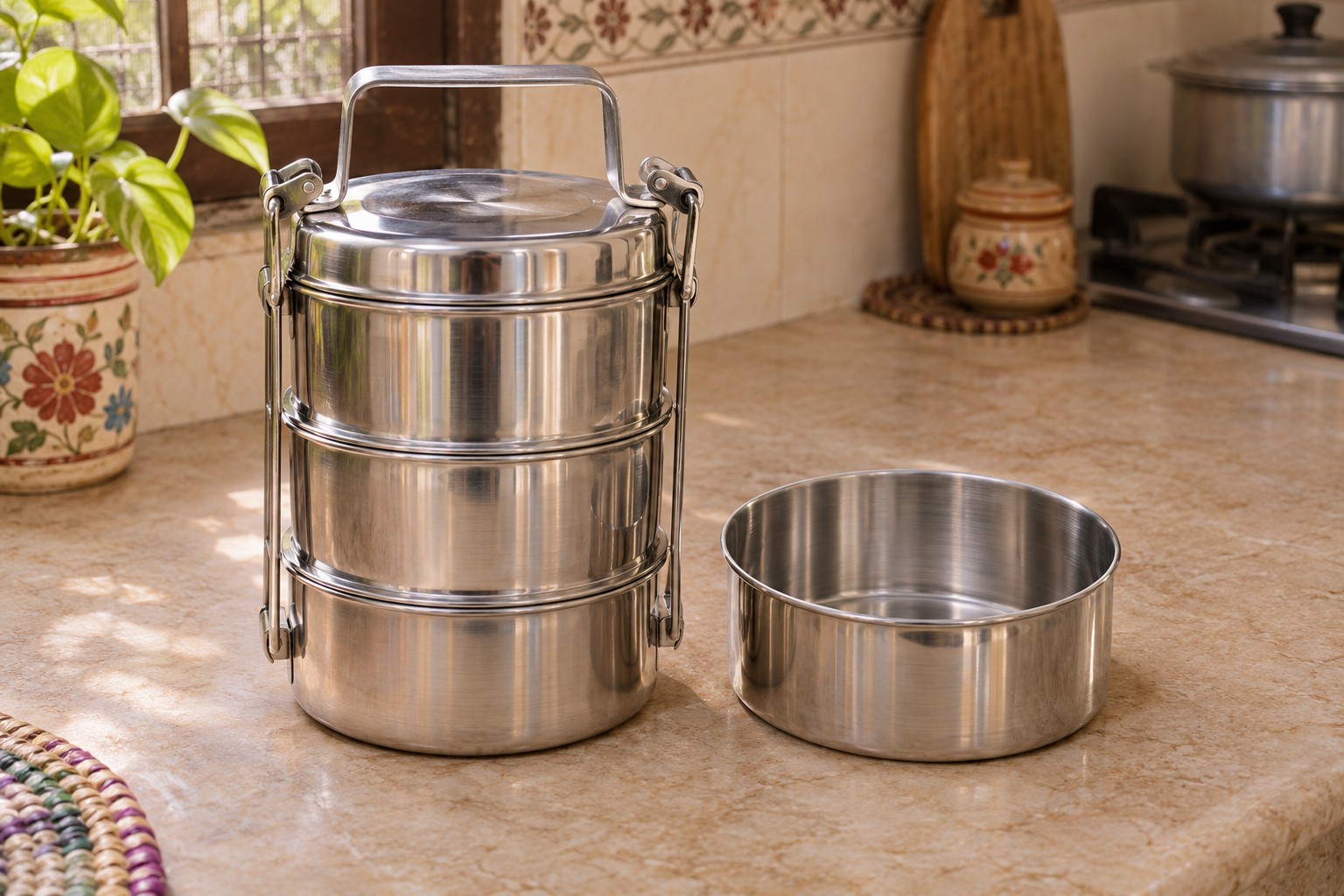
A steel tiffin dabba is a set of food containers that stack within a carrying frame or fastening system. It can keep roti, rice and sabzi in separate tiers without needing several unrelated boxes. In Pakistani households it suits a meal sent to work or delivered nearby. Most simple steel tiffins are carriers, not vacuum-insulated hot-food containers. Their shiny appearance does not establish how long food stays hot or cold. Choose the meal and transport arrangements first, then decide how many tiers are actually useful.
Inspect the complete stack
Round tiers nest neatly, while some rectangular designs use bag space differently. Check tier depth, the shape of each rim and how the lid or upper tier closes the one below. Side straps and carry handles should move smoothly without sharp edges. A separate curry insert may be needed because ordinary overlapping steel rims are not automatically liquid-tight. As editorial examples, compare a compact two-tier meal with a larger three-tier family delivery. Measure the carrier including handle and fasteners so it fits the bag and destination refrigerator, rather than adding only the advertised tier volumes.
Load it in the correct order
Use clean dry tiers and keep food below the seating rim so the stack closes without crushing it. Follow the manufacturer’s arrangement of tiers, inserts and lid; similar-looking pieces can have different roles. Engage every latch normally and lift the empty assembled carrier before relying on it with a full meal. Carry it upright. Avoid stuffing a top tier with extra roti until the latch must be forced shut. A strained fastening is inconvenient to open and may no longer hold the carrier evenly during a commute.
Steel does not replace temperature control
For perishable cold meals, use a suitable insulated bag with frozen cold sources and refrigeration where available. USDA’s packed-lunch guidance recommends two cold sources. For hot food, choose equipment documented for hot holding and follow its instructions; do not assume an ordinary tiffin has that performance. Conventional steel tiers should not be placed in a microwave. If reheating is needed, transfer food into suitable equipment and heat appropriately. Do not place the tier on a burner unless its maker explicitly designed it for that use.
Buying, washing and useful lifespan
Ask the supplier for material details, care instructions, leak claims and replacement clips or lids. Check inside corners and seams for cleaning access. Wash all used tiers after each trip and dry the rim folds, handle attachments and any removable seals. Do not store yesterday’s residue under a clean new meal. Replace a tier with damaged edges or a frame whose fastening is unreliable; a good body cannot compensate for a broken carrier. A set of separate food boxes is a workable substitute. Steel tiffins are reusable and organise dishes well, but can be bulky and require upright carrying and several pieces of washing.
Frequently Asked Questions
Is every steel tiffin leakproof?
No. Ordinary stacking rims may leak; check the exact design and use suitable sealed inserts.
Can I microwave a steel tier?
Conventional steel tiffin parts are not microwave containers. Transfer food to suitable cookware.
Does a steel tiffin keep food safely hot?
Only a product with documented insulated hot-holding performance should be relied on for that job.
How we know this
- Type Explainer
- Sources 3 (1 official/academic)
- Reviewed November 2026
- Disputed points None
3 sources
- Keeping a Bag Lunch Safe, USDA Food Safety and Inspection Service
- Food packaging, NSW Food Authority
- Safe school lunches, Health Canada
Photo credits (1)
- Three-tier stainless steel tiffin carrier with locking straps and an additional open steel tier., DailyLife.pk, All rights reserved
