
Kitchen item guide
Refrigerator: choosingusing and caring for it
Choose usable chilled space, verify actual temperature and organise Pakistani ingredients and leftovers for safe everyday storage.
DailyLife.pk kitchen equipment collection
Cold storage with separate temperature needs
A refrigerator provides controlled chilled storage for perishable food. A fridge-freezer combines that compartment with a separate frozen-storage space, while a small internal icebox may have different capabilities. Confirm what each compartment is rated to do rather than judging it by a door label. Milk, yoghurt, prepared chutney, raw meat and leftover salan require sound handling as well as an appliance that cools.
In a Pakistani kitchen the most useful refrigerator is one that fits the household's shopping and cooking pattern. A family cooking fresh meals daily may need a different shelf arrangement from one storing several prepared dishes. Cold storage slows deterioration; it does not restore food that was handled unsafely or make every ingredient keep for the same number of days.
Measure shelves, doorway and ventilation
Check delivery access through gates, stairs and kitchen doors, then the installed width, depth, ventilation clearance and door swing. A fridge that fits the cabinet gap may still need more space for drawers to pull out. As an editorial fit exercise, measure the covered containers used for salan and daal, a regular milk vessel and the vegetable drawer load. Tall door bins do not compensate for a main shelf that cannot hold your ordinary covered dish.
Compare the division between chilled and frozen space, controls, shelf adjustment and cleaning access. Check ambient operating limits for the intended kitchen and ask about local parts and service. Energy labels are useful when compared on equivalent test terms; they do not predict a Pakistani electricity bill without usage, tariff and installation information. Written warranty and model details help make the purchase reviewable.
Verify temperature with an appliance thermometer
Transport and install according to the model's instructions, including any settling period before switching on. Level the appliance as directed and keep its ventilation path clear. Have the supply arrangement checked where required; do not assume an arbitrary voltage stabiliser or extension cord is suitable for every compressor appliance. Let the compartments reach their required condition before loading perishables.
FDA recommends a refrigerator at or below 40°F, about 4°C, and a freezer at 0°F, about −18°C. Use an appliance thermometer to check the actual temperature. A dial numbered one to five does not directly report degrees, and a display may represent a setpoint rather than every shelf's current condition. Follow the manual's guidance on thermometer location and adjustment.
Organise food and plan outages
Keep raw meat and poultry contained so drips cannot reach ready-to-eat food. Cover prepared dishes, label them with preparation dates and leave the airflow the refrigerator requires. Divide a large cooked batch into suitable shallow containers for prompt chilling instead of placing an enormous hot degchi in a crowded compartment. Use authoritative storage guidance for the food rather than a universal leftovers rule.
For load shedding, minimise door opening and use temperature evidence to assess food afterwards. CDC's emergency guidance describes an unopened refrigerator's approximate four-hour protection during an outage, with food decisions still depending on time and temperature. That is not a guaranteed safe duration for every hot kitchen or an appliance already above its target. Do not taste questionable food to decide whether it is safe.
Clean seals and recognise cooling faults
Clean spills promptly, wash removable shelves by the approved method and allow cold glass to reach a safe washing temperature before contact with hot water. Wipe door seals gently so crumbs and sticky residue do not prevent closure. Clean accessible coils or vents only as the manual permits, with power isolated where required. Do not chip ice with a knife or disturb refrigerant components.
Persistent warm temperatures, a failed seal, damaged wiring, abnormal compressor behaviour or refrigerant-system damage requires qualified service. There is no fixed replacement age that overrides condition and repair feasibility. A refrigerator's benefits are accessible chilled storage and food organisation; its limitations are electrical dependence, finite space and the need for safe handling. A freezer serves different long-term frozen-storage tasks, while a properly managed insulated cool box is only a temporary solution with temperature control. Choose usable storage and support before optional screens or decorative finishes.
Frequently Asked Questions
Does a cold-feeling fridge prove it is safe?
Use an appliance thermometer; touch and a numbered control dial do not measure food-storage temperature.
Can I store a whole hot degchi of salan?
Divide large batches into appropriate shallow containers for prompt safe chilling and preserve airflow.
Can I taste food after an outage to test safety?
No. Use authoritative time-and-temperature guidance; tasting cannot establish safety.
How we know this
- Type Explainer
- Sources 3 (2 official/academic)
- Reviewed November 2026
- Disputed points None
3 sources
- Refrigerator thermometers and food safety, US Food and Drug Administration
- Food safety after an emergency, US Centers for Disease Control and Prevention
- Electrical safety in the kitchen, Electrical Safety First
Photo credits (1)
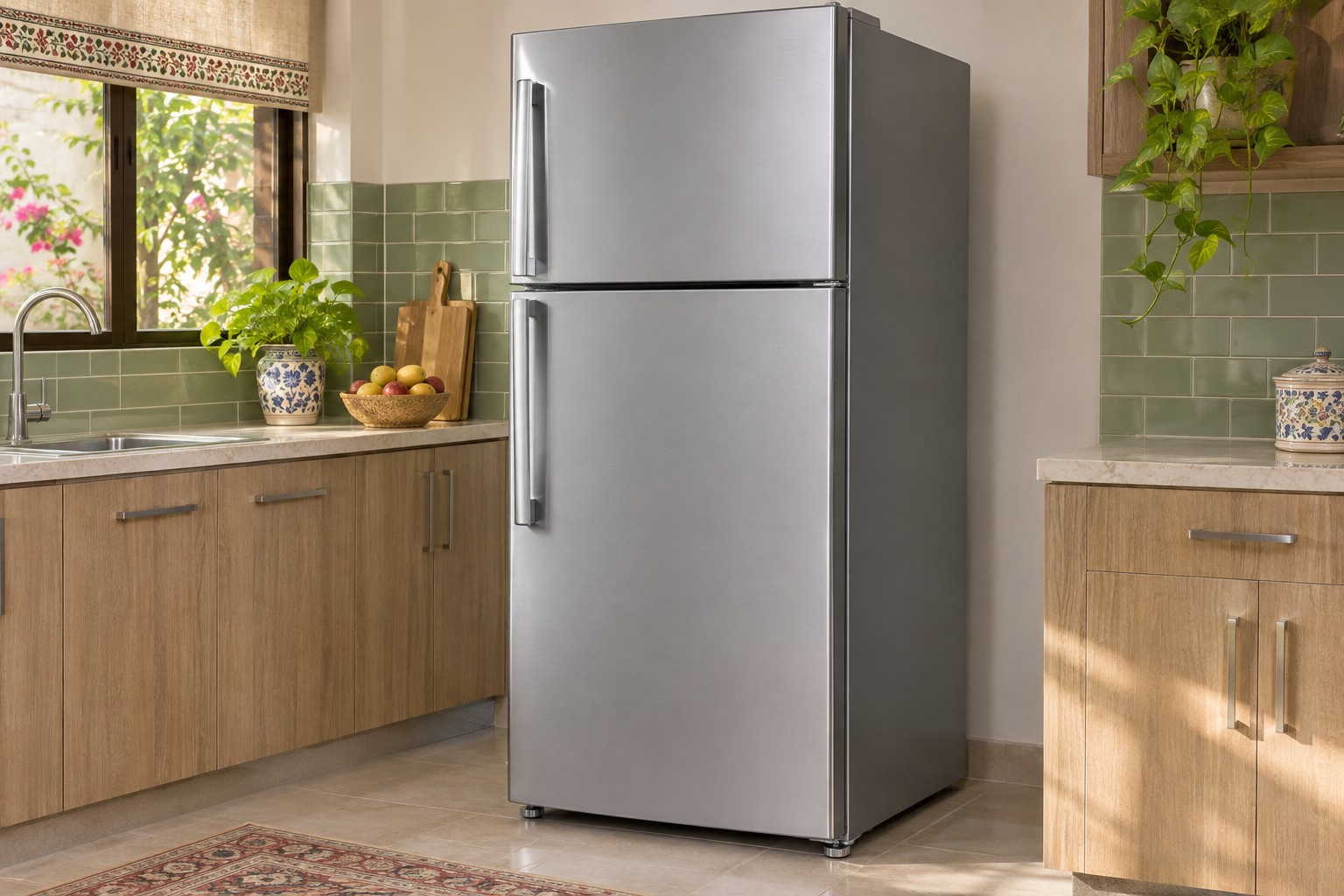
- Freestanding two-door refrigerator with freezer at top, doors closed, clean silver finish, installed with visible air space beside cabinetry., DailyLife.pk, All rights reserved
