
Kitchen item guide
Chimta for Roti: GripReach and Cleaning
Choose a chimta that grips roti securely and stays comfortable to operate around your tawa.
DailyLife.pk kitchen equipment collection
The familiar roti gripping tool
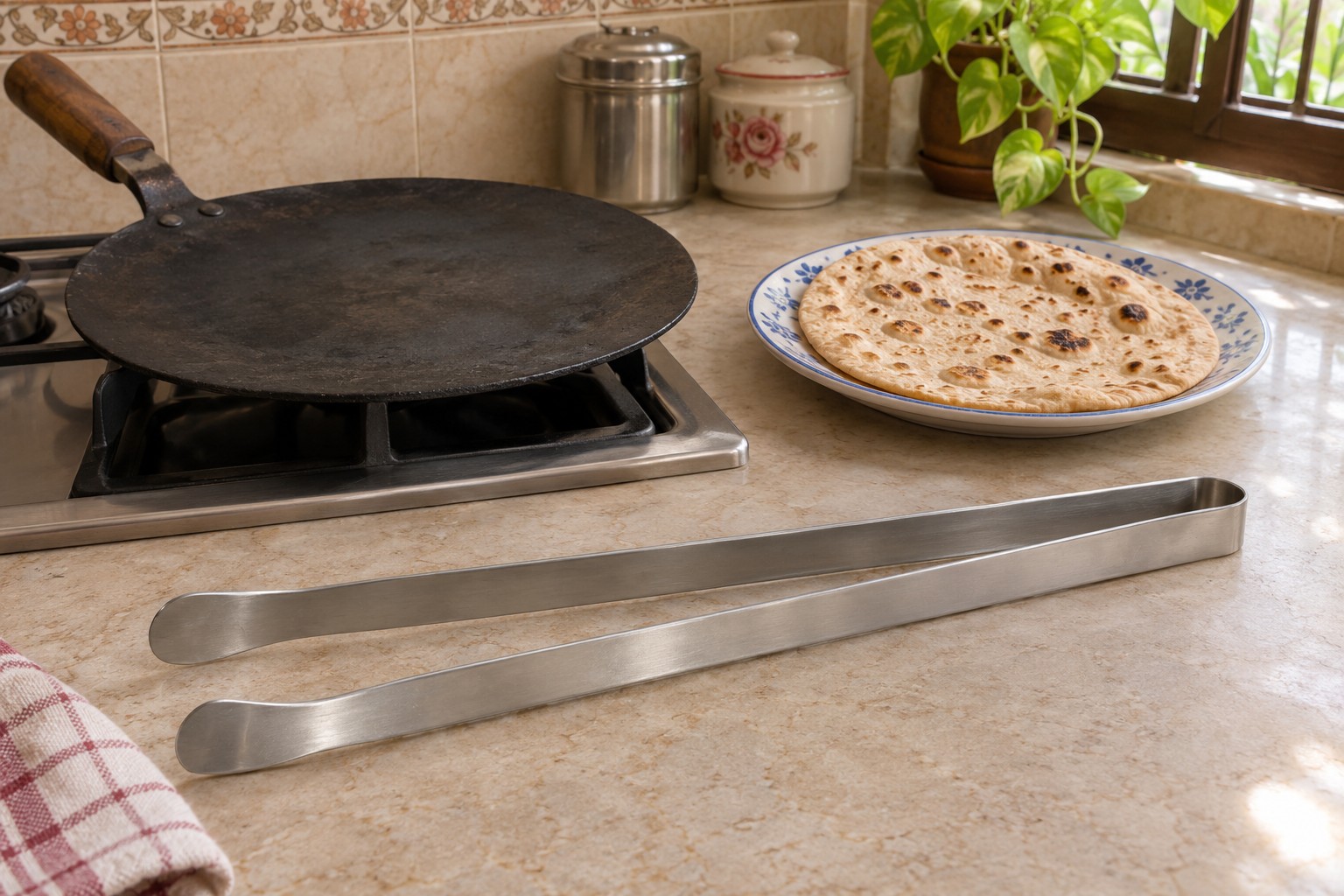
A kitchen chimta is a tong-like tool used to grip and turn food, especially roti. Traditional versions use two long springy metal arms connected at one end, leaving the other ends available to pinch the bread. It is useful when lifting a roti from a tawa or moving it to a serving plate. It should be chosen as a food-handling utensil: a decorative or musical chimta is a different object, despite sharing the name.
Tip shape and spring action
Plain stainless steel designs are common, while some utensils use a pivot or a separate grip coating. Flat tips contact more of the roti than sharp narrow points, but they still need to meet accurately. As editorial comparisons, try a shorter tool for close control and a longer one for reach, without assuming that the longest is easiest. Excessive spring resistance can tire the hand. Rough edges can tear soft bread and are also an avoidable cleaning and handling problem.
Prepare the landing place first
Set the roti plate or basket within easy reach before beginning. Hold the chimta in its intended grip and close the tips gently around a secure part of the cooked bread. Lift without dragging your wrist above the burner and turn or transfer the roti with a controlled movement. Avoid stabbing the bread or squeezing a fragile area unnecessarily. Keep the chimta on a clean utensil rest between uses, rather than leaning the gripping ends onto a dirty counter or stove edge.
Heat and cookware limitations
Metal conducts heat, so a handle must not be assumed cool after resting near a burner. Do not leave the chimta across the tawa or in direct flame, and keep plastic or coated parts away from heat sources unless expressly permitted. It is not a pot lifter: a full degchi needs the proper handles and heat protection. For coated cookware, check the pan maker’s permitted utensils before allowing metal tips to scrape the surface. General food hygiene remains relevant; FDA guidance calls for clean utensils between preparation tasks.
Inspect before buying
At a Pakistani kitchenware market, check how evenly the tips meet, whether the arms twist sideways and whether cut edges are smooth. Look at joints and grip seams for food traps. Ask for a food-contact utensil with known material rather than accepting a shiny finish as proof of stainless construction. For online purchases request total length and clear tip photographs. Buy when you regularly handle roti or similar flatbreads; a suitable pair of food tongs can otherwise cover occasional bread transfer.
Cleaning and replacement signs
Wash both inner faces and the connected end, where flour and oil can collect. Rinse and dry before putting it away; a narrow utensil holder should not trap water around the joined section. Follow any maker-specific instructions for coatings or removable grips. Replace a tool with rough corrosion, a cracked join, unreliable spring action or badly misaligned tips. The simple form is easy to store and quick to use, but offers less broad support than a turner for a heavy stuffed paratha.
Frequently Asked Questions
Can a chimta lift a cooking pot?
Do not use a roti chimta as an improvised pot lifter. Use the pot’s intended handles and appropriate heat protection.
Is metal always suitable for a nonstick tawa?
No. Follow the tawa maker’s utensil instructions and avoid scraping coatings.
What can replace it?
Food tongs can transfer bread; a broad turner may support a heavy paratha more effectively.
How we know this
- Type Explainer
- Sources 2 (1 official/academic)
- Reviewed November 2026
- Disputed points None
2 sources
- Safe Food Handling, FDA
- Chimta, D’source, IDC IIT Bombay
Photo credits (1)
- Chimta displayed on a Pakistani kitchen counter in natural light., DailyLife.pk, All rights reserved
