
Kitchen equipment guide
DegchiPatila or Handi: Choosing the Right Cooking Pot
Compare degchi, patila, handi and clay cooking pots by shape, usable capacity, hob fit and cleaning needs for rice, curry, milk and slow cooking.
DailyLife.pk kitchen equipment collection
Treat names as a starting point
Buying a pot by name alone can disappoint. Sellers may describe similar vessels as a degchi, deghchi, patila or handi, while families use these words differently. Examine the shape and ask for dimensions. A straight sided pot is convenient for liquid cooking and access with a ladle; a rounded body and narrower opening change stirring and serving. The right purchase should reproduce a useful cooking task, rather than merely match a familiar label.
Bring a list of your weekly dishes. Rice needs space for the method you use, milk needs attention and accessible stirring, and a thick meat gravy needs a base you can reach with a spoon. Cooking and serving may also be separate jobs: a decorative handi is not automatically suitable for the flame. Ask specifically whether a vessel is intended for cooking, oven use or presentation only.
Compare the working shapes
| Vessel | Useful task | Inspection priority |
|---|---|---|
| Degchi or deghchi | Rice, curries and household batch cooking | Base area, lid seating and lifting grip |
| Patila | Milk, stock, boiling and ladle serving | Rim access and comfortable depth |
| Metal handi | Gravy dishes and covered gentle cooking | Spoon reaches the curved lower wall |
| Clay handi or mitti pot | Recipes developed for that exact cookware | Food contact documentation and permitted heat sources |
| Wide casserole | An alternative for accessible stirring | Actual usable volume rather than exterior diameter |
Hawkins lists handi and patila separately within its tri-ply manual, confirming that construction and instructions matter alongside the traditional name. Its specified range has a stainless cooking surface, aluminium core and magnetic stainless base; do not infer that every shiny patila uses the same construction. See the illustrated manufacturer manual.
Plan capacity from your own recipe
Record the amount of finished food from a normal batch in a measuring jug or known containers. Then choose a pot that leaves comfortable working space above that quantity. This is more useful than guessing a number of people from nominal litres. Rice, thick daal and a thin soup occupy space differently during cooking and require different stirring movements.
As editorial shopping examples, compare a smaller 2 litre pot for modest liquid tasks with a 5 litre pot for larger household batches. Those figures are not standards, serving claims or guaranteed safe fill levels. Check the real interior dimensions and the manufacturer’s permitted use. A wide pot and a tall pot with equal volume can behave quite differently on the same burner.
| Fit question | Practical check |
|---|---|
| Can I stir it? | Reach the base without resting a wrist near steam |
| Can I drain it? | Rehearse the movement with the empty pot and lid |
| Will it fit the hob? | Measure base contact and neighbouring cookware clearance |
| Can I store it? | Check shelf height with the lid fitted |
| Can I carry it? | Test the grip with the mitts you actually use |
Buy clay cookware with specific evidence
A handmade appearance does not identify clay composition, glaze or cooking suitability. Ask the maker for written food contact information, whether the pot is glazed, and whether it is intended for your gas burner, electric hob, oven or other appliance. Avoid using a decorative souvenir as cookware. Health Canada identifies lead and cadmium in some ceramic glazes or decoration as a food contact concern. Read its ceramic cookware guidance. Appearance and a seller’s claim that something is natural cannot replace documentation.
Ceramic cookware is not one universal heat source category. Emile Henry markets a specific Delight collection as induction compatible; that is a property of that collection, not ordinary proof that a local clay handi works on induction. See the identified induction collection. Ask for the exact product instructions before adding a diffuser or adapter.
Follow the maker’s first use and washing procedure. Do not generalise soaking, milk boiling or seasoning instructions from another ceramic product. Inspect for damage before cooking and ask the maker how to distinguish cosmetic marks from structural cracks. Choose a metal pot when you need a predictable replacement without specialist care instructions.
Lids, simmering and storage
A lid should sit securely without requiring force. Choose a knob that leaves room for a protected hand, and check whether steam can escape as designed. An ordinary covered handi is not a pressure cooker. Never add weights, block vents or alter a lid to imitate one. For dum style cooking, follow a recipe and cookware instructions that account for the exact vessel and heat source.
Stir milk and thick sauces across the entire reachable base. If a narrow mouth prevents that motion, choose a different pot for that task. A heavy pot is not permission to leave milk unattended. Transfer finished dishes into appropriate serving or storage containers rather than using the cooking pot as a permanent refrigerator container.
Cool leftovers in smaller shallow containers: the USDA specifically advises dividing a large pot of soup or stew before refrigeration. See its cooling advice. Plan the containers before preparing a large batch. Finally, ask a Pakistani retailer about spare lids, handles and service support; check a replacement lid against the actual pot rather than relying on the nominal diameter alone.
Keep building your kitchen
Return to the Pakistani kitchen equipment directory for related tools, cookware, appliances and practical buying guides. Then choose a dish from the recipe collection and check its equipment list before buying another gadget.
Frequently Asked Questions
Is a handi always made of clay?
No. Handi describes cookware sold in several materials; verify the actual body and cooking surface.
Is the largest pot the best value?
Only when it fits the burner, storage and normal batch. An awkward oversized pot can make everyday cooking and washing harder.
How we know this
- Type Explainer
- Sources 4 (1 official/academic)
- Reviewed November 2026
- Disputed points None
4 sources
- Tri-ply cookware manual, Hawkins
- Safe use of cookware, Health Canada
- Delight collection, Emile Henry
- Hot food refrigeration, USDA FSIS
Photo credits (1)
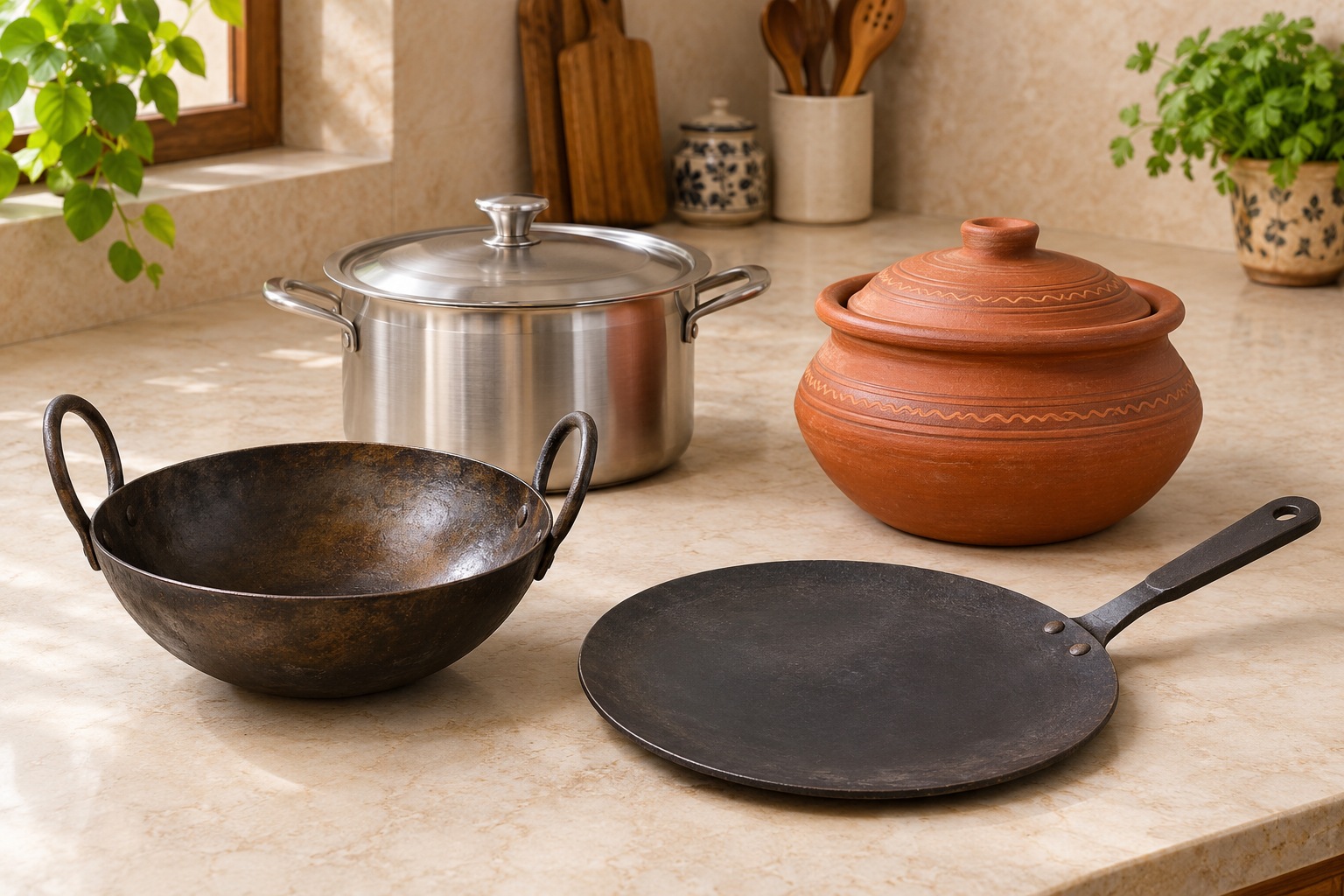
- Iron karahi and tawa displayed with a lidded stainless steel pot and terracotta handi., DailyLife.pk, All rights reserved
