
Ingredients & Spices · The complete guide
Bulgur
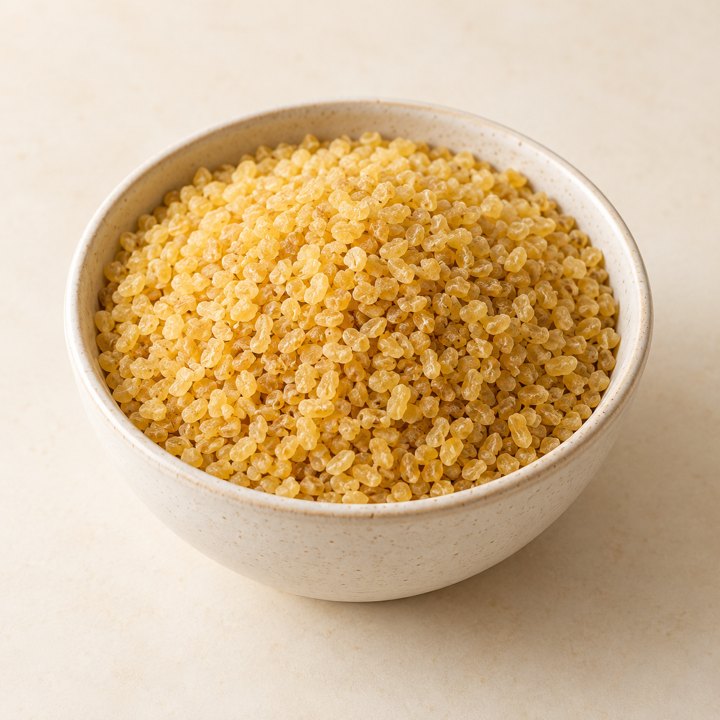
Bulgur is wheat that has been cooked or steamed, dried and cracked into grades ranging from fine to coarse. It is associated especially with Middle Eastern and eastern Mediterranean cuisines.
What it is and what to buy
Bulgur is wheat that has been cooked or steamed, dried and cracked into grades ranging from fine to coarse. It is associated especially with Middle Eastern and eastern Mediterranean cuisines. Fine bulgur is the form commonly used for tabbouleh. Its pre-cooked structure distinguishes it from raw cracked wheat, even when both products look like small golden fragments. Coarse pilaf bulgur needs more cooking and gives a more substantial bite.
Wheat, or gandum in Urdu, is a cereal grass whose edible kernels can be cooked whole, cracked, sprouted or milled. Common bread wheat is Triticum aestivum; durum wheat belongs to the Triticum turgidum group and is particularly associated with coarse semolina. The endosperm supplies starch and gluten-forming proteins, while bran and germ contribute fibre, oils and other nutrients. These milling fractions explain why two products made from wheat can behave very differently in the same recipe.
Origins and food history
Wheat belongs to the early agricultural traditions of Southwest Asia. Kew describes bread wheat as the result of hybridisation between a relative of durum wheat and wild goat-grass, with domestication roughly 10,000 years ago in the wider Caspian region. Farmers selected and exchanged these grains across many generations. That history supports an ancient crop origin, not a claim that a named ruler, physician or modern miller invented wheat or every food made from it.
Reference: Kew: bread wheat.
Growing regions, trade and Pakistan
Wheat is produced in Pakistan, China, India, Russia, the United States, Canada, Australia and many European countries. Pakistan has extensive domestic wheat farming and milling, although imports and government trade decisions vary with harvests and policy. Flour is a processed product, so local milling does not by itself prove local grain origin. For cooking, extraction rate, protein strength, particle size and freshness are often more useful than a general country label.
Reference: CBI: grain market context.
How to prepare and cook it
For tabbouleh, hydrate fine bulgur using the recipe’s measured water or acidic dressing, then drain or fluff as directed. The aim is tender grains without a puddle that dilutes parsley and tomato. Add herbs after washing and drying them well. Taste a few grains rather than assuming all fine grades soften at the same speed. Coarse bulgur generally needs simmering; use the packet’s directions and let it rest before fluffing so the remaining moisture redistributes.
Put this form of the ingredient to work in Tabbouleh. The method in each recipe determines whether it should be raw, soaked, ground, freshly cooked or chilled before it enters the dish.
Nutrition, benefits and their limits
Wheat products supply carbohydrate and some protein. Retaining bran and germ generally raises fibre content compared with a heavily refined flour; enrichment can replace selected nutrients but does not recreate the original grain structure. Gluten gives wheat dough its stretch and ability to trap gas, which is a practical baking property rather than a nutritional requirement. Pair wheat staples with pulses, vegetables, eggs, meat or dairy according to the meal instead of expecting the cereal alone to provide every nutrient.
Allergies, disadvantages and safe handling
All forms of wheat discussed here contain gluten and are unsuitable for coeliac disease. Wheat allergy is a separate condition and also requires avoidance. Sprouting, soaking, roasting and ordinary fermentation do not make wheat reliably gluten-free. Most flour is a raw agricultural food and may carry harmful bacteria; do not taste uncooked dough or batter. Follow a recipe that fully cooks the flour, and clean bowls and worktops after handling it.
Practical substitutions
Cooked couscous offers small grains but is a pasta with a different texture and processing history. Cooked quinoa or suitable rice can make a different gluten-free salad, with adjusted seasoning and liquid. Raw broken wheat should not simply be soaked for the short hydration period intended for fine pre-cooked bulgur.
Keeping it fresh
Keep wheat products in a clean, airtight container away from a hot cooker. Wholegrain and sprouted flours contain more exposed grain oils and benefit from refrigerated or frozen storage in warm climates. Let a sealed chilled container approach room temperature before opening to limit condensation. Discard flour with a stale oily smell, visible mould, damp lumps or insect webbing. A purchase date and regular stock rotation are more dependable than assuming every bag has the same shelf life.
For related ingredients and shopping terms, see the Pakistani ingredients and spices pantry guide.
Names and forms used in our recipes
View the recipe names covered by this guide
- fine bulgur
Frequently Asked Questions
Can I use raw cracked wheat in tabbouleh?
Only with a preparation that fully cooks or hydrates that specific product appropriately. It is not automatically equivalent to fine bulgur.
Is bulgur gluten-free?
No. Bulgur is wheat and retains gluten after pre-cooking and drying.
Keep Exploring
Related places and stories on DailyLife.pk

How we know this
- Type Explainer
- Sources 5 (3 official/academic)
- Reviewed November 2026
- Disputed points None
