
Places to visit
Minar-e-Pakistan: a practical visitor guide
Visit Minar-e-Pakistan: what to see, historical context, getting there, a realistic plan, families and official access checks.
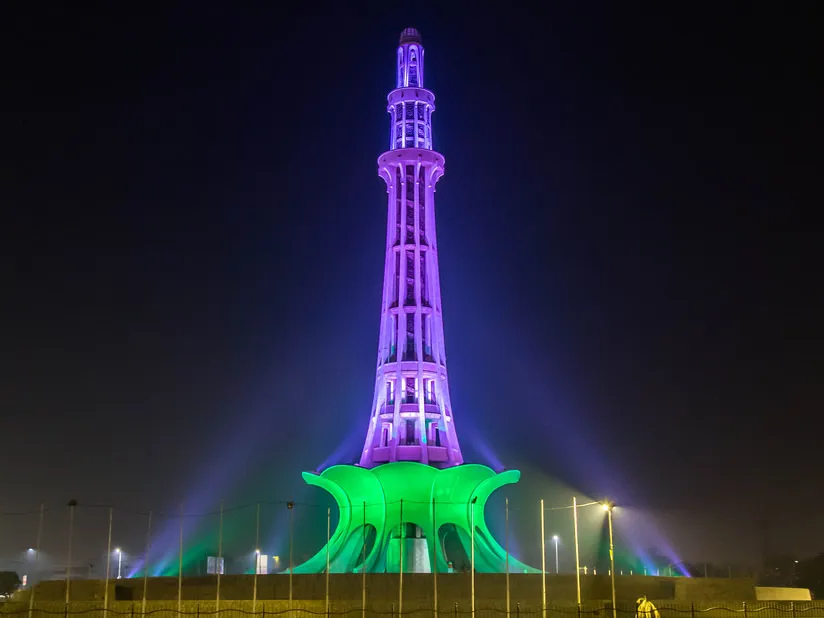
The Minar-e-Pakistan tower illuminated at night in Greater Iqbal Park
Read the monument within its park setting
Minar-e-Pakistan is best approached as a national memorial in a large public landscape, not simply as a tower to photograph from a car. It stands in Greater Iqbal Park near Lahore's historic monumental precinct. Allow roughly an hour to ninety minutes for a focused park-and-monument visit as an editorial estimate, with additional time if you choose a longer walk. This guide does not promise access inside or to an elevated viewpoint. A worthwhile visit can centre on the exterior, the memorial's meaning and its relationship to the nearby city skyline.
The historical event and the later memorial
The Walled City of Lahore Authority identifies the site with the Lahore Resolution of 23 March 1940 and dates completion of the minaret to 1968. Those are separate moments: the political gathering came first, and the built memorial interpreted that history later. Keep the distinction clear when explaining the place to children or writing a photograph caption. The tower should not be described as a structure standing at the original meeting in 1940. Its interest includes the way a later independent state gave a visible architectural form to the memory of that event.
What to look at besides height
Start from a permitted distance where the tower's whole silhouette is visible, then move closer along the public route to examine the base and any accessible inscriptions or panels. Notice how a memorial has to work at two scales: as a recognisable skyline form and as a place read by a person standing beside it. Do not assume every section of the base is open for close inspection. Barriers may protect surfaces or organise visitor flow. Avoid repeating a symbolic explanation for every curve unless an authoritative interpretation supports it; visible form and attributed meaning are different kinds of information.
Explore the places and guides mentioned
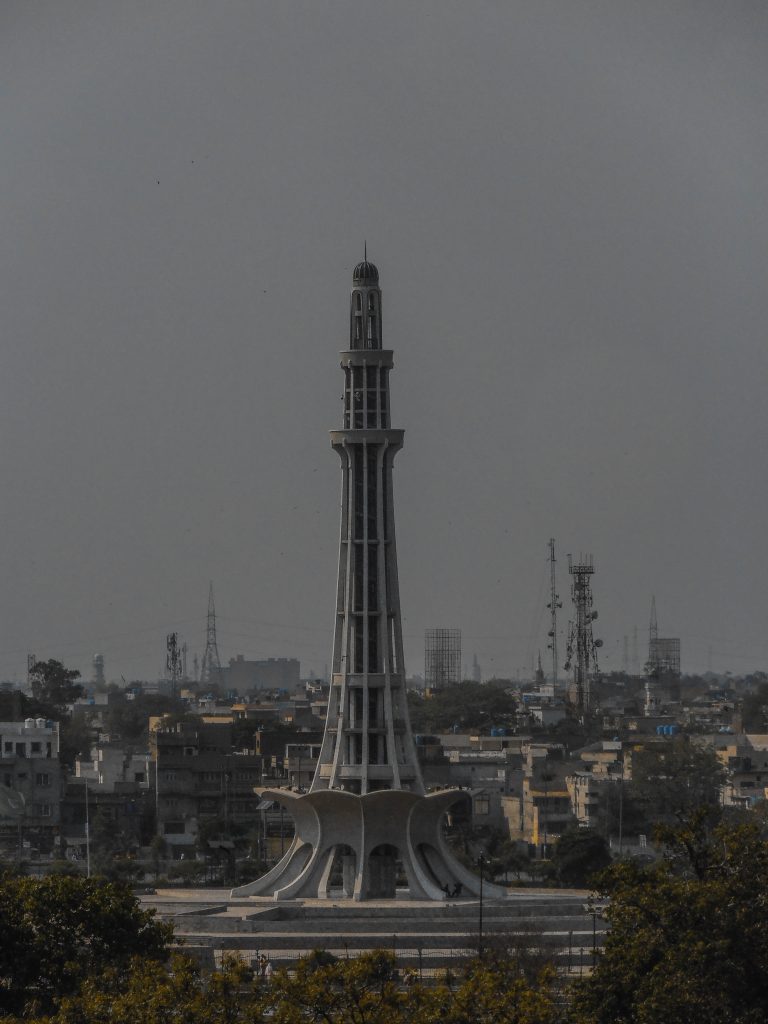
Photographs show the linked places or guide subjects. Open each page for its own visiting and planning information.

Use the skyline to distinguish historical layers
From an authorised viewpoint, compare the memorial's slender form with the broader masses of the nearby fort and mosque. The useful contrast is not a competition about which building is more impressive; it is how different kinds of authority and remembrance become visible in architecture. The minar commemorates a twentieth-century political event, while the older monumental precinct records other patrons and purposes. They share a skyline without sharing one construction history.
That comparison works particularly well for a family because the visible differences are clear before dates are introduced. Ask which building seems designed to be recognised from a distance, which organises a large enclosed space and which needs closer reading of a base or inscription. Then connect those observations with the documented functions. Keep conclusions tied to what you can see and to the authority's interpretation, rather than assigning an unsupported symbolic meaning to every architectural shape.
Park information needs careful filtering
Official provincial pages describe Greater Iqbal Park and list recreational features, but even those pages differ on the park's area and refer to facilities at different stages of development. This guide therefore avoids a precise acreage or a guaranteed list of operating rides, fountains and museum rooms. Use the monument as the fixed purpose of the outing and treat other features as conditional additions. If a particular fountain show, attraction or indoor facility is the main reason you are going, confirm it directly. A historic park overview does not establish today's timetable or service availability.
Getting to a workable gate
Use Minar-e-Pakistan together with Greater Iqbal Park in your destination notes, and ask for a gate suitable for the intended visit. Large park boundaries mean the nearest road point may still leave a substantial walk. Confirm where you can be dropped and collected, especially with young children or an older companion. If combining the visit with Lahore Fort or Badshahi Mosque, identify the actual pedestrian connection and entrances instead of assuming one large open precinct. Each monument's admission and access need separate checking. Do not build a tight itinerary around an assumed shortcut through a controlled gate.
A simple first-visit sequence
Begin with an orientation view and a short discussion of the 1940 event before approaching the memorial. Give time to accessible interpretation and the architecture itself, then take a park break rather than continuing immediately to another demanding heritage attraction. A family can choose one wide view and one close detail to remember. Finish with a view back towards the historic skyline if the permitted paths allow it. This sequence makes the outing coherent even without an interior visit or extra attraction. Adjust the walking distance to the group's stamina instead of making a full circuit obligatory.
Opening, fees and walking conditions
No current park admission amount, tower-entry arrangement or daily timetable is verified in this guide. Check the relevant park authority and any current notices before departure, especially on national holidays or when large events are planned. Ask about the gate in use, last entry and whether the area around the base is accessible. A wheelchair user should ask about the route from the chosen gate to the intended viewpoint, including surfaces, gradients and toilets. A large lawn does not necessarily provide an easy route, and a photograph taken at night does not establish current evening opening or illumination.
Use the official attraction information as your starting point for the enquiries above.
Families and a useful Lahore connection
The monument provides a chance to explain the difference between a political resolution, independence and the later building of memorials. Keep the explanation age-appropriate and connect it to what can actually be seen. Allow for the walk back to the gate; tired children often find that part longer than expected. Read the Lahore city guide and DailyLife's Pakistan Day history page before a broader itinerary. The nearby fort-and-mosque guide can support a separate visit, but there is no need to complete the entire precinct at once. A shorter outing with a clear historical focus is a sensible plan.
For related planning, read Pakistan Day and the Lahore Resolution.
Continue planning your trip
Frequently Asked Questions
Was Minar-e-Pakistan built in 1940?
No. The authority identifies the site with the March 1940 resolution and gives 1968 as the tower’s completion year.
Can I go to the top?
No current elevated-access arrangement is verified here. Plan around the exterior and confirm any interior or tower access directly.
Are fountain shows or rides guaranteed?
No. Official park descriptions are not live operating schedules. Check any particular feature before travelling for it.
How much walking should I expect?
It depends on the gate and route. Confirm the appropriate entrance and allow for the return walk, especially with children or limited mobility.
How we know this
- Type Travel guide
- Sources 2 (1 official/academic)
- Reviewed October 2026
- Disputed points None
Rules and fees change, confirm with the official links below before you act.
2 sources
- Minar-e-Pakistan — official information, Walled City of Lahore Authority, Government of Punjab
- Greater Iqbal Park historical overview, Government of Punjab
Photo credits (2)
- Minar e Pakistan night image.jpg, Holosoft, CC BY-SA 4.0, via Wikimedia Commons
- Night View of Badshahi Mosque (King’s Mosque).jpg, Muhammad Ashar, CC BY-SA 3.0, via Wikimedia Commons
