
Paya Soup
A stovetop goat-trotter broth with ginger, garlic and restrained whole spices
A stovetop goat-trotter broth with ginger, garlic and restrained whole spices. Use professionally cleaned, food-grade trotters cut by the butcher; collagen tenderness takes several hours.
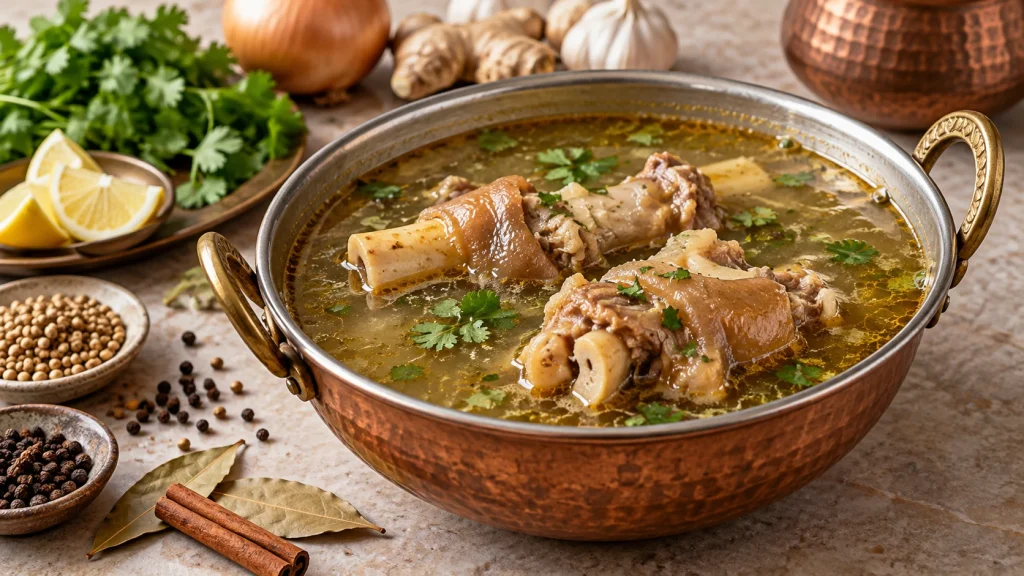
Plan about 300 minutes including 20 minutes preparation, 280 minutes cooking and 0 minutes of separate resting or chilling. Cooking times are ranges: ingredient thickness, pan width and burner strength alter the endpoint. Preparation is counted separately rather than assuming every task overlaps. One tablespoon = 15 ml; one teaspoon = 5 ml.
About Paya Soup
A stovetop goat-trotter broth with ginger, garlic and restrained whole spices. Use professionally cleaned, food-grade trotters cut by the butcher; collagen tenderness takes several hours.
Collagen-rich broth gels when cold. That is expected; it melts back into a broth on reheating and does not mean starch was added.
Personally cooked and tested by Zohair Fakhar for DailyLife.pk. Cooking times can vary with your stove, cookware and batch size; follow the texture and doneness cues in the method.
Make it work for your kitchen
Original quantities serve 4. Cooking times, pan size and frying-oil depth do not scale, cook in extra batches instead.
Before you start
Prepare the batch
Prepare the ingredient cuts listed below and complete the first method stage before moving on. Inspect the cleaned trotters for loose bone fragments; rinse without splashing.
Mise en placeControl liquid and salt
Keep each separately labelled liquid quantity distinct: dough water, cooking liquid, soaking water and top-up allowances serve different purposes. Do not add an allowance automatically.
Batch controlSet up the equipment
Have the following tools ready before starting: Digital kitchen scale and measuring jug; Sharp knife and stable chopping board; Heavy saucepan or pan sized to the batch; Wooden spoon or heatproof spatula.
Clean workspaceMeasure the ingredients
Measure the ingredient quantities for your selected servings before applying heat. Keep separately listed groups, such as dough, filling, sauce or garnish, in separate containers; keep any optional additions separate.
Use the ingredient list above
Step-by-step cooking method
1 Inspect and blanch
Inspect the cleaned trotters for loose bone fragments; rinse without splashing.
2 Inspect and blanch (continued)
Cover with the 1500 ml preliminary water in a large pot, boil 5 minutes, drain and rinse the pot. This improves clarity; it does not replace thorough cooking.
3 Build broth
Return trotters to the clean pot with 2800 ml water, onion, ginger, garlic, coriander seeds, peppercorns, bay and cinnamon. Bring slowly to a simmer and skim foam.
4 Cook gently
Partly cover and simmer 3–4 hours. Check every 30 minutes, stirring along the base and adding measured top-up water as necessary to keep the trotters mostly covered. Avoid reducing to a sticky glaze.
5 Judge tenderness
The connective tissue should be soft and yielding, and separate readily from the bone.
6 Judge tenderness (continued)
If rubbery, keep simmering and recheck in 20 minutes. Time varies with animal age and size; do not treat the lower estimate as a guarantee.
7 Strain and finish
Lift trotters out, strain broth and remove loose bones carefully. Return edible soft tissue and larger safe-to-handle pieces to the pan.
8 Strain and finish (continued)
Add salt and warm through; finish bowls with lemon and coriander. Warn diners to check for bones.
Chef’s tips
- Collagen-rich broth gels when cold. That is expected; it melts back into a broth on reheating and does not mean starch was added.
Common mistakes & quick fixes
- The mixture catches at the bottom.
- Lower the heat and stir along the base. If food has scorched, transfer the unburnt portion to a clean pan without scraping the burnt layer into it.
- The final texture is too thick.
- Add the listed top-up liquid in small increments, let it heat through, and check seasoning again. If there is no top-up allowance, use the texture correction specified in the steps.
Variations & serving ideas
Chosen version: A stovetop goat-trotter broth with ginger, garlic and restrained whole spices. Use professionally cleaned, food-grade trotters cut by the butcher; collagen tenderness takes several hours.
Seasoning adjustment: Keep the main ingredient and technique unchanged when adjusting chilli or finishing herbs. Substitute packaged sauces only after checking salt content and allergens.
Perfect result check
| Main ingredient | The connective tissue should be soft and yielding, and separate readily from the bone. If rubbery, keep simmering and recheck in 20 minutes. Time varies with animal age and size; do not treat the lower estimate as a guarantee. |
|---|---|
| Finished batch | Lift trotters out, strain broth and remove loose bones carefully. Return edible soft tissue and larger safe-to-handle pieces to the pan. Add salt and warm through; finish bowls with lemon and coriander. Warn diners to check for bones. |
Storage & reheating
| Covered and chilled | Refrigerate within 2 hours; use within 48 hours | Divide into shallow portions for rapid cooling. Reheat once until steaming hot throughout, stirring to eliminate cool pockets. |
|---|---|---|
| Freeze if suitable | Best quality within one month | Freeze in labelled meal portions after prompt cooling. Defrost in the refrigerator and reheat thoroughly once. |
Know when to change the heat
| Stage | Heat | What to look for |
|---|---|---|
| Inspect and blanch | High heat | Inspect the cleaned trotters for loose bone fragments; rinse without splashing. |
| Build broth | Medium heat | Return trotters to the clean pot with 2800 ml water, onion, ginger, garlic, coriander seeds, peppercorns, bay and cinnamon. |
| Cook gently | Low heat | Partly cover and simmer 3–4 hours. |
| Judge tenderness | Low heat | The connective tissue should be soft and yielding, and separate readily from the bone. |
| Strain and finish | Low heat | Lift trotters out, strain broth and remove loose bones carefully. |
Helpful answers before you cook
Why use butcher-cleaned trotters?
The recipe does not validate home singeing or chemical cleaning and assumes a food-grade prepared cut.
Why is cold paya broth jelly-like?
Collagen sets when chilled and melts again on reheating; no starch is required.
What if tissue is still rubbery?
Continue gentle moist cooking in intervals. Animal age and trotter size make a fixed short time unreliable.


