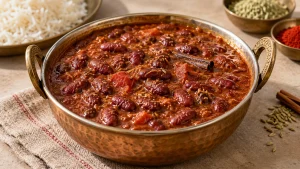
Kashmiri Dum Aloo
Small fried potatoes finished under a lid in a yogurt, fennel, dry-ginger and Kashmiri-chilli gravy
Small fried potatoes finished under a lid in a yogurt, fennel, dry-ginger and Kashmiri-chilli gravy. This no-onion/no-garlic dum aloo version uses fully cooked potatoes before the covered finishing stage.

For the original four-person batch, plan about 91 minutes: 25 minutes preparation and roughly 66 minutes cooking. Count the listed 15-minute potato-preparation stage within preparation, rather than adding it again. The cooking-stage allowances are 30 minutes frying in batches, 8 minutes for the yogurt sauce, 25 minutes covered finishing and 3 minutes for the final check. Oil heating, draining, potato size, pan capacity and extra batches can extend the plan. The 12–18 minute frying range applies to each batch, and the potatoes must be tender through the centre before the covered finish. These are planning allowances, not measured guarantees. One tablespoon = 15 ml; one teaspoon = 5 ml.
About Kashmiri Dum Aloo
Small fried potatoes finished under a lid in a yogurt, fennel, dry-ginger and Kashmiri-chilli gravy. This no-onion/no-garlic dum aloo version uses fully cooked potatoes before the covered finishing stage.
The covered dum stage flavours potatoes; it should not be relied on to rescue very large raw potatoes after the gravy has already thickened.
Personally cooked and tested by Zohair Fakhar for DailyLife.pk. Cooking times can vary with your stove, cookware and batch size; follow the texture and doneness cues in the method.
Make it work for your kitchen
Original quantities serve 4. Cooking times, pan size and frying-oil depth do not scale, cook in extra batches instead.
Before you start
Prepare the batch
Measure the ingredients for your selected servings before starting. Choose peeled potatoes close to the listed 3 cm size, with unusually large ones set aside or cut to match. Have the drying towels, fork or thin skewer and draining rack ready before heating the frying oil.
Mise en placeControl liquid and salt
Keep the initial gravy water separate from the top-up allowance. The initial water starts the covered finishing stage; use the allowance only in small additions if the sauce needs it. Keep the frying working oil separate from the measured gravy oil, and keep the selected salt for the gravy.
Batch controlSet up the equipment
Set out the scale, measuring jug, peeler or knife, board, fork or thin skewer, drying towels, deep heavy frying pan, oil thermometer, slotted spoon and draining rack over a tray. Have the yogurt bowl, whisk, heavy gravy pan with its well-fitting lid and stirring spoon ready.
Clean workspaceMeasure the ingredients
Measure the yogurt and ground spices separately from the shahi jeera, black cardamom, cinnamon and asafoetida used in the gravy-oil stage. For the gravy, choose either the listed food-grade mustard oil or its neutral-oil alternative, not both. Keep the frying-oil supply, initial water and top-up allowance distinct.
Use the ingredient list above
Step-by-step cooking method
1 Prepare potatoes
Prepare the small potatoes measured for your selected servings, choosing similar sizes so they cook evenly. Dry the peeled potatoes thoroughly and prick all over with a fork or thin skewer. Set aside any unusually large ones or cut them to match the others.
2 Fry
The frying oil is a working supply for the pan, not a per-person addition to the gravy. Choose the pan and working oil together so the potatoes can fry in uncrowded batches with ample headroom; do not scale the oil depth with servings or add the whole supply automatically. Use the oil thermometer to heat the frying oil to about 160°C. Fry in uncrowded batches for 12–18 minutes, turning until golden and tender through the centre. Drain on the rack. Do not add wet potatoes to hot oil, and allow extra batches when needed.
3 Cook yogurt sauce
Whisk the plain full-fat yogurt, Kashmiri chilli powder, ground fennel and dry ginger powder measured for your selected servings together in the bowl. In the heavy gravy pan, warm the selected food-grade mustard oil or the same measured volume of its neutral-oil alternative. Briefly sizzle the selected shahi jeera, black cardamom, cinnamon stick and asafoetida in this gravy oil.
4 Cook yogurt sauce (continued)
Lower heat and add yogurt gradually, stirring continuously until steaming and gently simmering. Cook 5 minutes.
5 Dum finish
Add the fried potatoes that are already tender through the centre, the salt measured for your selected servings and the full selected water quantity labelled as initial gravy. Keep the separate top-up allowance aside. Cover tightly and simmer on the lowest steady heat for 20–25 minutes.
6 Dum finish (continued)
Move the pan carefully from side to side occasionally. If the gravy begins to catch, lower the heat and use only the needed amount of the separate measured top-up water in small additions. Keep track of what remains for the final texture adjustment. The gravy should coat the cooked potatoes thickly.
7 Check
Pierce a central potato: it should be soft, not chalky.
8 Check (continued)
Uncover briefly on low heat if the gravy is watery, or loosen it with only the needed remaining top-up water if too thick. Divide the cooked potatoes and clinging sauce among the selected number of people, and remove the whole spices while portioning.
Chef’s tips
- The covered dum stage flavours potatoes; it should not be relied on to rescue very large raw potatoes after the gravy has already thickened.
Common mistakes & quick fixes
- The mixture catches at the bottom.
- Lower the heat and stir along the base. If food has scorched, transfer the unburnt portion to a clean pan without scraping the burnt layer into it.
- The final texture is too thick.
- Add the listed top-up liquid in small increments, let it heat through, and check seasoning again. If there is no top-up allowance, use the texture correction specified in the steps.
Variations & serving ideas
Chosen version: Small fried potatoes finished under a lid in a yogurt, fennel, dry-ginger and Kashmiri-chilli gravy. This no-onion/no-garlic dum aloo version uses fully cooked potatoes before the covered finishing stage.
Seasoning adjustment: Keep the main ingredient and technique unchanged when adjusting chilli or finishing herbs. Substitute packaged sauces only after checking salt content and allergens.
Perfect result check
| Potato centres | A fork or thin skewer enters the centre of a potato easily, with no firm or chalky core. Check that the potatoes are tender after frying, before they enter the covered gravy stage. A golden outside alone does not establish that the centre is cooked. |
|---|---|
| Finished yogurt gravy | The gravy clings thickly to the cooked potatoes without a watery pool or a dry, caught coating. The potatoes remain soft through the centre. Adjust with only the needed remaining measured allowance, and remove the whole spices while portioning. Texture does not establish the finished batch weight or frying-oil uptake. |
Storage & reheating
| Covered and chilled | Refrigerate within 2 hours; use within 48 hours | Divide the potatoes and yogurt gravy into shallow portions for rapid cooling and refrigerate within 2 hours. Reheat only the portion needed once until steaming hot throughout, including the centres of the potatoes. Move the sauce carefully around the potatoes to distribute heat, and keep the rest refrigerated. |
|---|---|---|
| Freeze if suitable | Best quality within one month | Freeze in labelled meal portions after prompt cooling. Defrost in the refrigerator and reheat thoroughly once. |
Know when to change the heat
| Stage | Heat | What to look for |
|---|---|---|
| Prepare potatoes | No heat | The peeled potatoes are similar in size, thoroughly dry and pricked before frying. This preparation stage uses no heat; keep wet potatoes away from the frying pan. |
| Fry | Medium heat | Use the thermometer to follow the method’s approximate 160°C oil target. Fry in uncrowded batches until golden and tender through the centre; check the centre rather than relying on colour or the clock alone. Keep the pan’s ample headroom and drain the cooked potatoes on the rack. |
| Cook yogurt sauce | Low heat | Keep the gravy pan over low heat as the yogurt mixture is added gradually and stirred continuously. The sauce becomes steaming and begins to simmer gently; avoid a hard boil and watch the base so the spices do not scorch. |
| Dum finish | Very low heat | The already-tender potatoes sit in a gently moving gravy under the well-fitting lid. Use the lowest steady heat and check that the sauce is not catching; the separate top-up allowance is used only as needed. |
| Check | Low heat | A central potato is soft rather than chalky and the gravy clings to it. Briefly uncover on low heat if the sauce is watery, or loosen it with only the needed remaining allowance if too thick. |
Helpful answers before you cook
Why prick the potatoes?
This method pricks the prepared potatoes before frying. Keep them similar in size and thoroughly dry, and check the centre is tender after frying. Pricking and a golden surface do not replace that centre check.
Must potatoes be cooked before dum?
For this formulation, fry until the potatoes are tender through the centre before adding them to the gravy. The covered stage finishes them in the sauce; do not depend on it to cook a firm or chalky core after the gravy has thickened. The reference provides dish context, not a test of these batch quantities or timings.
Why does yogurt gravy split?
Whisk the yogurt smooth and follow this method’s gradual addition, low heat and continuous stirring as the sauce heats. Keep the simmer gentle and watch the pan base. These handling cues do not guarantee an identical texture with every yogurt brand, pan or stove.