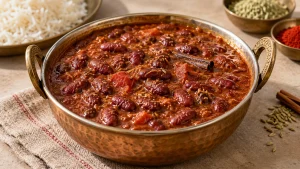
Gushtaba
Large finely processed lamb meatballs in a pale fennel-yogurt gravy
Large finely processed lamb meatballs in a pale fennel-yogurt gravy. This gushtaba is a cold food-processor adaptation, not a claim to reproduce the texture of traditionally hand-pounded warm meat.

For the original eight-person batch, plan about 115 minutes: 45 minutes preparation and roughly 70 minutes cooking. Count the listed 15-minute cold-processing stage and 15-minute shaping stage within preparation, rather than adding them again. The cooking-stage allowances are 35 minutes poaching, 12 minutes for the yogurt gravy and 15 minutes finishing, with the remainder of the 70-minute allowance covering heating, lifting and straining. Actual chilling time, equipment capacity and extra batches can extend the plan. The 25–35 minute poaching range is a guide; use the method’s thermometer endpoint rather than the clock or floating alone. These are planning allowances, not measured guarantees. One tablespoon = 15 ml; one teaspoon = 5 ml.
About Gushtaba
Large finely processed lamb meatballs in a pale fennel-yogurt gravy. This gushtaba is a cold food-processor adaptation, not a claim to reproduce the texture of traditionally hand-pounded warm meat.
A smooth cold emulsion is essential. Standard coarse mince rolled into balls makes a pleasant kofta but does not give the intended fine springy texture.
Personally cooked and tested by Zohair Fakhar for DailyLife.pk. Cooking times can vary with your stove, cookware and batch size; follow the texture and doneness cues in the method.
Make it work for your kitchen
Original quantities serve 8. Cooking times, pan size and frying-oil depth do not scale, cook in extra batches instead.
Before you start
Prepare the batch
Measure the ingredients for your selected servings before starting. Have the lean lamb trimmed of tough sinew and cut into the listed 2 cm cubes, with the fat in 1 cm pieces. Keep both very cold and have the processor bowl and blade chilled before processing.
Mise en placeControl liquid and salt
Keep the ice-cold processing water, poaching water and sauce top-up allowance in separate containers. Divide the selected salt total into five eighths for processing and three eighths reserved for the sauce. Do not add the full salt total to the meat mixture or add a water allowance automatically.
Batch controlSet up the equipment
Have the chilled processor, scale, measuring jug, clean bowls and covered refrigerated tray ready. Set out the wide poaching pan and lid, slotted spoon, heatproof strainer, clean receiving vessel, heavy yogurt pan, whisk, spoon and instant-read food thermometer.
Clean workspaceMeasure the ingredients
Keep the meat-processing ingredients separate from the whole spices for poaching and the yogurt-gravy ingredients. Reserve the sauce portion of salt and dried mint for finishing. Keep the measured water supplies labelled by their separate roles.
Use the ingredient list above
Step-by-step cooking method
1 Keep meat cold
Chill processor bowl and blade. Trim all visible tough sinew from lamb.
2 Keep meat cold (continued)
Process the lean boneless lamb leg and lamb fat measured for your selected servings in small batches that fit the processor without crowding. Use five eighths of the measured salt, the selected ground black cardamom seeds and ground cumin, and the selected ice-cold water labelled for meat processing. Use short pulses followed by brief continuous bursts until smooth and tacky. Stop and refrigerate if the mixture warms or fat smears. Reserve the other three eighths of the salt for the sauce.
3 Shape carefully
Divide the finished cold mixture into equal portions, making one large meatball for each selected person. Pour a small portion of the measured sauce top-up allowance into a separate bowl to wet your hands, then shape the balls firmly without cracks or trapped air. Discard any hand-wetting water left in that bowl; do not return it to the sauce supply. Keep the shaped balls refrigerated while heating the poaching liquid.
4 Poach
Bring the selected water labelled as poaching liquid to a bare simmer in the wide pan with the selected green cardamom and cinnamon stick. Lower the balls in gently and partly cover; use extra batches if the pan would be crowded.
5 Poach (continued)
Poach 25–35 minutes, turning once carefully. Check the centre of a large ball reaches 71°C; floating is not the doneness test. Lift out and strain liquid.
6 Cook yogurt gravy
Whisk the plain full-fat yogurt, ground fennel and dry ginger powder measured for your selected servings together in the heavy sauce pan.
7 Cook yogurt gravy (continued)
Add the neutral oil measured for your selected servings and heat slowly, stirring continuously until steaming and gently simmering. Cook for 5 minutes, then gradually whisk in warm strained poaching liquid to make a pourable sauce. For planning, use a volume from one third to five twelfths of the selected poaching-water quantity; add only as much as the sauce needs, allowing for evaporation. Use the remaining clean sauce top-up water only if needed, excluding any portion already used for hand wetting.
8 Finish gushtaba
Return the poached meatballs to the yogurt gravy and simmer very gently for 10–15 minutes, spooning sauce over them. Add only as much of the reserved three eighths of the measured salt as needed, and add the dried mint measured for your selected servings. Keep the gravy pale and smooth rather than reducing it to a dry coating. Serve one large ball per selected person.
Chef’s tips
- A smooth cold emulsion is essential. Standard coarse mince rolled into balls makes a pleasant kofta but does not give the intended fine springy texture.
Common mistakes & quick fixes
- Meatballs crack or become grainy.
- Remove sinew, keep meat and fat cold and process to a tacky paste before shaping. Avoid vigorous boiling.
- Gravy reduces before balls finish.
- Keep a quiet simmer and use measured allowance gradually; avoid breaking balls with forceful stirring.
Variations & serving ideas
Chosen version: Large finely processed lamb meatballs in a pale fennel-yogurt gravy. This gushtaba is a cold food-processor adaptation, not a claim to reproduce the texture of traditionally hand-pounded warm meat.
Seasoning adjustment: Keep the main ingredient and technique unchanged when adjusting chilli or finishing herbs. Substitute packaged sauces only after checking salt content and allergens.
Perfect result check
| Poached meatballs | Use the method’s thermometer check at the centre of a large meatball: it must reach at least 71°C. Floating, a pale surface or a springy texture does not replace this check. Keep the poaching liquid at a quiet simmer so the balls are handled gently. |
|---|---|
| Finished gravy | The yogurt gravy is pale, smooth and pourable around the meatballs, without reducing to a dry coating. Spoon it carefully over the balls. Sauce texture does not establish the measured gravy volume or the meatballs’ centre temperature. |
Storage & reheating
| Covered and chilled | Refrigerate within 2 hours; use within 48 hours | Divide the meatballs and yogurt gravy into shallow portions for rapid cooling and refrigerate within 2 hours. Reheat only the portion needed once until steaming hot throughout, including the centres of the meatballs. Move the sauce carefully around the balls to distribute heat without breaking them; keep the rest refrigerated. |
|---|---|---|
| Freeze if suitable | Best quality within one month | Freeze in labelled meal portions after prompt cooling. Defrost in the refrigerator and reheat thoroughly once. |
Know when to change the heat
| Stage | Heat | What to look for |
|---|---|---|
| Keep meat cold | No heat | The meat mixture stays cold while it becomes smooth and tacky. If it warms or fat smears, stop processing and refrigerate as directed; this stage uses no heat. |
| Shape carefully | No heat | The shaped balls have an even surface without visible cracks. Keep them refrigerated while the poaching liquid heats; shaping itself uses no heat. |
| Poach | Bare simmer | Small, quiet bubbles move through the poaching liquid without a rolling boil. Handle the balls gently, and use the method’s 71°C centre-temperature check rather than floating as the endpoint. |
| Cook yogurt gravy | Low heat | The continuously stirred yogurt base becomes steaming and begins to simmer gently. Add warm strained poaching liquid gradually until pourable, avoiding a hard boil or heavy reduction. |
| Finish gushtaba | Low heat | The gravy moves gently around the meatballs while sauce is spooned over them. It stays pale and pourable; avoid vigorous stirring that could break the balls. |
Helpful answers before you cook
Why process lamb with fat while cold?
This home adaptation uses cold equipment, very cold lamb and fat, and the processing sequence in the method. Stop and refrigerate if the mixture warms or fat smears. The regional reference describes fine meat-and-fat preparation, including a hand-pounded method; it does not validate this cold-processor formula or guarantee the same texture.
Are ordinary kofta equivalent?
The intended texture here is a finely processed, smooth and tacky mixture before shaping. A coarser mince can give a different result. Texture and appearance are not doneness tests: follow the thermometer instruction during poaching.
What distinguishes the gravy?
This formulation uses full-fat yogurt, fennel and dry ginger for a pale gravy, finished with dried mint. Heat the yogurt slowly while stirring and add warm strained poaching liquid gradually. The final consistency is pourable, rather than a thick coating; an exact gravy volume has not been established.