
Wildlife
The Indus River Dolphin: A Blind Dolphin in a Brown River
One of the world's rarest dolphins lives only in the Indus: how it survives without sight, why barrages divided its range, and what recent counts do and do not tell us.
- Platanista minor
- IUCN: Endangered (2022 assessment)
- Indus River, mostly Sindh
- Freshwater, nearly blind
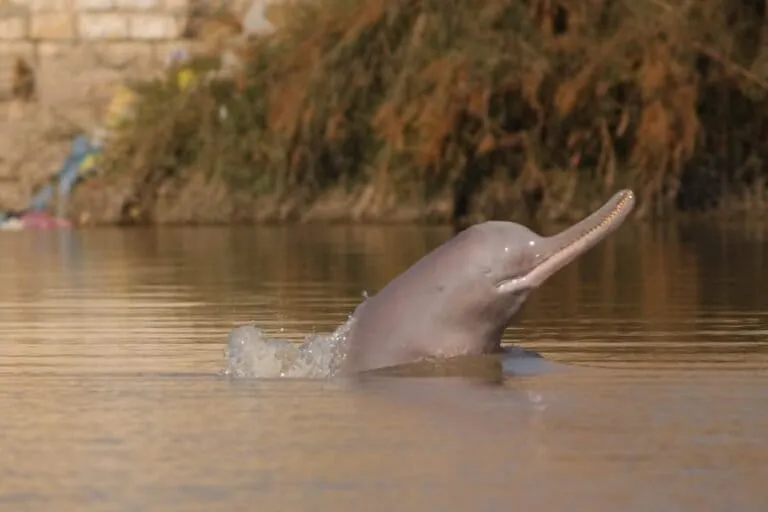
Indus river dolphin, Sindh
About the Indus River Dolphin
The Indus river dolphin, known locally as the bhulan, lives nowhere else on Earth except the Indus basin. It is a freshwater dolphin with a long, slender beak and a body that looks grey-brown in the silty water. Its eyes are tiny and it lacks a true lens, so it cannot form images; it senses light and dark, and finds fish and the riverbed by echolocation, sending out clicks and listening for the echoes. It often swims on its side, which is thought to help in shallow water, and it must surface to breathe every few minutes.
Until 2021 the Indus and Ganges dolphins were treated as subspecies of a single South Asian river dolphin. A 2021 taxonomic revision in Marine Mammal Science by Braulik and colleagues showed they are separate species, so the Indus form now stands as Platanista minor. The IUCN lists it as Endangered; the most recent assessment was carried out in 2022 and the errata version published in 2023.
The great majority of surviving dolphins live in Pakistan. The largest concentration is in Sindh, between the Guddu and Sukkur barrages, where the river is wide, deep and rich in fish. Smaller groups live farther upstream in Punjab and Khyber Pakhtunkhwa. Because the species is found only in the Indus, protecting it is a national responsibility with international weight.
A dolphin that cannot see its river has had to learn it entirely by sound.
How It Lives
Range, Barrages and the Dolphin Reserve
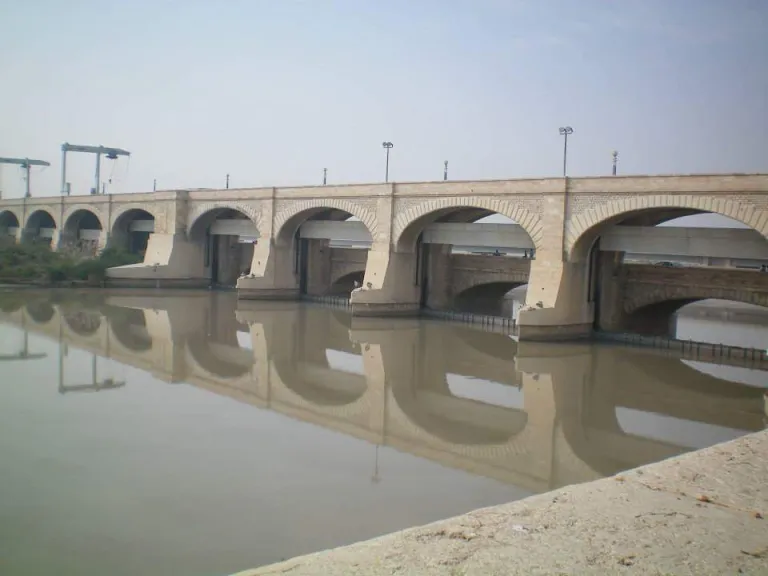
Historically the dolphin ranged through some 3,400 kilometres of the Indus and its tributaries. According to summaries of Braulik's research, the range has shrunk by roughly 80 per cent since 1870, to about 690 kilometres, and the dolphin has disappeared from the tributaries. The cause is mainly the barrages and dams that supply Pakistan's vast irrigation system. Barrages split the river into isolated stretches, cut off fish migration and reduce the flow that dolphins need, especially in the dry months. The Sukkur Barrage opened in 1932 and Guddu was one of five barrages built in Pakistan between 1946 and 1971.
The Indus Dolphin Reserve protects a 170 km stretch of the Indus in Sindh, covering 125,000 hectares, and was designated a Ramsar wetland of international importance on 10 May 2001, according to the Ramsar Sites Information Service. It lies in the same Guddu to Sukkur section that holds the largest dolphin concentration.
What the Counts Say
| Year | Count | Source and note |
|---|---|---|
| 2017 | Roughly 1,800 to 2,000 | WWF-linked survey, about 1,800 per Wikipedia and close to 2,000 per River Dolphins Org |
| 2021 | About 2,100 | Sindh Wildlife Department figure reported by Al Jazeera in January 2024 |
Counts from different years use different methods, survey lengths and conditions, so the figures should not be read as a precise trend. Summaries of the research describe an increasing overall trend over recent decades, linked to hunting bans and other protection measures. Sources: River Dolphins Org, Wikipedia, Al Jazeera.
Threats
The pressures on the dolphin are interconnected. Fishing nets entangle and drown animals. Barrages and canals change flows, and dolphins can enter irrigation canals and become stranded in shallow water, where they need to be rescued. Pollution from households, industry and agriculture, including heavy metals, affects the river's fish. Water diversion to canals reduces river flows, especially in dry months. The consequences are small, fragmented groups that cannot easily interbreed, which is why conservation scientists emphasise connectivity as much as numbers.
The fishing communities who share the river are essential partners. Al Jazeera's 2024 report quotes a climate activist urging that fishing families' concerns be heard because their lives are tied to the river. Their cooperation is essential to any plan to reduce entanglement.
Seeing Dolphins Responsibly
Dolphins are most often seen by boat in the Guddu to Sukkur reach, where the density is highest, usually as a quick glimpse of a beak and back as the animal surfaces. If you hire a boat:
- Ask local fishers or the Sindh Wildlife Department about safe, established viewing practice.
- Keep speeds low, avoid circling or chasing, and cut the engine when animals are near.
- Never throw anything into the water or touch a stranded animal; report strandings and entanglements to the wildlife department.
Sukkur is also the place to see the barrage itself and the island temple complex of Sadhu Bela, both described on separate pages.
Frequently Asked Questions
Is the Indus river dolphin blind?
It is effectively blind: it lacks a true lens and can only sense light and its direction. It navigates and hunts by echolocation.
Is the Indus dolphin endangered?
Yes. The IUCN lists the species as Endangered, in an assessment carried out in 2022 and published with errata in 2023.
Where can I see Indus dolphins?
Mainly in the Indus between the Guddu and Sukkur barrages in Sindh, where the largest group lives. Sightings are brief and never guaranteed.
How many are there?
A 2017 survey reported roughly 1,800 to 2,000 and the Sindh Wildlife Department figure reported in 2024 was about 2,100 from 2021. Methods differ, so treat both as approximate.
What is the Indus Dolphin Reserve?
A 170 km stretch of the Indus in Sindh, 125,000 hectares, designated a Ramsar site on 10 May 2001.
Keep Exploring
Related places and stories on DailyLife.pk
 Sadhu Bela and Sukkur BarrageSadhu Bela and Sukkur Barrage guide: the Udasi temple island in the Indus
 Keenjhar LakeVisit Keenjhar Lake near Thatta: Ramsar wetland, winter birds, Noori Jam Tamachi shrine, boating, STDC resort
 Haleji LakeHaleji Lake near Thatta: Ramsar wetland and bird sanctuary, winter waterbirds, how it was made
 Wildlife of PakistanPakistan's wildlife: markhor (national animal), snow leopard, Indus river dolphin, Himalayan brown bear, ibex
 Rivers and Lakes of PakistanPakistan's rivers and lakes: the Indus and its tributaries, the Indus Waters Treaty, Attabad, Saiful MulukRamsar Wetlands of PakistanList of Pakistan's 19 Ramsar sites with designation dates, areas and provinces
How we know this
- Type Explainer
- Sources 4
- Reviewed October 2026
- Disputed points None
4 sources
- Indus river dolphin, River Dolphins Org
- Indus river dolphin (used to locate the IUCN 2022 assessment and Braulik et al. 2021), Wikipedia
- Can Pakistan's Indus River dolphins be saved?, Al Jazeera, 7 January 2024
- Ramsar Sites annotated summary: Pakistan, Ramsar Sites Information Service
Photo credits (5)
- Indus river Dolphin , The National Aquatic Animal of Pakistan.jpg, Shiana1, CC0, via Wikimedia Commons
- Sukkur Barrage in daylight.jpg, Ashahid83, CC BY-SA 4.0, via Wikimedia Commons
- Halaji Lake.jpg, Iqran Rasheed, CC BY-SA 4.0, via Wikimedia Commons
- Indus River Skardu Pakistan.jpg, Akhtar Bashir Nigyaal, CC BY-SA 4.0, via Wikimedia Commons
- Snow Leopard In Naltar Gilgit.jpg, Nazir Baig, CC BY-SA 4.0, via Wikimedia Commons
