
Travel · Attractions
Read the stone, script and setting together
Study Ashoka’s third-century BCE rock edicts through their Kharosthi script, two-boulder setting, archival documentation and conservation needs, with current Mardan travel advice kept explicit.
- Identify the script
- Check current advice
- Study the setting
Shahbazgarhi, Mardan district
Begin with writing in a landscape, and the current advice
Shahbazgarhi's rock edicts preserve a form of imperial communication that depended on a durable natural surface. To understand them, begin with the relationship between boulder, incised writing and setting, rather than expecting a temple façade or a freestanding pillar. For UK audiences, the FCDO advises against all but essential travel to Mardan district, as checked on 7 November 2026. This is a heritage study guide, not a recommendation for a leisure journey against that advice.
The site is in Mardan, not Peshawar city. The distinction matters because advisories apply to named districts and routes, not simply to a province as one uniform area. Published official descriptions and archival records allow a substantial remote introduction. Any independently authorised local observation requires current permission and route checks; a photograph of a visitor standing beside a boulder does not establish today's admission arrangements.
Place Ashoka and the inscriptions in the third century BCE
Pakistan's UNESCO Tentative List description attributes the inscriptions to the Mauryan emperor Ashoka and dates them to the middle of the third century BCE. That is the appropriate level of precision for this introduction. A broad epigraphic date should not be silently converted into the exact year when a particular line was cut.
The edicts belong to an extensive programme of royal inscriptions, but each surviving version has its own material setting and textual history. Shahbazgarhi should therefore be identified by name when discussing its evidence. A translation from another edict location is not automatically a translation of the words preserved here. The site's significance also does not depend on an absolute claim that no earlier writing existed in South Asia. The Archaeological Survey of India distinguishes early decipherable Ashokan inscriptions from the much earlier, still undeciphered Indus material.
Recognise Kharosthi, and keep script separate from language
The decisive script identification is Kharosthi, also spelled Kharoshthi: the Shahbazgarhi inscriptions run from right to left. Pakistan's UNESCO submission and the Archaeological Survey of India's epigraphy introduction both support this identification. It is misleading to label the site Brahmi simply because Brahmi appears so often in general accounts of Ashoka's inscriptions.
A script is a writing system, while a language is the speech represented through it. Identifying the former does not mean an observer can translate the latter. Letter shapes seen in a photograph should be checked against a specialist edition, not matched casually to modern Urdu, Sanskrit lettering or a decorative font. Even the direction of writing should be taken from the published identification if the photograph is reversed or cropped. This guide reproduces no invented ancient characters and offers no reconstruction of missing words.
Archaeological Survey of India, Bharat SHRI: Epigraphy: Early Scripts and Kharoshthi.
Read the boulders as distinct surfaces
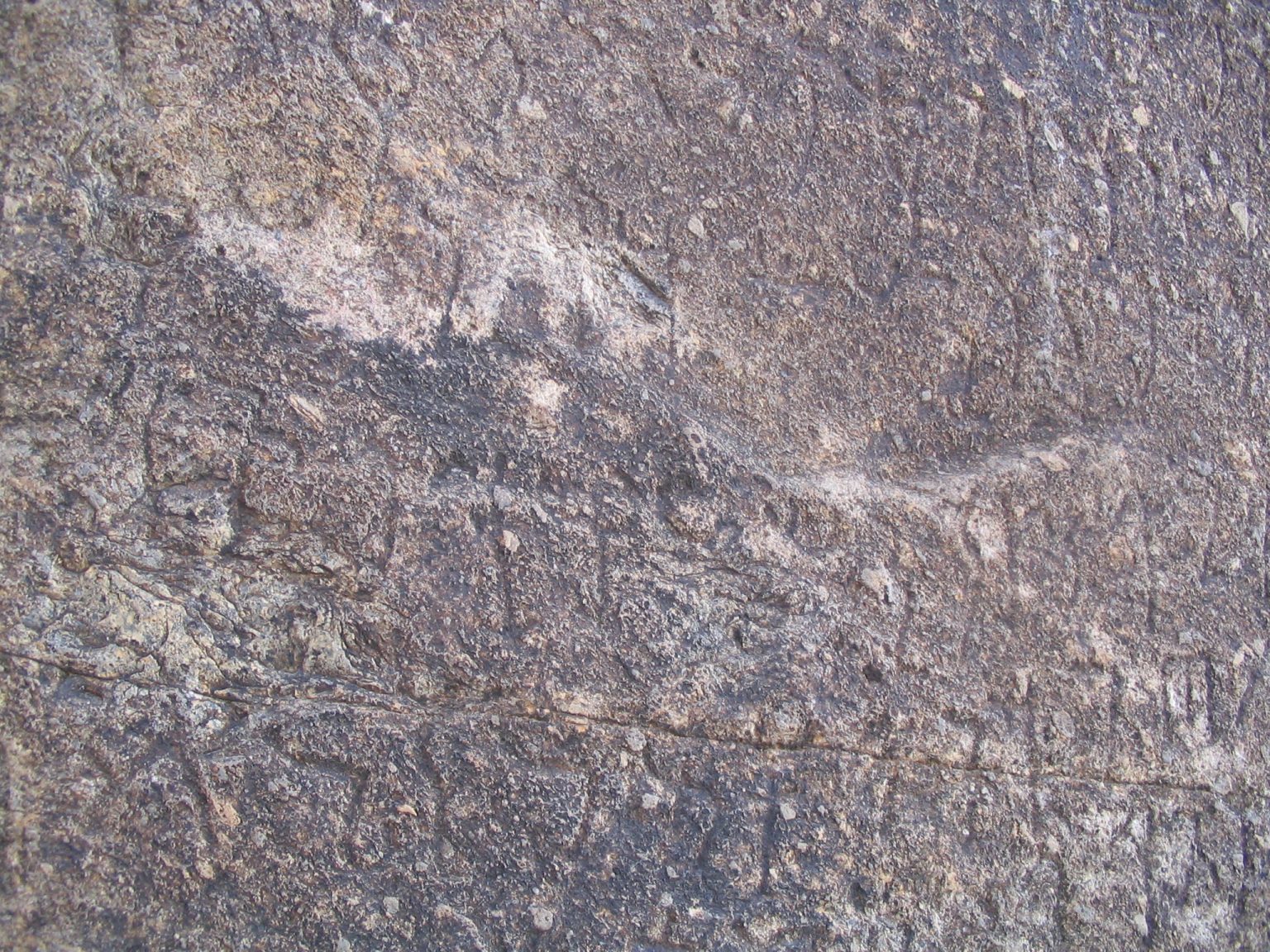
The Tentative List description records fourteen edicts on two large boulders beside a small rocky outcrop. Fourteen is a textual count; it should not be read as fourteen separate standing stones, fourteen chambers or fourteen identical panels. Begin with a wide view that establishes the rock and its surroundings before turning to a detail of the writing.
The British Library catalogue identifies an archival view of the eastern face bearing edicts I–XI. Its record also describes evidence on another face, reminding readers that one convenient photograph cannot stand for the complete inscriptional arrangement. Use a reliable location label to distinguish a face of the main rock from the other boulder. Do not infer the total text from whatever happens to be visible in a hero image. Captioning the object, face and image date is part of interpreting the evidence.
Let light reveal incisions without altering the stone
Incised letters are shallow relief features: their visibility changes with light, surface texture and the angle of a photograph. A darker line is not necessarily deeper, and an apparently blank area may reflect poor contrast rather than the absence of writing. Compare authorised images under different lighting before treating a mark as a letter or a gap as a loss.
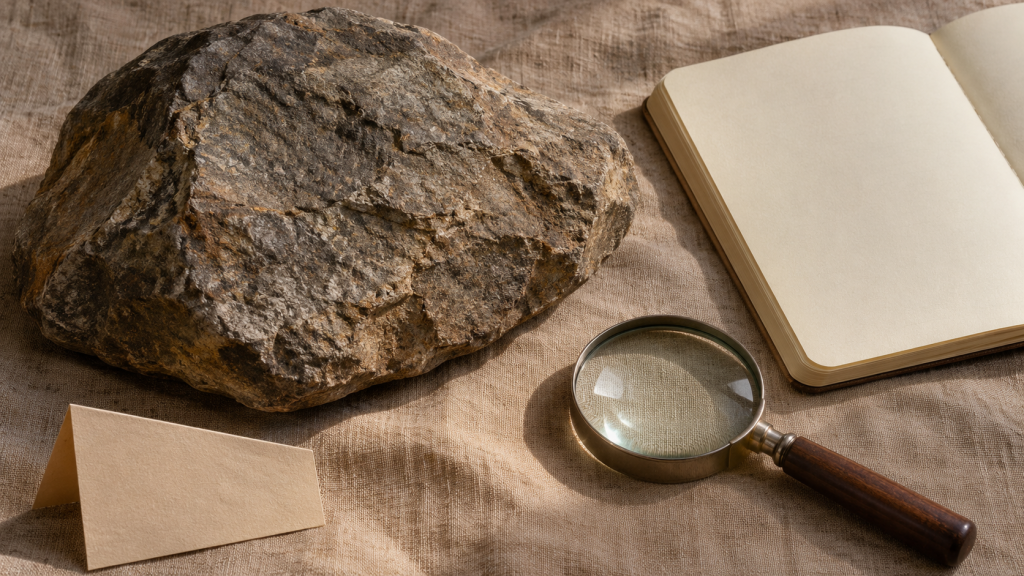
The British Library's archival record documents how difficult earlier investigators found the hillside position and uneven surfaces. Historic accounts include recording practices that should not be repeated by a visitor. Do not chalk, ink, wet, rub or press paper against the inscription to make it more legible. The accompanying still life uses an uninscribed modern stone sample to illustrate texture and observation. It is neither an ancient object nor a teaching reconstruction of the Shahbazgarhi text.
Understand the route setting without inventing an ancient audience
Pakistan's submitted description associates the edicts with an ancient trade connection between the Peshawar valley, northern valleys and Taxila. That provides a geographical framework for asking why a royal message was placed in this landscape. It does not prove that every passing traveller could read it or that a particular caravan stopped at the exact spot in a reconstructed scene.
A useful hypothetical study could compare a wide landscape view with a historical route map, explicitly as interpretation. Modern roads should not be traced backwards as though their alignments and traffic were unchanged for more than two millennia. The accompanying photograph of Dharmarajika at Taxila gives a separate regional heritage context. It depicts a different Buddhist monument complex with its own periods of development, not another view of Shahbazgarhi, a contemporary companion structure or evidence for a building beside the inscription.

Use an edition before repeating the message
The UNESCO description summarises the major edicts as presenting aspects of Ashoka's dharma, or righteous law. That is a source-attributed introduction, not a complete translation. A serious reading needs an identified edition that distinguishes the preserved characters, a transcription, a translation and any editorial restoration or explanation.
Do not convert a popular paraphrase into a quotation from the stone. If a school project compares translations, retain each editor's name, date and the edict number, then explain where wording differs. Missing or uncertain letters should remain visibly uncertain in any specialist transcription; they should never be filled with plausible decorative script for an illustration. The British Library photograph record is valuable for its documented view and recording history, but a picture catalogue is not itself a critical edition of all fourteen edicts. Each kind of source answers a different question.
Keep conservation and international status precise
Shahbazgarhi Rock Edicts entered Pakistan's UNESCO Tentative List on 30 January 2004, under reference 1880. Tentative listing is different from inscription on the World Heritage List. The published text is the submitting state's description and justification; it should not be presented as a committee decision endorsing every statement or as an operational notice about access.
The conservation priority is the inscribed surface together with the setting that makes its location understandable. Do not climb a boulder, place equipment against it or remove a fragment for identification. Cracks, surface colour and sheltering arrangements require specialist assessment before they can be called recent damage or successful repair. An archive photograph and a present image may differ because of lighting, framing or interventions as well as deterioration. No current conservation completion certificate or engineering assessment was established for this guide.
Check present permission and the whole route separately
For UK readers, Mardan's all-but-essential-travel advice must be considered alongside restrictions on any approach. On 7 November 2026 the FCDO also advised against all travel on the N45 north of the Mardan ring road towards Chitral, and against all travel to districts including Peshawar and Buner. A destination's district category cannot be applied automatically to a journey through another area. This guide proposes no driving route.
The FCDO safety page also tells travellers to obtain advance permission for travel in Khyber Pakhtunkhwa and check with local authorities. Anyone independently authorised to be locally present should confirm the approved approach, photography rules, walking surfaces, steps and any closed area with the custodian. No opening hours, admission fee or accessibility guarantee is asserted here. Remote study can instead end with three clear notes: the site's date range, its Kharosthi identification and the difference between a photograph and an edited reading of the text.
UK Foreign, Commonwealth & Development Office: Pakistan travel advice: warnings and insurance.
Documentary photograph: Shahbazgarhi-big3.jpg by Jona Lendering and Marco Prins, CC0 1.0, via Wikimedia Commons. Display sizes may be scaled.
Frequently Asked Questions
Are the Shahbazgarhi edicts written in Brahmi?
They are in Kharosthi, written right to left. General statements about Brahmi in Ashokan inscriptions must not be transferred to this site.
Are there fourteen separate inscribed rocks?
No. Pakistan’s UNESCO submission describes fourteen edicts on two large boulders.
Is Shahbazgarhi inscribed on the World Heritage List?
It is on Pakistan’s UNESCO Tentative List, submitted 30 January 2004, reference 1880. Tentative listing is different from World Heritage inscription.
What is the current UK travel advice for Mardan?
As checked on 7 November 2026, FCDO advises against all but essential travel to Mardan. Some approach districts and the specified N45 stretch have all-travel warnings; the full route needs its own check.
How we know this
- Type Practical guide
- Sources 5 (1 official/academic)
- Reviewed November 2026
- Disputed points None
Rules and fees change, confirm with the official links below before you act.
5 sources
- Shahbazgarhi Rock Edicts, UNESCO World Heritage Centre; submission by Pakistan Department of Archaeology and Museums
- Epigraphy: Early Scripts and Kharoshthi, Archaeological Survey of India, Bharat SHRI
- Photo 1003(1141): rock with Asoka inscriptions, eastern face, Shahbazgarhi, British Library Archives and Manuscripts Catalogue
- Pakistan travel advice: warnings and insurance, UK Foreign, Commonwealth & Development Office
- Pakistan travel advice: safety and security, UK Foreign, Commonwealth & Development Office
Photo credits (1)
- Dharmarajika stupa,Taxila.jpg, Sasha Isachenko, CC BY-SA 3.0, via Wikimedia Commons

