
Travel · Attractions
Read the court, hall and painted frame
Read the courtyard, domes and painted surfaces of a working Mughal mosque through official records, with the current Peshawar advisory kept explicit.
- Study the architecture
- Check current advice
- Confirm permission
Mahabat Khan Mosque, Peshawar
Start with worship, architecture and the current advisory
Mahabat Khan Mosque rewards close attention to the relationship between its open courtyard, western prayer hall and painted interior. This is also a working place of worship, where the priorities of worshippers determine what an observer may do. For UK audiences, the FCDO advises against all travel to Peshawar, including the city, as checked on 7 November 2026. This article supports heritage study and does not recommend a leisure journey against that advice.
The white appearance of the courtyard is only the beginning of the architectural story. A photograph can flatten differences between paving, plaster, masonry and decoration. Read those materials separately, using the federal archaeology inventory as a starting point. The discussion below offers observation questions for photographs, official documentation or any independently authorised local access; it does not confirm that every part of the mosque is presently open.
Place the patron within the seventeenth century
The federal Department of Archaeology and Museums dates the mosque to 1630 and associates its construction with Mahabat Khan, governor under the Mughal emperor Shah Jahan. It also records renovation in 1898. Pakistan Tourism Development Corporation’s Peshawar booklet instead places construction in the 1670s. These official descriptions disagree, so this guide does not claim an uncontested founding year.
A patron's name helps locate a monument politically, but does not identify the makers of every carved, painted or plastered surface. Avoid attributing all visible work to the founding campaign. When a guide supplies a different precise date, ask which inscription, archival account or conservation report supports it. A careful set of notes can distinguish the official inventory's chronology, an interpretation offered on site and something the observer can actually see. That separation makes the history more useful than an uninterrupted string of confident anecdotes.
Department of Archaeology and Museums, Pakistan: Mahabat Khan Mosque.
Read the courtyard as an organising space
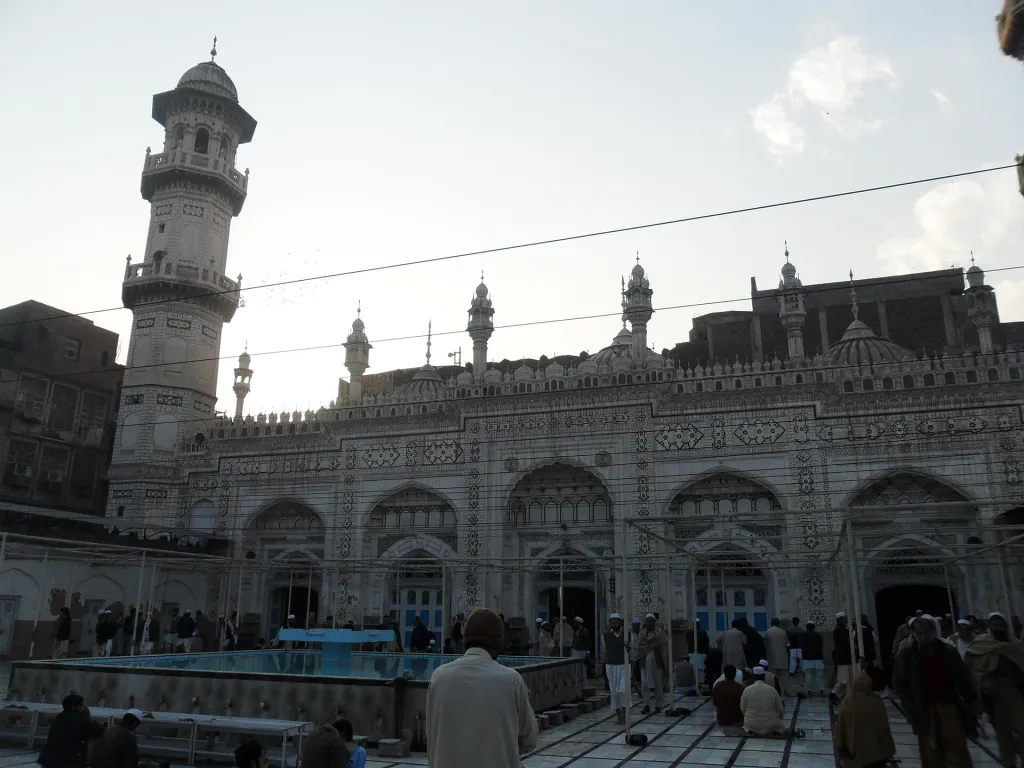
The inventory describes a central ablution pool in an open courtyard, with rooms along the sides. Treat these as connected parts of a religious building. The pool serves an established worship practice; the surrounding open area also gives the prayer hall a clear foreground. It should never be treated as a decorative obstacle to move around for an unobstructed portrait.
In an authorised photograph, compare the apparent width of the court with the opening of the prayer hall. Notice how paving joints and the pool edge establish directions across the space. These are visual observations, not measurements of the original design. Keep circulation routes clear and do not stand beside someone performing ablution to complete a composition. The architectural experience depends on the courtyard remaining usable, and an empty-looking image cannot establish that it is available for unrestricted photography.
Understand the western hall and its domes
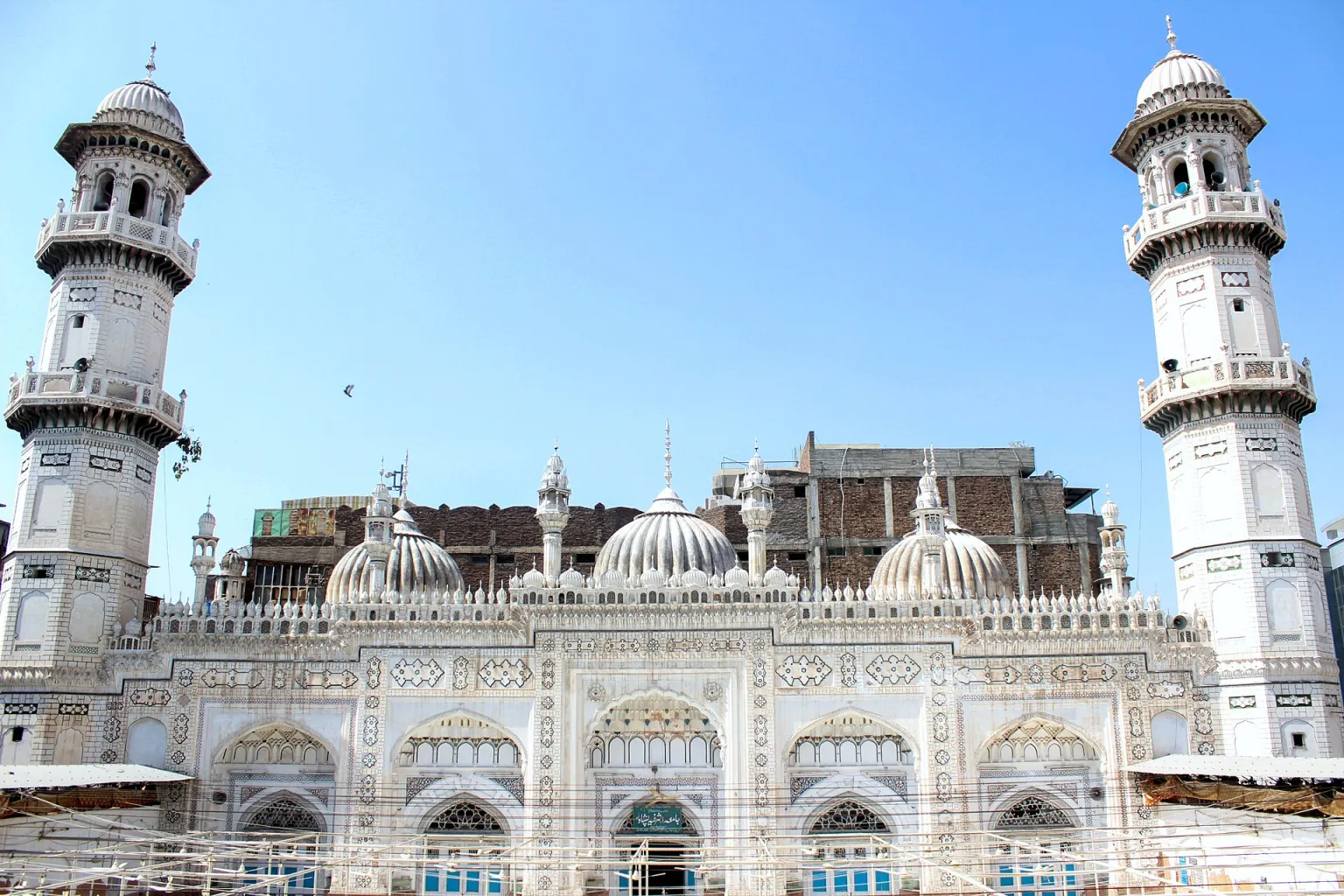
The federal description places the prayer hall on the west side, flanked by two tall minarets, and records three low fluted domes over the hall. From a permitted position, compare the strong vertical emphasis of the minarets with the domes' broader profile. Then look at how the openings below divide the elevation into a rhythm of bays.
Do not assume that a prominent stair, doorway or upper opening belongs to a visitor route. Minarets and roofs are parts of the building's fabric and operation; a historical description does not grant access to them. A ground-level comparison is enough to understand the balance between court, hall and skyline. Where a photograph crops out the sides, record that limitation before interpreting the entire plan from it. A pleasing frontal image can conceal both circulation and the depth of the prayer space.
Separate painted patterns from structural materials
Floral motifs, geometric painting and Quranic calligraphy are documented in the federal entry. Their relationship is more interesting than a single claim that the interior is richly decorated. Look for the boundaries of a panel: does its frame follow an arch, sit within a recess or establish a smaller pattern inside a larger surface?
This is a reading exercise, not permission to inspect at touching distance. Do not rub a painted edge, trace lettering with a finger or use a flash where it is prohibited. If you cannot read the calligraphy, describe its location and visual arrangement without inventing a translation. Similarly, a white finish alone does not establish that the entire wall beneath it is marble. Surface colour, construction material and decorative technique answer different questions, and careful captions should preserve those distinctions rather than merge them into an impressive material list.
Use light to understand depth without staging the mosque
An arch seen in direct light may appear almost flat, while a side-lit recess reveals thickness and a sequence of surfaces. If authorised documentation offers several views, compare the same opening under different light before calling a dark patch a missing finish. Shadow is not decay, and a bright surface is not necessarily a recent repair.
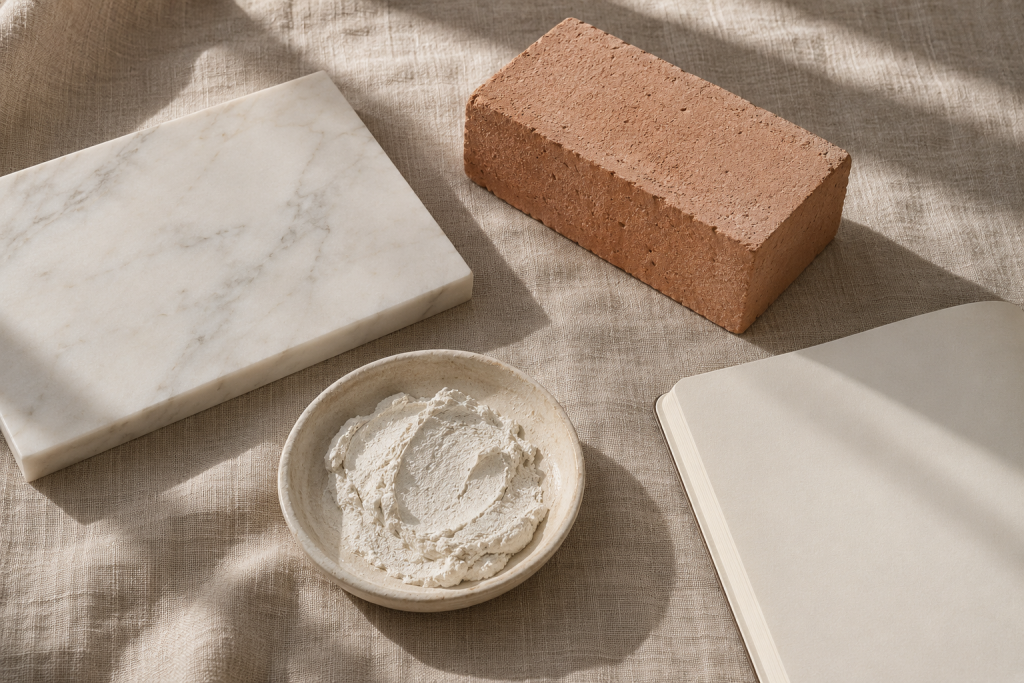
The accompanying material illustration uses modern samples to separate texture from monument photography. It is an illustrative arrangement, not recovered fabric from the mosque. A notebook exercise could mark the position of a panel, an opening and a shadow in a simplified sketch, labelled as an observer's interpretation. Such a sketch should avoid exact dimensions unless they come from a measured survey. This approach makes visual study possible without arranging props inside a sacred space or asking worshippers to move for the camera.
Read conservation records as dated evidence
The provincial information directorate published a conservation meeting account on 14 June 2023. It records discussion of the mosque's restoration, concerns of traders and instructions for a detailed survey of the building and foundations. The archaeology directorate also lists repair and rehabilitation documentation among its downloads. These are evidence of an administrative conservation process, not a certificate of today's structural condition.
Do not turn a historic project announcement into a claim that all work is complete. Ask for a current notice if the status of a hall or courtyard matters. From photographs, differing plaster tones or joints may suggest questions for a conservator, but they cannot reliably date an intervention. Conservation should be understood through records, compatible materials and documented decisions, rather than judged by whether every surface looks uniformly new.
Keep permission and respectful conduct specific
For anyone independently entitled to be locally present, ask mosque management about the permissible route, suitable timing around prayers and whether photography is allowed in each space. Dress respectfully, follow instructions on footwear and avoid photographing worshippers without their consent. A general statement that tourists have visited in the past cannot answer these questions for a particular day.
If mobility is a concern, ask about the actual approach, thresholds, steps, courtyard surface and resting possibilities. A broad court in a photograph does not establish step-free access from the street. This guide does not publish a fee, opening schedule or admission promise because no verified current operational notice was established in the research. Security and religious use can both alter arrangements, and permission to enter should never be interpreted as permission to climb or record everything visible.
Leave with a record of relationships
A useful architectural note about Mahabat Khan Mosque should explain one relationship: for example, how the open court frames the western hall, or how a painted panel responds to an arch. Add the source of any historical statement and the date of any photograph. That produces something more durable than a collection of unlabelled close-ups.
For UK readers, recheck the FCDO advice before considering any travel decision; the all-travel warning for Peshawar applied on 7 November 2026. Official records and authorised images provide a way to study the mosque remotely. For locally authorised observers, the best outcome may be a short, quiet look from the approved area. Architectural understanding does not require access to the roof, a perfectly empty prayer hall or uninterrupted use of a courtyard that belongs first to its worshipping community.
Frequently Asked Questions
Who commissioned Mahabat Khan Mosque?
The federal inventory attributes the mosque to Mahabat Khan and gives 1630. PTDC’s Peshawar booklet instead places construction in the 1670s; the official dates disagree.
Is the whole mosque made of white marble?
A white appearance does not establish the material of every wall. Separate paving, masonry, plaster and painted decoration.
Can visitors climb the minarets?
No access entitlement is established here. Follow the current instructions of mosque management; a historic feature is not a visitor route.
What does the UK advisory say?
As checked on 7 November 2026, FCDO advises against all travel to Peshawar, including the city.
How we know this
- Type Practical guide
- Sources 5 (3 official/academic)
- Reviewed November 2026
- Disputed points None
Rules and fees change, confirm with the official links below before you act.
5 sources
- Mahabat Khan Mosque, Department of Archaeology and Museums, Pakistan
- Mahabat Khan Mosque heritage and conservation meeting, 14 June 2023, Directorate General Information and Public Relations, Khyber Pakhtunkhwa
- Important Downloads: Repair & Rehabilitation of Mahabat Khan Mosque, Directorate General of Archaeology & Museums, KP
- Pakistan travel advice: warnings and insurance, UK Foreign, Commonwealth & Development Office
- Peshawar travel guide: Mahabat Khan Mosque, Pakistan Tourism Development Corporation
Photo credits (2)
- Masjid Muhabat Khan.jpg, Hafeezburki, CC BY-SA 4.0, via Wikimedia Commons
- Mohabbat Khan Mosque.jpg, Abdul Samad khan sherwani, CC BY-SA 4.0, via Wikimedia Commons
