
Travel · Attractions
Keep the bird in its architectural setting
Study pilasters, niches and the famous bird motif while keeping architectural influence and religious attribution separate.
- Read the details
- Plan the approach
- Respect the fabric
Sirkap, Taxila
Find the monument within an excavated city
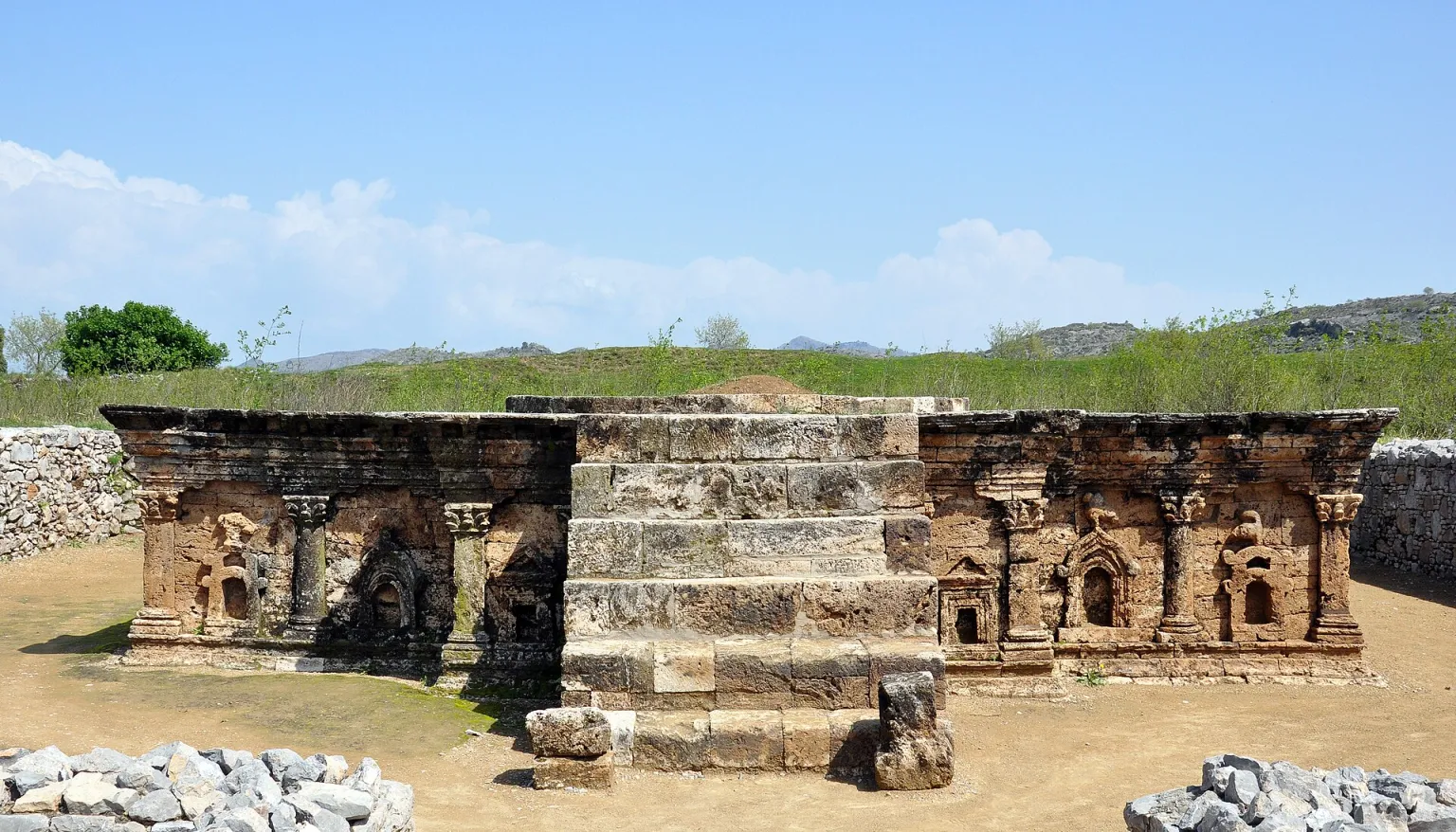
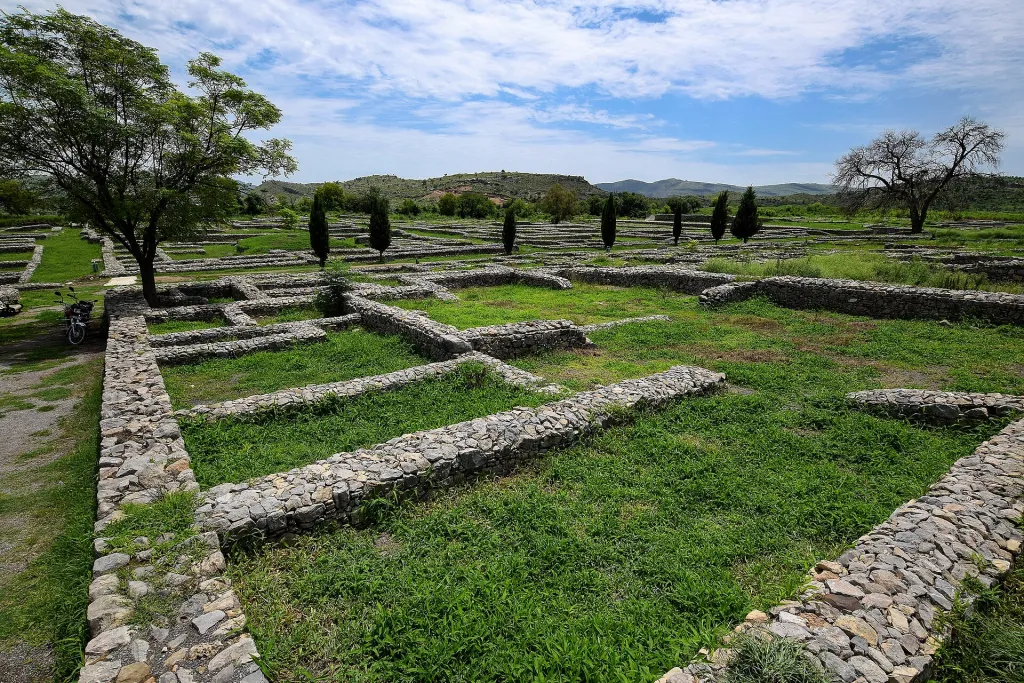
Sirkap’s Double-Headed Eagle Stupa is best approached as part of a city street rather than a detached masterpiece. Establish your position on the authorised visitor route before looking for its decorated base. The surrounding low walls matter: they place the shrine among urban spaces and remind you that a striking religious structure belonged to a much larger settlement. Leave time for a long view before concentrating on a detail.
This guide focuses on the façade and the questions it raises. It does not attempt to reconstruct the whole city or select between every Taxila attraction. Carry a photograph of the interpretation panel, when photography is permitted, alongside your detail shots. A bird without its architectural setting can become an illustration of almost any theory; a bird connected to a specific façade is a piece of situated evidence.
Keep the city’s chronology separate from a motif’s origin
Taxila Museum describes Sirkap as the principal city after the abandonment of Bhir Mound, from the second century BCE. It records successive excavated layers, evidence that the visible site is not one frozen moment. The museum’s account of partial excavation also matters: the exposed remains cannot stand for every district and every period of the ancient city. An orderly visitor view is a selection made legible through archaeology.
Avoid dating the bird motif by repeating the city’s foundation date. A site’s founding, a monument’s building phase and a decorative tradition’s earlier appearances are separate questions. If a label gives a date for the shrine, preserve its qualifications. Architecture can retain or borrow forms over long periods, and resemblance alone does not prove that one identifiable craftsperson or migrant group made the monument.
Read the façade from divisions to details
Begin with the repeated vertical divisions of the decorated face. A pilaster is an attached, shallow column-like element; it helps divide the surface into bays without functioning as a free-standing column. Identify the bays before examining the smaller forms within and above them. This approach makes the façade easier to follow and reduces the temptation to turn every isolated ornament into a separate historical story.
The federal archaeology description identifies Corinthian-order pilasters. That is a description of architectural vocabulary with a classical history, not proof that the shrine itself was a Greek temple. Note the relation between supports, niches and crowning elements. A useful photograph records one complete bay as well as any close-up. If details are too distant to identify confidently, keep the wider view and consult a reliable image afterwards.
Locate the bird without overreading its meaning
The familiar modern name directs attention to the eagle-like birds above niches, including a double-headed example. Try first to locate the motif in relation to the bay below it. Is it a small crowning accent, or the main organising element of the whole face? That question prevents the name from making the bird appear architecturally larger or more dominant than it actually is. Use only permitted viewpoints.
The official inventory itself uses cautious visual language about the bird. Preserve that care when discussing its origin or symbolism. A double-headed form can appear in different historical traditions without carrying one unchanging meaning. Do not turn resemblance to a later emblem into evidence of direct descent or political ownership. Identifying a motif is an observation; explaining why it was chosen requires a different body of evidence.
Do not turn mixed forms into a census
Sirkap is frequently presented as a meeting place of traditions, and the façade offers a productive starting point for that idea. Compare the decorative frames and supporting elements that the site interpretation identifies. Notice the deliberate combination within one composition. The important visible fact is that the elements work together architecturally, rather than sitting as unrelated museum objects in separate cases.
It is much harder to infer the identity of everyone involved. An architectural form does not establish an individual builder’s birthplace, the language of every worshipper or the proportions of communities in the city. Those questions require inscriptions, excavated contexts and comparative research. Describe a classical architectural reference as a reference; do not use it to write an imagined biography of an otherwise undocumented sculptor. Contact and borrowing are interpretive subjects, not automatic conclusions from one capital.
Explain why the religious label needs qualification
The monument is widely known as the Double-Headed Eagle Stupa, and Taxila Museum uses that name. The federal archaeology inventory, however, describes the shrine as probably belonging to the Jaina faith. These are not interchangeable assertions. A careful visitor can retain the familiar name while explaining that religious attribution has been treated as uncertain in an official account. The word probably is part of the evidence.
Do not solve the problem by assigning an unlabelled deity to a niche or inventing a lost dedication. Nor does the uncertainty make the monument historically empty: its setting, construction and decoration remain available for study. Ask whether the current interpretation discusses the attribution and whether a published excavation report is referenced. Where sources differ, recording the difference is more useful than choosing the most confident-sounding version for a caption.
Keep the inscription find attached to its recorded context
The archaeology inventory also reports an Aramaic-inscribed fragment of a marble pillar found reused in a wall of quarters associated with the shrine. The distinction between an object’s findspot and its earlier life is essential. A reused fragment can demonstrate that material circulated or was incorporated later, but it cannot automatically date the wall, name its occupants or prove the original dedication of the shrine.
If you encounter an inscription in a museum, read its label for findspot, material, date and collection information before connecting it to this monument. Do not assume that every Aramaic object from Taxila is the particular fragment mentioned here. A museum visit can deepen an architectural visit only when the connection is documented. The accompanying museum photograph shows the institution as context, not the inscription or an assurance that a specified object is currently on display.

Read preservation as part of what you see
Sirkap belongs to the inscribed Taxila serial property. The World Heritage Centre identifies environmental exposure, vegetation and wider development among concerns for the property. At the decorated base, this is a reason to give vulnerable surfaces space. A low wall or platform is not an invitation to climb for a closer view, and a clear detail photograph is not worth abrasion or accidental pressure on ornament.
Avoid confidently identifying repaired fabric from colour alone. Read any conservation notice and ask about documented interventions where relevant. The illustrated modern stones, brush and magnifier are a still-life reminder to observe carefully; they are not excavation equipment shown in use on the monument. Visitors should not brush, scrape, trace or clean the façade. Record what can be seen from the authorised route and let trained conservators investigate the surface itself.
Plan for an exposed detail-focused visit
Confirm Sirkap’s current entrance, ticket arrangements and any restricted areas with management close to departure. Check the route from the entrance to the shrine specifically if distance, uneven ground or mobility are concerns. A map of the city cannot establish present accessibility. Choose a day and time when heat, rain and visibility allow unhurried observation, and carry water and sun protection for the open site.
Before leaving, review three images if you took photographs: the shrine in its street setting, a complete façade bay and the bird detail. Match each caption to the scale of what it actually shows. Keep the religious attribution qualified and the history of the city separate from the history of the ornament. That small discipline turns a famous visual symbol into a richer encounter with architecture and archaeological evidence.
Frequently Asked Questions
Is the Double-Headed Eagle Stupa certainly Buddhist?
Taxila Museum uses the familiar stupa name; the federal inventory says the shrine probably belonged to the Jaina faith. Preserve that uncertainty.
Do Corinthian pilasters prove Greek worship here?
No. Architectural vocabulary can be borrowed and adapted; it does not establish religious dedication or every builder’s identity.
Does the bird have one proven meaning?
The motif’s appearance is observable, but a specific symbolic interpretation requires separate supporting research.
Can visitors climb up for a close photograph?
Use only authorised routes and viewpoints. Decorated bases and low archaeological walls should not be climbed.
How we know this
- Type Practical guide
- Sources 4 (4 official/academic)
- Reviewed November 2026
- Disputed points None
Rules and fees change, confirm with the official links below before you act.
4 sources
- Sirkap, Taxila Museum, Government of Punjab
- Sirkap site, Department of Archaeology and Museums, Pakistan
- Taxila, UNESCO World Heritage Centre
- Taxila: component maps, UNESCO World Heritage Centre
Photo credits (2)
- Double-Headed Eagle Stupa at Sirkap 04.jpg, Furqanlw, CC BY-SA 4.0, via Wikimedia Commons
- Sirkap ruins.jpg, Teseum, CC BY-SA 4.0, via Wikimedia Commons
