
Travel · Attractions
Follow the stepped-cross plan
Read the stepped-cross stupa in relation to courts, monastic space and excavation evidence near Khanpur’s reservoir.
- Read the details
- Plan the approach
- Respect the fabric
Bhamala, Haripur, Khyber Pakhtunkhwa
Begin with the shape, then widen the view
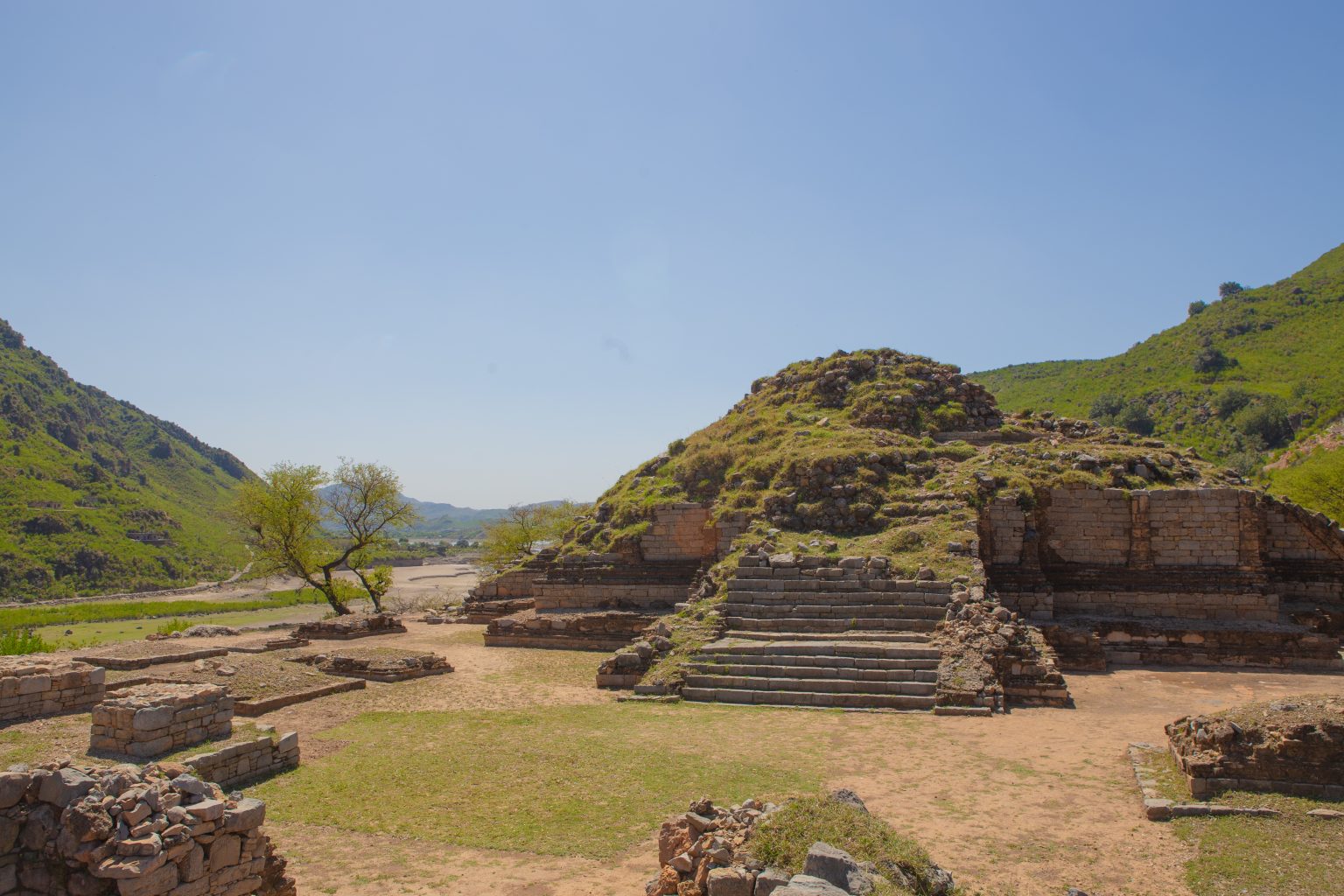
Bhamala is often reduced to the unusual outline of its main stupa. Start instead with the relationship between that outline and the surrounding excavated spaces. From the permitted visitor route, locate the prominent base and compare it with the smaller structures around it. The aim is to understand a complex of movement, worship and residence rather than collect a photograph of an isolated geometric form. Keep the surrounding hills in the same field of attention.
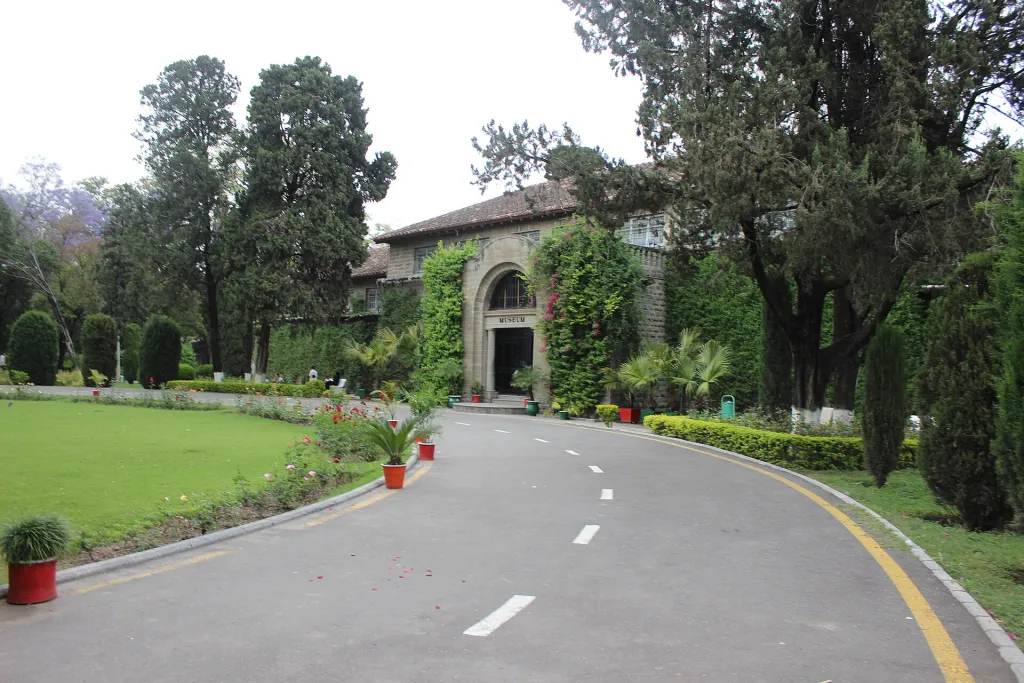
Bhamala lies in Khanpur Tehsil, Haripur District, in Khyber Pakhtunkhwa. Its proximity to the wider Taxila landscape helps explain its regional setting, but a regional connection is not the same as sharing another site’s inscription status. Plan the visit as a destination requiring its own approach and access confirmation. A map pin for Taxila Museum will not deliver you to this excavated landscape.
Be precise about the 2026 Tentative List entry
The UNESCO World Heritage Centre publishes a separate Tentative List entry for Bhamala Buddhist Complex, submitted by Pakistan on 11 May 2026. Tentative listing is a proposal stage, distinct from inscription on the World Heritage List. Bhamala should therefore not be presented as an already inscribed component of the Taxila serial property merely because some older publicity calls it a World Heritage site. Check the actual record rather than repeating a familiar label.
The submission places the complex broadly in the second to fifth centuries CE and explains its architectural significance. Those dates describe a span of activity, not a single construction season for every element. In a photograph caption, name the particular structure when known. A broad site label can otherwise make a later chapel, an earlier floor and a repaired wall seem as though they were all created together.
Understand what cross-shaped describes
At Bhamala, cross-shaped or cruciform refers to the stepped projections of the stupa’s architectural plan. It is a description of form within a Buddhist complex, not evidence of a Christian dedication. The submitted UNESCO account identifies a tall square podium with stair approaches on four sides. Observe the offsets and the way a projection changes the silhouette from your permitted viewpoint. Seeing one face does not reveal the entire plan.
Avoid rebuilding the missing superstructure in your imagination and then presenting the result as something observed. The surviving base is evidence; a complete dome or crowning arrangement needs a sourced reconstruction. If you make a personal sketch, mark invisible and uncertain parts clearly. Understanding the difference between ground plan and elevation is enough to make the stupa’s distinctive shape meaningful without supplying details that the remains cannot confirm.
Compare large and small devotional structures
The main monument does not exhaust the sacred area. Official archaeology descriptions record smaller votive stupas and chapels around it. Look at how their scale changes your view of the central base and how the open spaces connect them. Smaller structures can be important evidence of repeated religious investment; their value is not determined by whether they make the most dramatic photograph. Remain outside any protected or fragile area.
Do not assign a particular donor, ritual or date to each small foundation without a label or excavation record. A repeated form can suggest a category of building while leaving its individual history unresolved. Where identification is uncertain, describe the visible relationship: a small base beside a court, for instance. This makes your account useful to another visitor while keeping an interpretation from hardening into an unsupported fact.
Look for living space as well as sacred space
A monastery introduces a different set of questions from a stupa court. How do rooms face an open area? Where might circulation be concentrated? Which parts are identified by excavators as service or communal spaces? Use the site’s interpretation to distinguish those functions. An empty room does not disclose its use simply through atmosphere, and a building beside a sacred court is not automatically another shrine.
Hazara University’s archaeology department lists excavation campaigns at Bhamala, including work in 2014–15 and 2015–16. That research history is a reminder that the readable plan is a result of investigation as well as ancient building. Some spaces become intelligible only through a published plan. If a section is inaccessible, a reliable excavation drawing can explain its relationship without requiring visitors to cross a barrier or climb exposed walls.
Treat floors and masonry as vulnerable evidence
The cruciform base attracts attention, but surfaces at ground level can be equally revealing. The Tentative List account records a terracotta-tiled court with lime treatment. Use that information as a reason to watch where you stand and to ask which historic surfaces are exposed and protected. It is not a promise that a visitor will see every recorded feature or be allowed to walk across it.
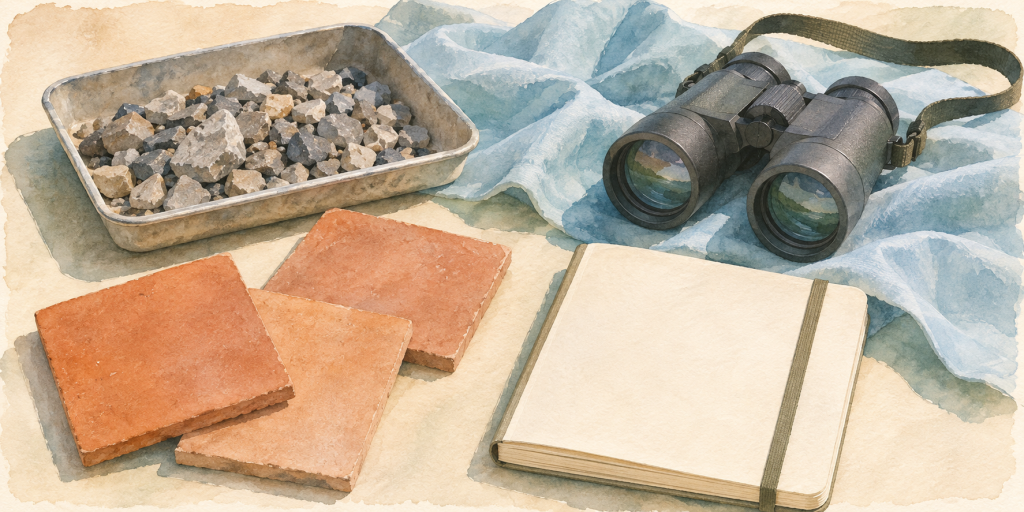
Notice differences between dressed stone faces, smaller packing pieces and surface coverings from the authorised path. Do not test mortar with a finger, brush dust away or wet a surface for a clearer photograph. Nor can colour alone distinguish a new conservation fill from an ancient joint. The illustrated gravel and tile samples are a modern arrangement for material observation; they are not finds from Bhamala and should never be captioned as such.
Understand the Parinirvana discovery without a viewing promise
The complex is also known for the excavated monumental representation of the Buddha’s Mahaparinirvana, or final passing. The UNESCO submission records a figure approximately fourteen metres long. Its significance lies in the archaeological and devotional context, not simply a size ranking. Avoid unqualified claims that it is the world’s oldest or largest example: such superlatives depend on definitions, dating and comparisons that require a fuller scholarly argument.
A published discovery is not confirmation that the sculpture is fully exposed, intact or available for viewing today. Ask site staff which remains can currently be seen, how they are protected and where further interpretation is available. Do not move coverings or enter a protected chamber. If only part of the associated space is visible, describe that honestly instead of using a photograph from another Buddhist site to stand in for the discovery.
Recognise excavation and conservation as continuing histories
Bhamala’s exposed remains have two overlapping histories: their ancient use and their later excavation and care. The KP tourism project’s document register includes a conservation and preservation management plan covering Bhamala alongside other monuments. This establishes a formal planning context, but a listed plan does not establish which works have been completed or whether a particular route is currently open. Ask about the actual arrangements on the day.
A tidy wall top or protective shelter should prompt a question about conservation, not a complaint that the place is insufficiently ancient. Equally, neat presentation cannot prove that every intervention follows the same method. Read available project signs, noting dates and the organisation responsible. Keep present repairs separate from surviving ancient masonry in your notes whenever documentation allows, and mark the distinction as unknown when it does not.
Plan the reservoir-side approach conservatively
Confirm the current road approach, final vehicle access and entry arrangements before setting out towards Khanpur and Bhamala. Ask about road condition after rain, the walking distance from the permitted drop-off, and whether work affects the route. A description of a scenic reservoir setting does not establish a safe waterside shortcut. Stay on the approved approach and keep clear of water edges, excavation cuts and unstable masonry.
Cooler, dry weather generally suits deliberate observation, but check that day’s forecast and daylight rather than relying on a fixed best-month slogan. Carry drinking water, sun protection and shoes with grip. Ask specifically about steps and toilets if they affect the group’s participation. A successful visit may be a short authorised circuit connecting the main base and its setting; it does not require access to every excavated chamber or a second destination that day.
Documentary photograph: The Bhamala Stupa.jpg by ClicksByMohammadOmer, CC BY-SA 4.0, via Wikimedia Commons. Display sizes may be scaled.
Frequently Asked Questions
Does cross-shaped mean it is a Christian monument?
No. Here it describes the stepped-cross plan of a Buddhist stupa.
Is Bhamala inscribed on the UNESCO World Heritage List?
The World Heritage Centre publishes Bhamala’s separate Tentative List entry, submitted on 11 May 2026. That status is distinct from inscription.
Will I see the complete reclining Buddha?
The archaeological discovery does not guarantee current display or access. Confirm the permitted viewing arrangements with site management.
Can I walk on the excavated floors?
Follow the marked route and staff instructions; recorded historic paving may require protection and may not be open to foot traffic.
How we know this
- Type Practical guide
- Sources 4 (3 official/academic)
- Reviewed November 2026
- Disputed points None
Rules and fees change, confirm with the official links below before you act.
4 sources
- Bhamala Buddhist Complex: Tentative List submission, UNESCO World Heritage Centre; submission by Pakistan
- Bhamala Stupa, Department of Archaeology and Museums, Pakistan
- Department of Archaeology: projects and Bhamala excavation campaigns, Hazara University
- Download register: conservation management plan including Bhamala, Khyber Pakhtunkhwa Integrated Tourism Development Project
Photo credits (1)
- Museum taxila front.jpg, Junaidgondal0, CC BY-SA 4.0, via Wikimedia Commons

