
Travel · Attractions
Follow the brickwork into the blue
Look at the relationship between the mosque’s courtyard, arcades, brick surfaces and tiled domes, with prayer, conservation and source uncertainty shaping a respectful visit.
- Read the details
- Plan the approach
- Respect the fabric
Thatta, Sindh
Begin with the mosque’s working purpose
Shah Jahan Mosque is a place of prayer whose architecture becomes clearer when the visitor slows down. The Sindh antiquities department identifies it as Thatta’s central mosque, built during the reign of Shah Jahan. Begin by asking whether a visit is appropriate at that moment and which spaces are open. The right position for a photograph is one that leaves worshippers and circulation undisturbed.
The focus here is the relationship between construction and decoration. Warm brick and glazed tile create different surfaces; arcades and domes give those surfaces different shapes to cover. Look first across an authorised courtyard viewpoint, then choose a single bay or opening. This approach is more revealing than trying to reproduce an entire building in one image or turning a visit into an exercise in counting every dome.
Keep patronage, tradition and status distinct
The federal archaeology entry names Nawab Abdul Baq Amir Khan as the official who completed the construction on Shah Jahan’s orders. The provincial account describes an imperial gift of gratitude. These are different kinds of information: a recorded attribution helps identify patronage, while a story about motivation should be presented as the account of the source rather than a scene the visitor can reconstruct.
The mosque’s UNESCO status also needs care. It has been on Pakistan’s Tentative List since 1993. Nearby Makli is an inscribed World Heritage property, but proximity does not make the mosque separately inscribed. In notes and captions, keep the two places distinct. You can appreciate the mosque’s importance without upgrading its formal status or borrowing Makli’s inscription date. A source label is useful only when it accurately describes the building being discussed.
Use the courtyard to understand the plan
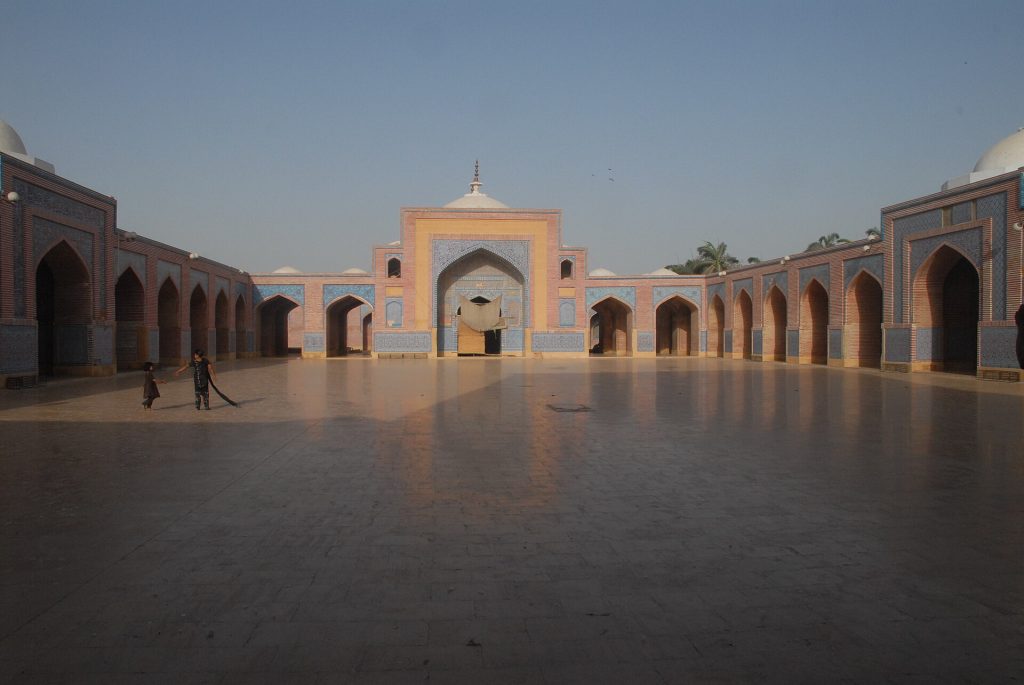
The courtyard gives a broad space from which to compare the surrounding openings. From a position approved by the mosque’s attendants, notice how the edges organise movement between open and covered areas. Look at the recurrence of arches and the contrast between exposed daylight and the deeper shade behind them. These are spatial observations you can make without interrupting prayer.
Do not read a perfectly empty photograph as the normal condition or a promise of unrestricted access. A functioning mosque changes with worship, maintenance and local needs. Keep entrances clear, avoid placing bags where people walk, and ask before setting down a tripod or sketching equipment. If your group wants to discuss the building, move to a place where quiet conversation is appropriate. The courtyard is part of the mosque, not simply a viewing platform for its façades.
Look for geometry in the brick surfaces
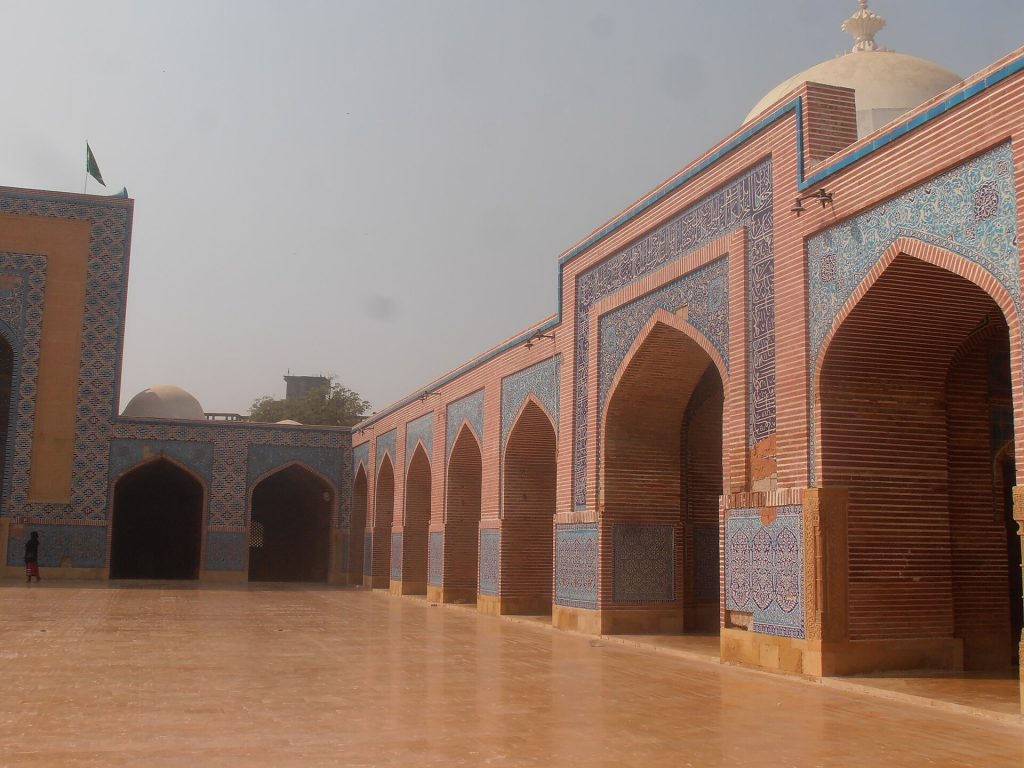
The provincial description highlights geometric brickwork as well as the better-known tiles. To see the distinction, find a permitted view where the masonry surface is legible and compare the direction of joints, the arrangement of repeated units and the shadows at projecting edges. Brick can organise a wall visually even when it carries no separate coloured image.
Avoid using colour alone to decide whether a brick is original or replaced. Weather, exposure and repairs can all affect appearance. Nor should a visible joint be tested with a key, fingernail or stick. A helpful observation is simply to note where the pattern changes relative to an opening or corner. That keeps attention on the architectural arrangement while leaving material diagnosis to people working with conservation records and proper examination methods.
Read an arch before reading its decoration
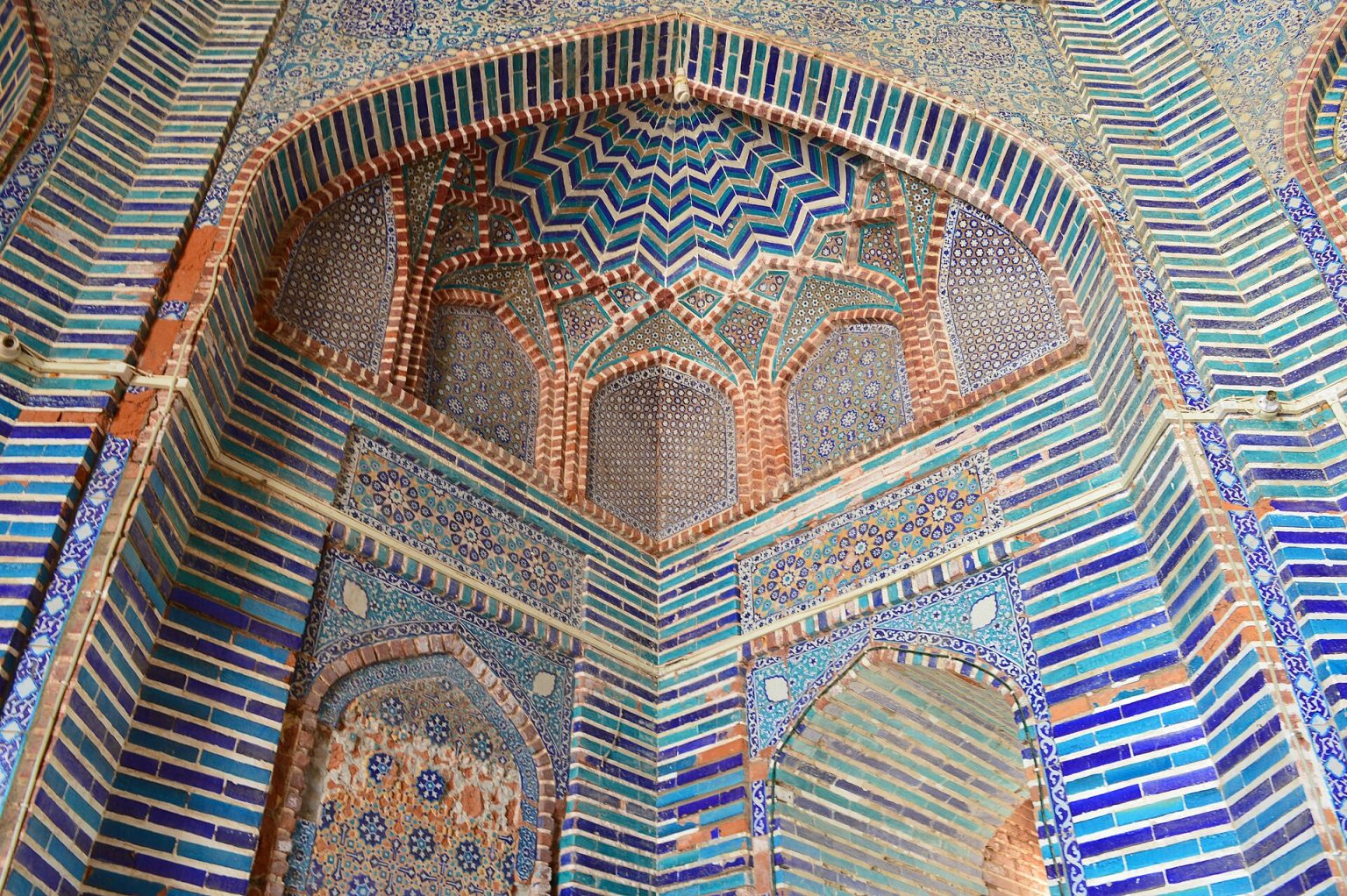
An arch creates an opening; its border and the areas around it provide surfaces for ornament. First trace its curve with your eyes. Then compare the decorative treatment of the arch itself with the surrounding panel or spandrel, the area beside the upper curve. Changing that order helps prevent the tile pattern from obscuring the shape it covers.
Choose one opening that can be viewed without standing in a prayer line or blocking a route. Compare its appearance straight on with a permitted oblique view. A foreshortened curve may look narrower, while deep shadow can make its border appear thicker. These are effects of viewpoint and light rather than proof of different construction. Do not ask attendants to move objects or worshippers for a clearer composition. The building’s continuing use belongs in the interpretation.
See how tiles respond to curved surfaces
Pakistan’s UNESCO submission describes blue-and-white radial tile arrangements in the main domed chambers, floral decoration near arches and geometric panels elsewhere. Treat this as a set of broad distinctions to look for rather than a requirement to identify every pattern. On a curved surface, repeated elements may draw the eye towards a centre; on a flat panel, an edge or grid can organise the design differently.
Remain in permitted areas and avoid prolonged upward looking while walking. Stop somewhere suitable before studying a ceiling. Use a camera’s zoom instead of lifting equipment close to decoration. A photograph can flatten the dome and make a radial arrangement seem like a flat disc, so include enough surrounding structure to show its position. Exact tile dates or workshop attributions require documentary evidence beyond a visitor’s visual impression.
Treat the famous acoustics quietly
Accounts of the mosque often emphasise its sound. The UNESCO Tentative List description proposes a connection between the domes and an echo, but that is not a modern acoustic survey establishing how every sound behaves in every occupied condition. The same text gives a particular dome count, while popular accounts vary. Neither a counting contest nor a performance is necessary to understand the building.
Do not clap, shout or play audio to test a story while people pray or attendants work. If the topic interests you, ask whether staff can explain it at an appropriate time. Listening quietly to the ambient sound is enough for an ordinary visit. Keep a clear boundary between a historically repeated claim, a source’s explanation and a measurement conducted with permission. Each can be interesting without being treated as the same kind of evidence.
Protect the surfaces and respect prayer
Glazed decoration deserves careful distance even when it appears robust. Do not touch, polish or wet tiles to improve a photograph. Avoid leaning against decorated walls, setting bags on vulnerable edges or attaching paper for tracing. Differences between surfaces may reflect maintenance and repair, and a visitor should not scrape them to establish what lies underneath. Let visible barriers and instructions determine the route.
Dress modestly, follow attendants’ guidance on footwear and permitted areas, and ask before photographing people. Religious activity takes priority over a planned architectural sequence. If access is paused, shorten or postpone the visit. No online guide can promise the same access for every visitor or on every day. The meaningful practical question is which spaces you may respectfully enter now, not which spaces appear open in an older travel photograph.
Plan a visit around weather and permission
The mosque is in Thatta, southern Sindh. Confirm the current visitor arrangements with local management, particularly prayer periods, group visits and photography. Cooler months generally make a town and heritage visit more comfortable than the hottest season, but check the daily forecast and local travel conditions. Carry water for the journey, and ask where it may appropriately be consumed before taking it into prayer spaces.
Finish with a small, accurate set of observations: a brick surface, an arch and a tiled curved surface. These can explain the building’s character better than an unverified superlative about its size or beauty. If Makli is included elsewhere in your day, caption its photographs separately. Leave the mosque’s own materials and spatial relationships at the centre of this visit, with the experience of a working religious place guiding how you look.
Frequently Asked Questions
Is Shah Jahan Mosque an inscribed UNESCO World Heritage Site?
It has a separate Tentative List entry dating to 1993. Nearby Makli is inscribed; those statuses should not be combined.
Should I test the echo?
Do not clap or shout in a working mosque. Ask attendants whether they can explain the acoustics at an appropriate time.
What should I study besides tiles?
Compare geometric brickwork, arch profiles and the relationship between the courtyard and covered spaces.
Are all spaces always open to visitors?
No access guarantee is made. Follow current management instructions and give prayer priority.
How we know this
- Type Practical guide
- Sources 3 (3 official/academic)
- Reviewed November 2026
- Disputed points None
Rules and fees change, confirm with the official links below before you act.
3 sources
- Shah Jahan Mosque, Thatta, UNESCO World Heritage Centre
- Shah Jahan Mosque (Jamia Masjid), Thatta, Directorate General of Antiquities and Archaeology, Government of Sindh
- Shahjahani Mosque / Jamia Mosque Thatta Town, Department of Archaeology and Museums, Pakistan
Photo credits (3)
- Shahjahan Mosque Thatta Sindh 1.JPG, Ghazimemon, CC BY-SA 4.0, via Wikimedia Commons
- Gate ways from Courtyard - Shah Jahan Mosque.jpg, Saba Qayoom, CC BY-SA 4.0, via Wikimedia Commons
- Shah Jahan Mosque View inside.JPG, MunawarAhmed7, CC BY-SA 4.0, via Wikimedia Commons
