
Travel · Attractions
Start with the square beneath the dome
Read the square chamber, octagonal upper stage and dome while allowing worship, conservation and uncertain dates their proper place.
- Read the details
- Confirm the approach
- Respect the setting
Bahauddin Zakariya Shrine, Multan
Start with the square beneath the dome
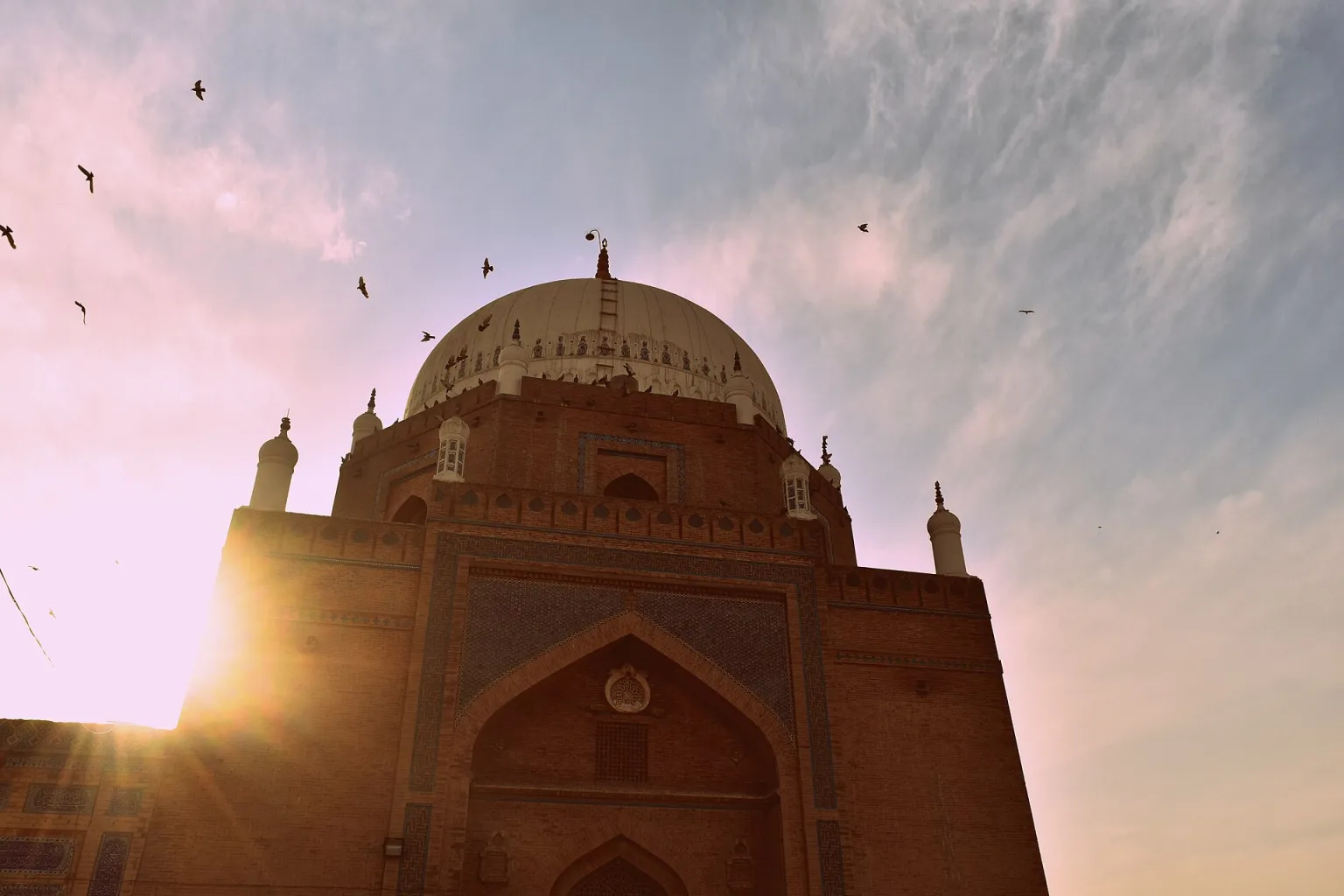
Bahauddin Zakariya’s shrine becomes easier to understand when you look beneath its dome. The square lower chamber, the octagonal stage above it and the rounded crown create a sequence of changing shapes. From a permitted position, trace that sequence slowly before moving towards decorative detail. It offers a clear architectural question without requiring entry into every part of the complex.
This is a place of devotion in Multan, not a detached architectural exhibit. People may be coming to pray, accompany relatives or mark a religious occasion. Begin by asking about the visitor route, shoe arrangements and photography. A respectful visit can combine an exterior reading with a brief permitted interior pause; it does not depend on obtaining a photograph beside a grave or occupying the centre of a congregation.
Meet the saint through the shrine authority
Punjab Auqaf presents Bahauddin Zakariya as a major Suhrawardi Sufi connected with Umar Suhrawardi in Baghdad, and records his settlement in Multan in 1222. The biography describes a religious network extending across southern Punjab and Sindh. This makes the shrine a useful starting point for understanding Multan’s connections beyond its own walls, rather than treating the building as an isolated local curiosity.
Dates need care. Auqaf gives 1268 for the saint’s death, while Archnet’s architectural entry associates the tomb with 1262. Those institutional accounts should not be silently combined into one exact construction narrative. For an introductory visit, thirteenth-century context is sufficient. If a precise death or building date matters to a research project, state which authority you are following and seek specialist discussion of the differing chronologies.
Watch the transition from four sides to eight
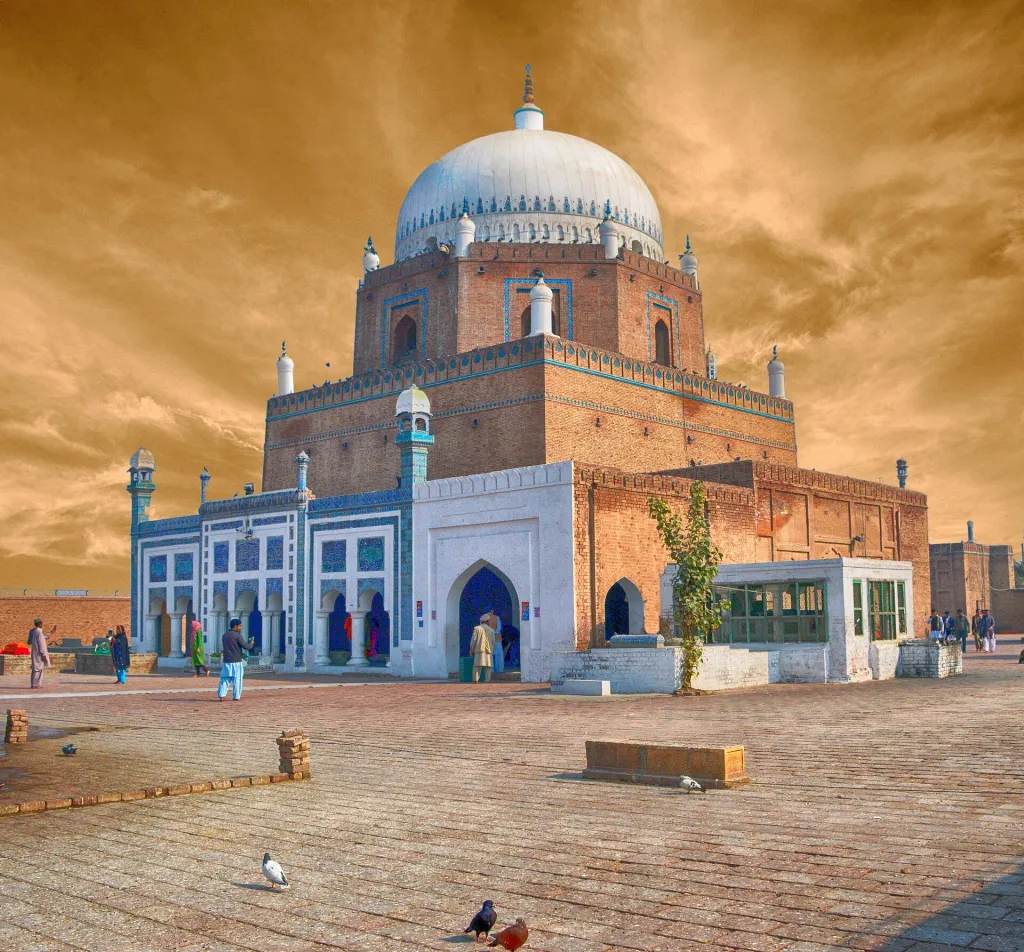
Auqaf describes a square chamber with an octagon above and a hemispherical dome. Archnet also identifies this arrangement and notes corner minarets. Look at where the square’s corners cease to dominate and the upper stage begins. The transition is the central visual problem: how does a building move from a room with four principal faces towards a curved roof?
You do not need to invent an engineering explanation from a photograph. Compare the shapes that are actually visible, noting where your viewpoint or an enclosure prevents a complete view. A quick sketch of the silhouette can help, provided sketching is allowed and does not obstruct circulation. Label hidden elements as unseen. The distinction between an observed outline and an assumed internal structure is useful even in an informal travel notebook.
Look at surfaces without assuming a single original finish
Archnet places the shrine within a regional funerary tradition involving exposed brick, faience and faience mosaic, with timber framing associated with support for the drum. It also notes that layers of plaster and whitewash have simplified the exterior silhouette. The visible building therefore needs to be read as a surface with a history, rather than as an untouched sample of one medieval moment.
Choose a small area you can see safely and describe its texture, colour and relationship to the larger wall. A patch that appears smoother might be plaster; a darker line might be an opening, shadow or material change. Avoid firm identifications when you cannot inspect them reliably. Never scratch, rub or wet a surface to make a detail clearer. Magnifying a photograph taken with permission is a better method.
Understand why conservation changes the visitor experience
The Punjab Walled Cities and Heritage Areas Authority describes a conservation project involving structural reinforcement, tile and mosaic work, inscriptions, drainage and landscaping. Its public project page establishes the scope of intended work; it does not provide a dependable completion timetable or promise that every route is presently open. Ask the site administration about barriers and working areas on the day.
Conservation is not just polishing decoration for visitors. Drainage and structural stability affect whether decorated masonry can survive at all. If a route is diverted, follow the diversion without seeking a shortcut. A barrier may protect the surface, a work process or the visitor, and its purpose need not be visually obvious. Keep away from stored tools and materials, and do not photograph workers at close range without their consent.
Enter as a guest in a living religious place
Follow the local instructions about removing footwear and covering the head, and choose modest clothing before arriving. Keep your voice low, turn off phone sounds and move aside when worshippers need to pass. Do not use a tomb enclosure as a seat or place belongings on it. Respect any separate circulation arrangements that staff explain, without assuming that an old photograph shows the rules today.
Photography requires more than a technically open camera view. Ask whether interiors, graves and ceremonies may be recorded. People praying are not background scenery, and a general permission to photograph the building does not cover identifiable individuals. If you do not wish to take part in a devotional act, observe quietly and politely; copying gestures for a picture can cause discomfort and distract from worship.
Prepare the practical questions before travelling
Confirm the current entrance, visitor hours if applicable, any event restrictions and whether there is a suitable route for your group. No fee or timetable is asserted here because the cited architectural and project records do not verify one. Ask specifically about access needs: the approach, steps, thresholds, shoe storage and a place to pause can matter as much as the main chamber.
Bring drinking water and keep bags manageable. Arrange transport around a clear pickup point and allow time for security checks or a slow approach when busy. Do not schedule the visit so tightly that a short delay forces you to hurry through a sacred space. If an urs or another large gathering is taking place, ask whether an architectural visit is appropriate then or better postponed.

Compare with Rukn-e-Alam on a single question
Shah Rukn-e-Alam was Zakariya’s grandson, according to Punjab Auqaf. Their nearby monuments can be studied together through one precise question: how does each building organise its lower mass before reaching the dome? Zakariya’s square-to-octagon sequence provides a useful comparison with Rukn-e-Alam’s strongly octagonal body. Look at each in its own setting before drawing conclusions.
Do not transfer a date, conservation story or photograph from one shrine to the other. Save images in separately named folders and record the institution behind each historical claim. The two sites also have their own worship patterns and visitor instructions. Permission at one entrance is not a permission for another building. If your group has time for only one unhurried stop, a careful single visit remains worthwhile.
Make a record that respects both fabric and faith
A useful record separates three kinds of information: what you observed, what an institution states and what remains uncertain. You might note a square lower body from observation, the Suhrawardi association from Auqaf and a date disagreement between published sources. That is a stronger account than a confident paragraph built around an unexplained exact year.
Leave all fragments and devotional items in place. Do not move a cloth, barrier or object to expose what you think is a better architectural view. If a detail is inaccessible, describe the limit instead of trying to overcome it. The aim is to understand a religious monument that continues to be used and cared for. The people maintaining it and the people seeking spiritual comfort there are part of the reason it survives.
Frequently Asked Questions
What is the basic architectural form?
Institutional descriptions identify a square lower chamber, an octagonal stage and a hemispherical dome.
What date should I use?
Sources differ: Auqaf gives 1268 for the saint’s death, while Archnet associates the monument with 1262. Attribute a precise date rather than hiding the disagreement.
Is conservation finished?
The heritage authority describes a conservation programme but the cited page does not establish a current completion date or unrestricted route.
Can non-devotional visitors photograph the shrine?
Ask management about entry and images, and obtain separate consent before photographing identifiable people.
How we know this
- Type Practical guide
- Sources 3 (1 official/academic)
- Reviewed November 2026
- Disputed points None
Rules and fees change, confirm with the official links below before you act.
3 sources
- Hazrat Bahauddin Zakariya (RA), Multan, Punjab Auqaf and Religious Affairs Department
- Baha al-Din Zakaria Tomb, Archnet, Aga Khan Trust for Culture / MIT
- Shrine of Hazrat Baha ud Din Zakariya, Punjab Walled Cities and Heritage Areas Authority
Photo credits (2)
- Tomb of Bahauddin Zakariya, Multan 2016.jpg, Junaidshah11, CC BY-SA 4.0, via Wikimedia Commons
- Front view of Bahauddin Zakariya Tomb by Balochlens.jpg, Balochlens, CC BY-SA 4.0, via Wikimedia Commons
