
Travel · Attractions
Look closely at a small marble pavilion
Read Naulakha’s curved roof and marble surfaces in their Shah Burj setting, keeping material observation separate from stories of imperial luxury.
- Read the details
- Plan the approach
- Respect the fabric
Naulakha Pavilion, Lahore Fort
Begin with the pavilion’s modest scale
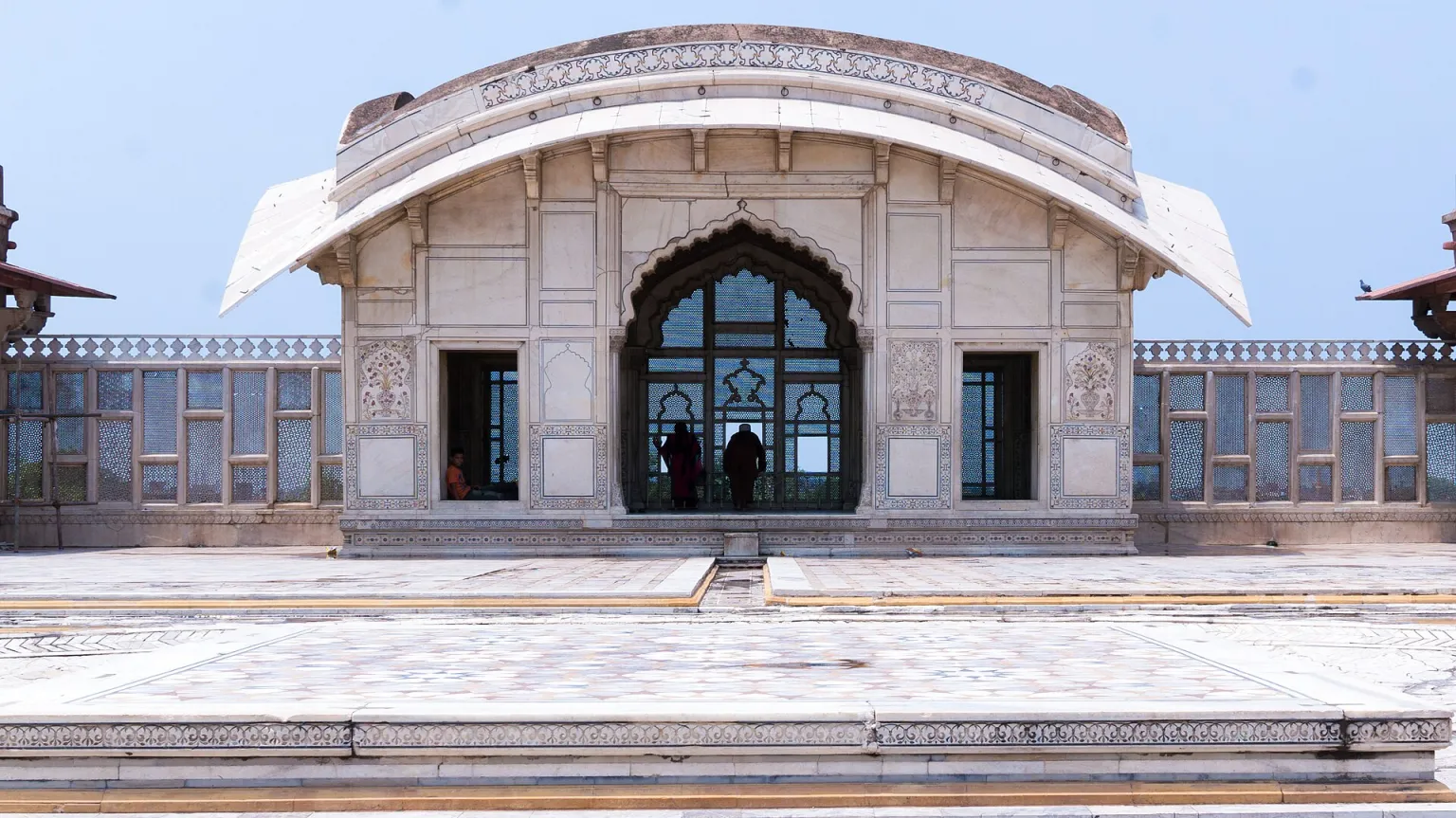
Naulakha Pavilion invites a different pace from Lahore Fort’s monumental gateways. It is a small rectangular marble building beside the Sheesh Mahal in the fort’s northern area. Archnet attributes it to Shah Jahan and records 1633. The authority places it west of the Sheesh Mahal and draws attention to its extraordinary curved roof. Start with that compact combination of plan, material and silhouette before becoming absorbed in the name’s associations with wealth.
From the permitted viewing area, notice the contrast between a small pavilion and the larger court around it. Its importance does not depend on enclosing an immense interior. A light-looking roof, carefully shaped openings and finely worked surfaces can focus attention within a much larger palace complex. This guide keeps the pavilion as its subject; it does not attempt to replace a wider fort visit or a separate reading of the mirror-work in the neighbouring Sheesh Mahal.
Put Shah Jahan’s patronage ahead of the cost story
The authority explains Naulakha’s name through nine lakhs of rupees and the significance associated with the number nine. It also attributes the pavilion to Shah Jahan’s architectural world. Present the cost explanation as the authority’s account rather than converting it into a modern budget comparison. Historic money, building accounts and later storytelling do not translate neatly into what an equivalent project would cost today.
The securely useful starting points are the patronage, the marble construction and the relationship to the surrounding Shah Burj buildings. If a guide adds a story about the emperor’s favourite seat or a particular court ceremony, ask what record supports it. A palace building can express status without every anecdote being documented. Keeping the interpretation close to the fabric allows visitors to enjoy its refinement while leaving room for unresolved questions about exact use and personal preference.
Trace the curve with your eyes
Archnet identifies the deeply curving roof with the Bengali tradition and also discusses a relationship to baldachin forms seen in European illustrations. This is a reminder that Mughal architecture could bring different visual references into a courtly setting. It is more useful than treating the roof as an inexplicable flourish or assuming that every curved form belongs to a single exclusive source.
Look at the roof from a frontal viewpoint, then from a permitted oblique position. The first emphasises the rise and fall of its outline; the second reveals how that profile sits above the rectangular body. Notice where shade collects beneath projecting edges. These are observation prompts, not a measured analysis of the roof’s structure. Do not lean over a parapet or cross a barrier to obtain the outline. A partial safe view is enough to understand why the roof is the pavilion’s most recognisable feature.
Separate marble structure from coloured inlay
The white marble gives the pavilion a strong material identity, but its decorative effect is not limited to a uniform pale surface. Archnet highlights pietra dura, the technique of fitting coloured stone into a stone ground. At a permitted close viewpoint, distinguish the surrounding marble from the boundaries of an inlaid motif. The contrast between a large continuous field and small precise shapes is central to the visual effect.
Do not assume that every coloured area uses the same technique. Archnet also records glazed tile decoration around arched openings. Different materials may be present within one small building, and their condition can make distinctions less obvious. Use labels or a knowledgeable guide where available. Touching, polishing with a sleeve or wetting the surface will not improve understanding and can harm the work. A camera zoom can help record an edge without bringing hands near sensitive ornament.
Read the pavilion through the court around it
The Naulakha stands within a connected palace setting rather than as a detached garden ornament. Compare its openings with the open court and neighbouring façades. Ask what can be seen through an arch and what changes when the observer moves slightly to one side. A pavilion can organise looking as much as it provides shelter; that is an architectural observation, not a claim to recreate the emperor’s exact experience.
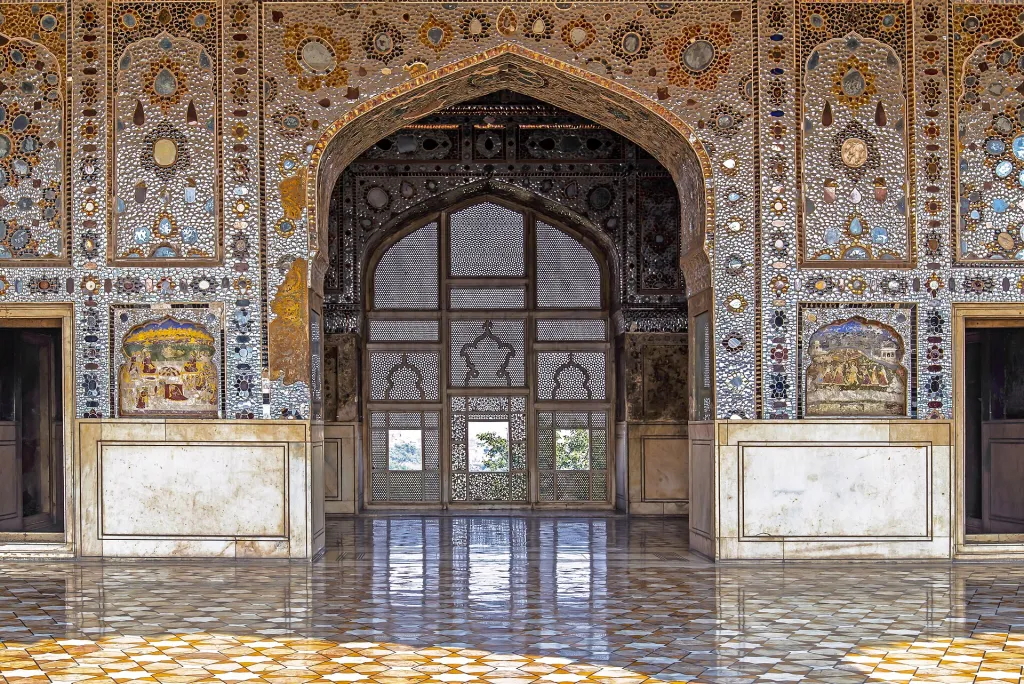
Keep the Naulakha distinct from the Sheesh Mahal in captions. A photograph of mirror-work documents the neighbouring hall, not an unseen interior of the pavilion. Similarly, the Alamgiri Gate is another structure elsewhere in the fort. It can supply wider context for an arrival route, but its red masonry and monumental bastions should not be presented as Naulakha details. Clear place names make a visual article more useful than a collection of attractive but interchangeable fort photographs.
Add the documented 2021 conservation layer
The authority records conservation of Naulakha Pavilion in 2021 by AKTC and the Walled City authority, with funding from the Royal Norwegian Embassy. This gives the building a documented recent care history alongside its seventeenth-century attribution. It does not mean every bright surface is a replacement or that an irregularity visible today can be diagnosed from a visitor’s glance.
Where an interpretive panel explains a treatment, note the date and the element discussed. Compare that information with what is actually visible, without assigning original or restored status from colour alone. Lighting, polish, weathering and earlier interventions can all affect appearance. Conservation deserves attention as skilled work guided by evidence, rather than a contest to make an old building look new. Visitors can support that care by keeping bags clear of surfaces and respecting any temporarily restricted observation area.

Plan the pavilion as one deliberate stop
Before travelling, confirm the fort’s current admission arrangements and whether the route to Shah Burj and the pavilion is available. A general fort ticket description is not proof that every chamber or platform is open. If the pavilion is the main reason for visiting, ask specifically about its current viewing arrangements rather than relying on an old tour photograph or a general list of highlights.
The fort’s official visitor information says the standard route may not be step-free and advises arranging access needs in advance. Discuss the actual distance, surfaces, steps and rest options for the intended stop. Check air quality and weather before a prolonged outdoor walk, and carry water. Leave enough time to return to transport without hurrying through level changes. A focused stop with two viewpoints and a short rest can be more rewarding than adding another palace interior after the group is already tired.
Try a hypothetical material-and-outline exercise
Imagine a hypothetical family learning visit. One person makes a simple line showing the roof’s curve on a blank page, another lists the visible materials, and a third describes how an opening frames the surrounding court. Afterwards, they compare the notes and put question marks beside anything they could not confirm. This is a suggested activity, not a report of a family observed at the fort.
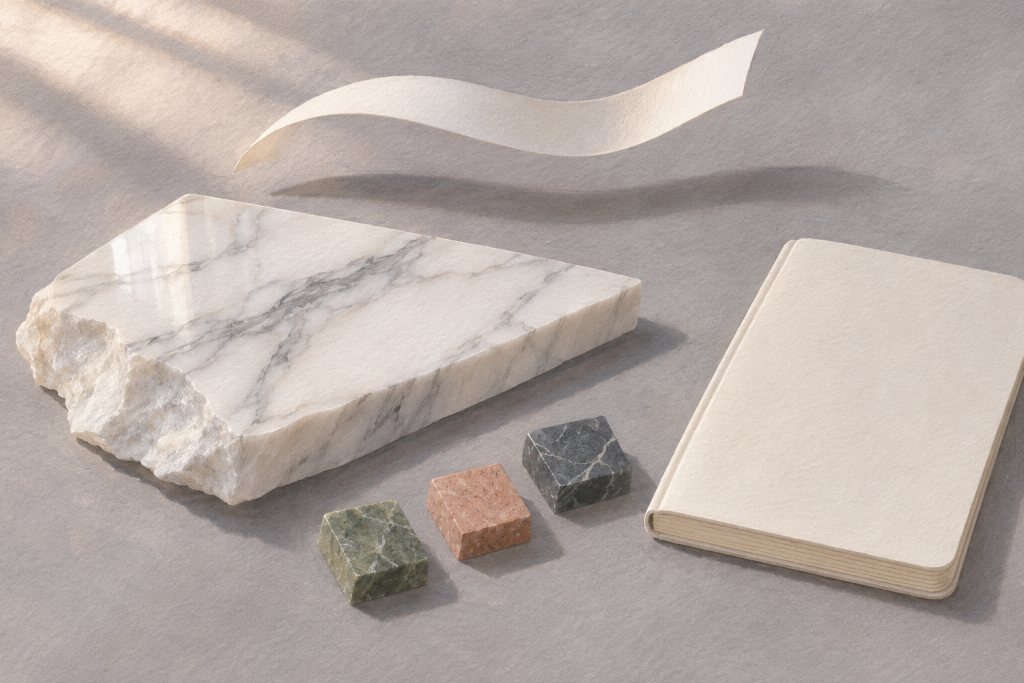
At home, a curved strip of paper and a modern stone sample can introduce the distinction between outline and material. They cannot reproduce the pavilion’s engineering or establish historic carving methods. The accompanying illustration uses contemporary observation materials for that limited purpose. Keep all props away from the actual monument. The best outcome is a few sharper questions about how a small building creates presence, rather than an invented reconstruction that supplies missing details with confidence.
Keep the roof’s appeal and the evidence together
The pavilion’s memorable silhouette makes it tempting to reduce a visit to a single iconic photograph. Add a second view that includes its court relationship and a third note about material or conservation. Together, these explain why the Naulakha remains distinctive even within a fort full of important buildings. Its charm comes from the interaction of a compact form, unusual roof and finely handled surfaces.
Archnet treats the roof’s original gilding as probable, not certain. Preserve that qualification if discussing its earlier appearance, and avoid promising a complete recovery of the seventeenth-century colour scheme. Lahore Fort’s World Heritage status provides wider context, while current access remains a management question to verify separately. A careful account can retain the pleasure of the name and the elegance of the architecture without transforming attractive possibilities into established facts.
Frequently Asked Questions
Where is Naulakha Pavilion?
It is in the northern palace area of Lahore Fort, beside and to the west of the Sheesh Mahal.
Why is the roof distinctive?
It has a deeply curved profile. Archnet discusses Bengali and baldachin references in its architectural interpretation.
Was its roof gilded?
Archnet says the original roof was probably gilded. That qualification should be retained.
Can I enter the pavilion on a normal fort visit?
Confirm the current route and viewing arrangements with the fort. A general highlights list does not guarantee interior access.
How we know this
- Type Practical guide
- Sources 4
- Reviewed November 2026
- Disputed points None
Rules and fees change, confirm with the official links below before you act.
4 sources
- Naulakah Pavilion, Punjab Walled Cities & Heritage Areas Authority
- Lahore Fort Complex: Naulakha Pavilion, Archnet
- Naulakha Pavilion, Lahore Fort / Walled City of Lahore Authority
- Visit & Information, Lahore Fort / Walled City of Lahore Authority
Photo credits (3)
- Naulakha Pavilion in Lahore Fort.jpg, Jawad.hassan89, CC BY-SA 3.0, via Wikimedia Commons
- Sheesh Mahal, Shahi Qila, Lahore (1).jpg, Faisalrazamalik, CC BY-SA 4.0, via Wikimedia Commons
- Alamgiri Gate - Main entrance to Lahore Fort.jpg, S.hassanjawad, CC BY-SA 3.0, via Wikimedia Commons
