
Travel · Attractions
Read the gateway from both sides
Follow the transition from Lahore’s eastern gateway into its working streets, separating the gate’s historic role from later changes and area conservation.
- Read the details
- Plan the approach
- Respect the fabric
Delhi Gate, Lahore
Start outside the arch, with a question
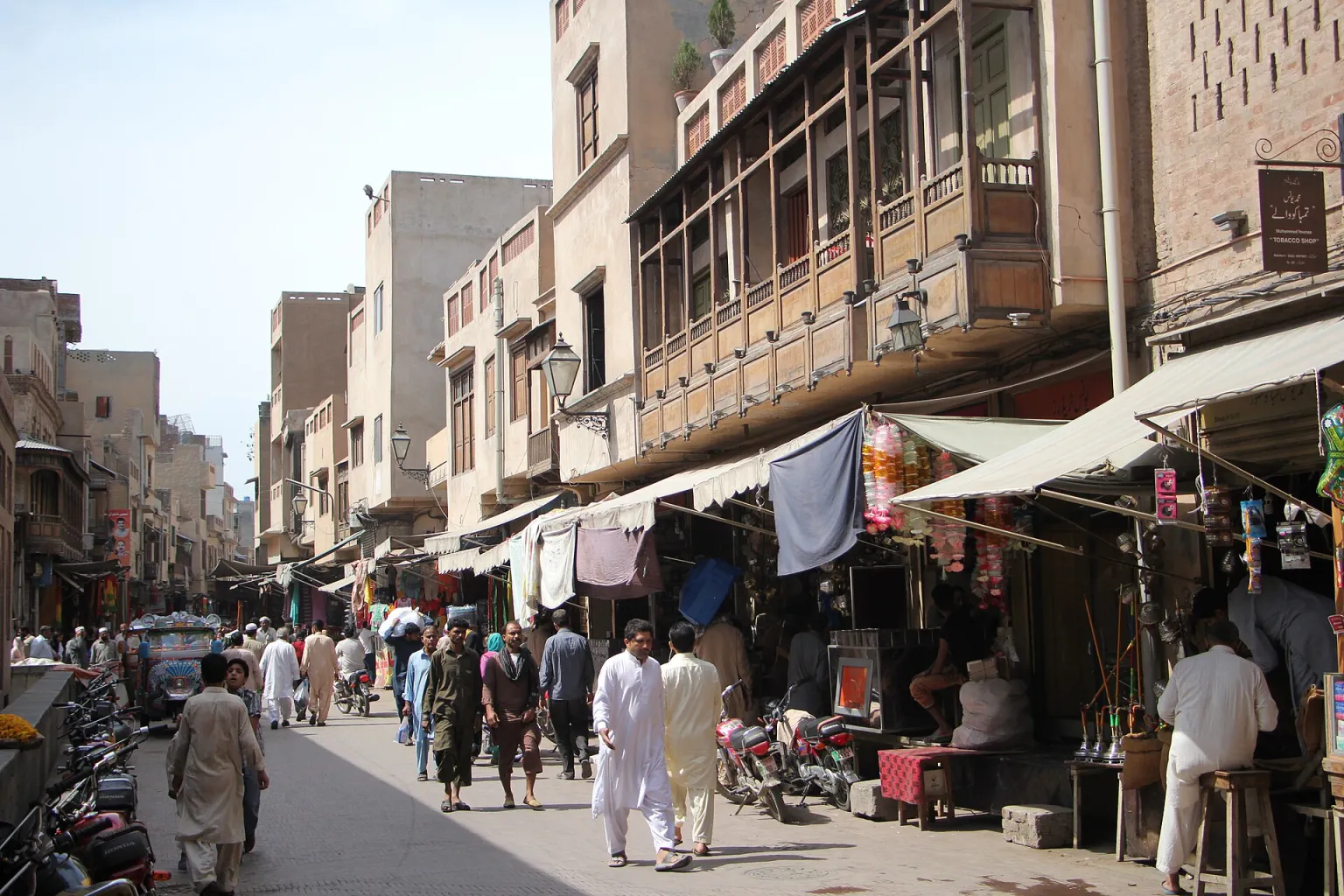
Delhi Gate rewards a slower approach than a photograph taken under its arch. It is a threshold between a major historic entrance and the streets that continue to carry everyday trade, errands and religious journeys. The federal archaeology inventory places it on the eastern side of Lahore’s fortification, facing towards Delhi, and explains the name through that orientation. Begin by noticing the relationship between a large opening and the smaller routes beyond it.
Choose a safe standing place outside the flow of traffic. Look at how the gate frames a view, then ask what lies outside that frame: approaching streets, commercial activity and connections to the railway station. The gate becomes more intelligible when treated as part of an urban network. This guide follows that threshold and its immediate setting; it is not an itinerary through every monument inside the Walled City.
Keep the gateway’s role separate from the age of every surface
Lahore’s gateways belong to a city that changed under Mughal, Sikh and British rule. The authority’s history records the Mughal development of the walled city and names Delhi Gate among its entrances. That establishes an important historic role, but it does not prove that every visible brick, plaster patch or parapet belongs to a single campaign. An ancient entrance can retain its place and name while its fabric changes.
Resist assigning the entire visible structure to an emperor merely because the gateway existed in his period. A useful guide should distinguish the history of the entrance from the dating of surviving construction. If an on-site panel identifies a rebuilding, record its wording and source. Until then, describe what can be observed: the arch opening, wall thickness, adjacent structures and transitions in materials. These details tell a richer story than an unsupported claim of complete originality.
Read the opening, thickness and changing view
From an authorised pedestrian position, compare the gate straight on and from an angle. The frontal view emphasises the outline of the opening. The angled view makes the depth of the passage easier to understand. Notice how a wall can be both a façade and a space through which people move. The transition from outside to inside is an architectural experience even without access to upper rooms.
Look upwards only after stopping safely. Identify ledges, openings and changes in plane without assuming their precise original use. A window is not proof of a guardroom, and a closed door does not establish a public staircase. From inside, turn back towards the opening to see how the surrounding street changes its apparent scale. Photograph the two views if the passage is clear. Avoid standing in the centre while other people negotiate the same threshold.
Follow the street as a connected piece of heritage
The conservation programme in Lahore developed beyond individual buildings. AKDN records a restored heritage trail of 383 metres between Delhi Gate and the Chowk Purani Kotwali market area. Its wider account describes surveys, infrastructure and attention to housing and services. These are reminders that the quality of a heritage street depends on drains, utilities, building frontages and daily maintenance as well as its most photogenic arch.
On a short walk, observe how shopfronts, upper storeys and intersecting lanes relate to the principal route. Keep a distinction between visible work and the published project record: a tidy façade is not sufficient evidence of the date or scope of a conservation intervention. Nor does a restored corridor mean the entire surrounding neighbourhood has been rebuilt. Move through the street as an inhabited place, allowing traders to serve customers and residents to reach their doors.
Use neighbouring monuments as orientation points
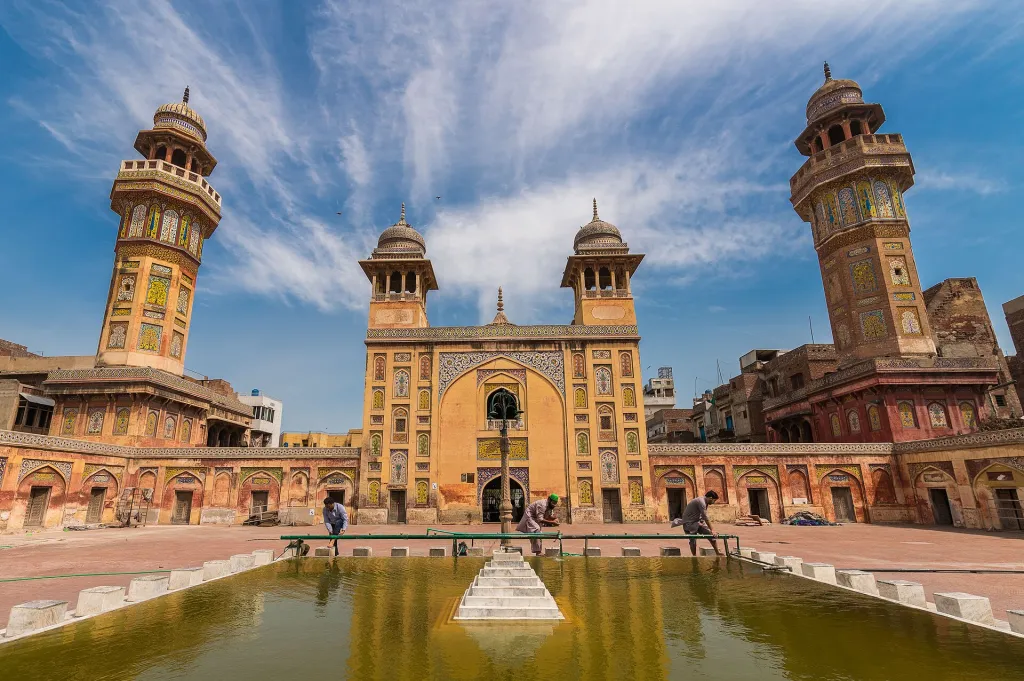
The federal gate record places Wazir Khan Mosque nearby inside the entrance. The Shahi Hammam is another important point on this approach, and AKTC records completing its conservation in 2015. These landmarks help visitors orient themselves, but each has its own history, management and conditions of entry. Passing the gateway should not be confused with admission to the hammam or permission to enter a religious space.
For a focused visit, choose the gate and the walk towards the next clear public landmark. Save interior visits for a separate decision based on available time and current arrangements. This makes the changing street width, framed views and transition between transport and walking the main subject. If you continue towards the mosque forecourt, notice how another threshold appears: a dense commercial route opens into a larger public space. Delhi Gate begins a sequence rather than completing the story.
Understand conservation without expecting a frozen street
The authority’s description of the old city acknowledges wooden balconies, havelis, bazaars and surviving layers from different periods. Such a place cannot be understood as a single Mughal scene preserved without interruption. The point of area conservation is partly to keep buildings useful and the neighbourhood viable. Modern services and contemporary livelihoods belong in that discussion, even when they are less decorative than a historic façade.
Compare the ground floor with the storeys above it. A commercial use below and domestic spaces above can produce different patterns of maintenance and alteration. Treat that as a question to investigate, not permission to photograph a private interior. Ask before making a person the subject of a photograph. Avoid describing residents as part of a spectacle or presenting ordinary commerce as an obstacle to an otherwise empty monument. The living street is central to this attraction.
Plan a short pedestrian approach that can change
Check the day’s air quality, heat, rain and visibility before committing to a long outdoor walk in Lahore. Arrange a clear drop-off and collection point that the driver can legally reach, and keep enough flexibility to shorten the outing. A map’s short line between monuments does not account for crowds, deliveries, uneven surfaces or the time needed to cross a busy road. Walking slowly can be more demanding than the distance suggests.
For someone using a wheelchair, walking aid or pushchair, ask specifically about the approach surface, kerbs, pinch points and any steps at intended stops. Do not infer continuous step-free access from a wide gateway photograph. Carry drinking water and use footwear suited to uneven paving. Keep children close when crossing the threshold and negotiating traffic. Confirm toilets and a suitable rest stop before the group needs them rather than assuming the next monument will provide both.
Try a two-view threshold exercise
This is a hypothetical observation exercise for a small group. Before passing through, one person notes three things the opening frames and another records what remains outside it. After crossing, they repeat the exercise looking back. A blank notebook and a pencil are enough; a detailed plan or knowledge of architectural terminology is unnecessary. The aim is to see how position changes the apparent shape and importance of the gate.
Then choose one contemporary function visible nearby, such as moving goods or entering a shop, and consider how the gateway accommodates it. Do not question strangers about private business or stage photographs in their path. Keep notes descriptive: narrow, wide, shaded, crowded, recessed. Save interpretations such as defensive intention or original room use for evidence from a reliable record. A short exercise can improve observation without converting the street into a classroom that blocks everyone else.
Leave with a precise description of the threshold
At the end of the walk, distinguish three things: where the gate sits, what its visible architecture does and how the street continues to function. The eastern orientation and relationship to Delhi belong to the documented history. The framing of views and contrast between passage and street are observations. The condition of an individual shopfront, access to an upper room or a specific traffic pattern belongs to the day of a visit.
Keep those categories separate when sharing recommendations. An image taken in quiet conditions does not guarantee a similarly clear route later. A successful visit may consist of two viewpoints and a short section of the street, particularly when air quality or mobility makes a longer outing unwise. Delhi Gate offers enough interest for that modest plan: a substantial architectural opening, a remembered city boundary and a working connection between Lahore’s past and its present.
Frequently Asked Questions
Why is it called Delhi Gate?
The federal inventory explains the name through its position on the eastern side of the old fortification, facing towards Delhi.
Is this an entrance ticket to all nearby monuments?
No. Check each monument’s current arrangements separately; passing along a public route does not establish interior access.
Can visitors go upstairs in the gate?
Do not assume that upper rooms or stairs are open. Follow the current permitted route and ask the responsible authority.
How much walking is needed?
A focused outing can use the gate and a short adjoining street section. Choose distance around the group’s mobility and the day’s conditions.
How we know this
- Type Practical guide
- Sources 4 (1 official/academic)
- Reviewed November 2026
- Disputed points None
Rules and fees change, confirm with the official links below before you act.
4 sources
- Delhi Gate, Department of Archaeology and Museums, Pakistan
- History of Lahore’s Walled City, Punjab Walled Cities & Heritage Areas Authority
- Heritage and Renewal in the Walled City of Lahore, Aga Khan Development Network
- Protecting Heritage & History, Punjab Walled Cities & Heritage Areas Authority
Photo credits (3)
- Delhi Gate 11 (WCLA).jpg, The Walled City of Lahore Authority, CC BY-SA 4.0, via Wikimedia Commons
- Wazir Khan Mosque by Moiz.jpg, Moiz Ismaili, CC BY-SA 4.0, via Wikimedia Commons
- Tile art at Wazir khan Mosque.jpg, self (Atif Gulzar), CC BY-SA 3.0, via Wikimedia Commons
