
Travel · Attractions
Look closely at colour, structure and loss
Read Uch Sharif’s tomb cluster through its brickwork, blue-and-white decoration and damaged forms while respecting a sacred landscape and its conservation boundaries.
- Read the built landscape
- Observe from permitted paths
- Check current access
Uch Sharif, southern Punjab
Begin with a cluster, not one postcard view
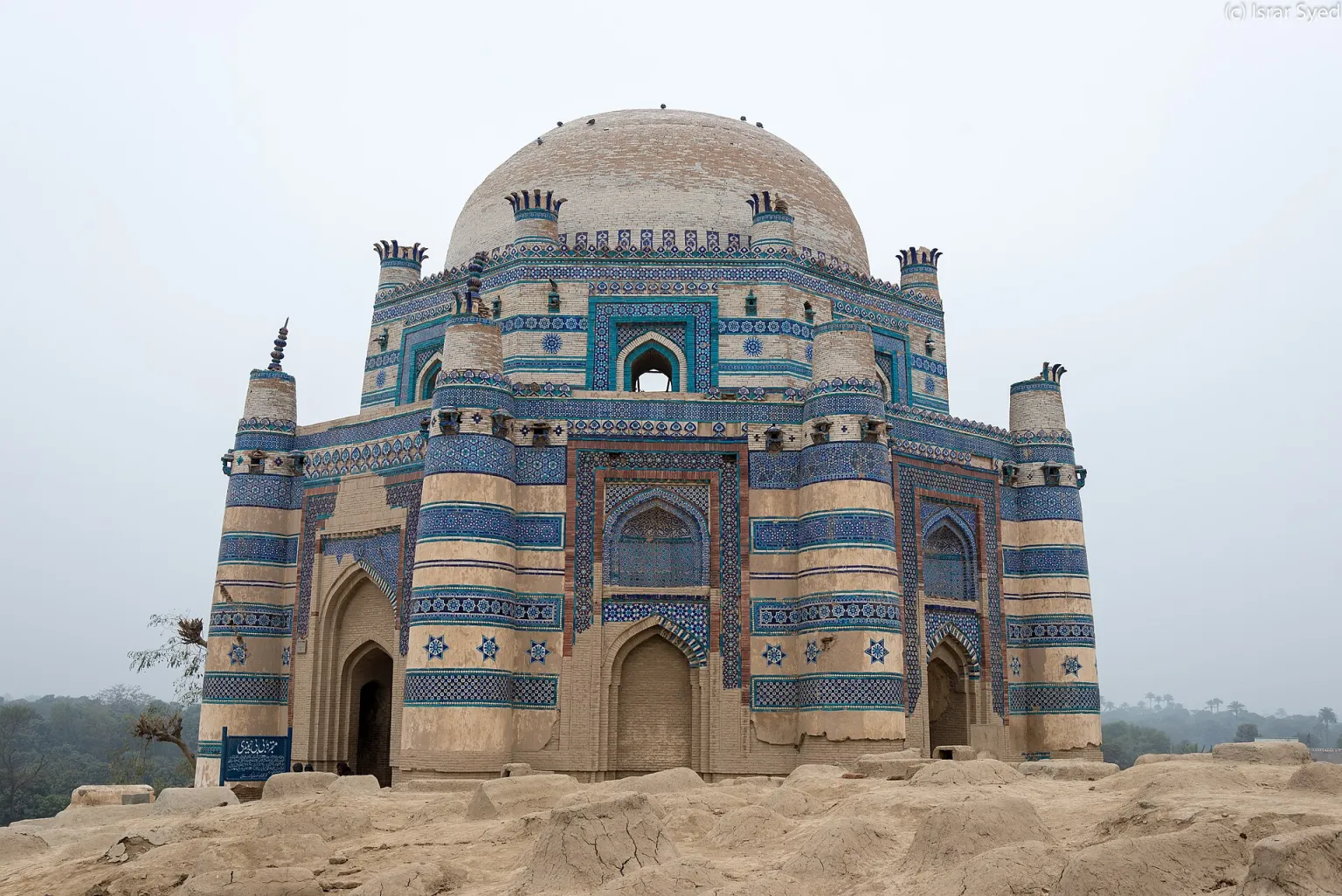
Uch Sharif’s celebrated tombs are part of a wider sacred and architectural landscape in southern Punjab. Bibi Jawindi’s monument often becomes the visual shorthand, yet the relationship between neighbouring tombs and other religious buildings is central to understanding the place. Start with names and a plan, and keep the individual monuments distinct when taking photographs or describing details.
Pakistan’s UNESCO Tentative List submission groups five monuments: the tombs associated with Bibi Jawindi, Baha’al-Halim and Ustead, and the tomb and mosque of Jalaluddin Bukhari. Submitted in 2004, this is not a World Heritage inscription. Names and spellings vary across accounts, including Jawindi, Javindi and Jalwindi. Match a label to its particular structure instead of assuming every blue-and-white domed ruin is the same tomb. This guide concentrates on the relationship between architectural form, decoration and damage rather than treating the town as a checklist of saints’ names.
Read the transition from base to dome
The official submission describes the three domed tombs through a sequence of forms: an octagonal lower body, a transitional zone above it, and a dome. This is a helpful reading exercise even where only part of the structure survives. From permitted ground, trace how the wall changes direction and where the upper form would have been supported, using interpretation to distinguish observed fabric from an inferred complete outline.
Look at corner towers or engaged supports as part of the building’s organisation. Do they emphasise edges, frame a decorated panel or change your sense of height? These are questions you can explore without touching the wall. Do not treat a gap in damaged masonry as an invitation to move into the building. A view showing a broken edge may be informative, but the observation should be made from an approved path, with present barriers and any conservation staff’s directions taking priority over an attractive camera angle.
Let tilework explain how the surface is organised
Blue-and-white decoration is more useful to observe as an arrangement than as a single colour impression. At a safe distance, identify broad bands, framed panels and repeated geometric or floral elements. Notice where a pattern changes scale to fit a corner or a different part of the building. A detail photograph should be paired with a wider view so that the decorative fragment retains its architectural location.
Pakistan’s UNESCO submission describes faience mosaic tiles, cut and moulded brick, and carved timber among the materials of the ensemble. Do not assume that every blue surface uses the same technique or that a plain section was originally undecorated. Use the particular monument’s interpretation to identify material. Avoid rubbing a tile, wetting a surface to intensify colour or lifting a loose piece for a photograph. The image you want is temporary; the surface is part of a fragile building whose material history continues beyond your visit.
Understand flood damage without diagnosing every crack
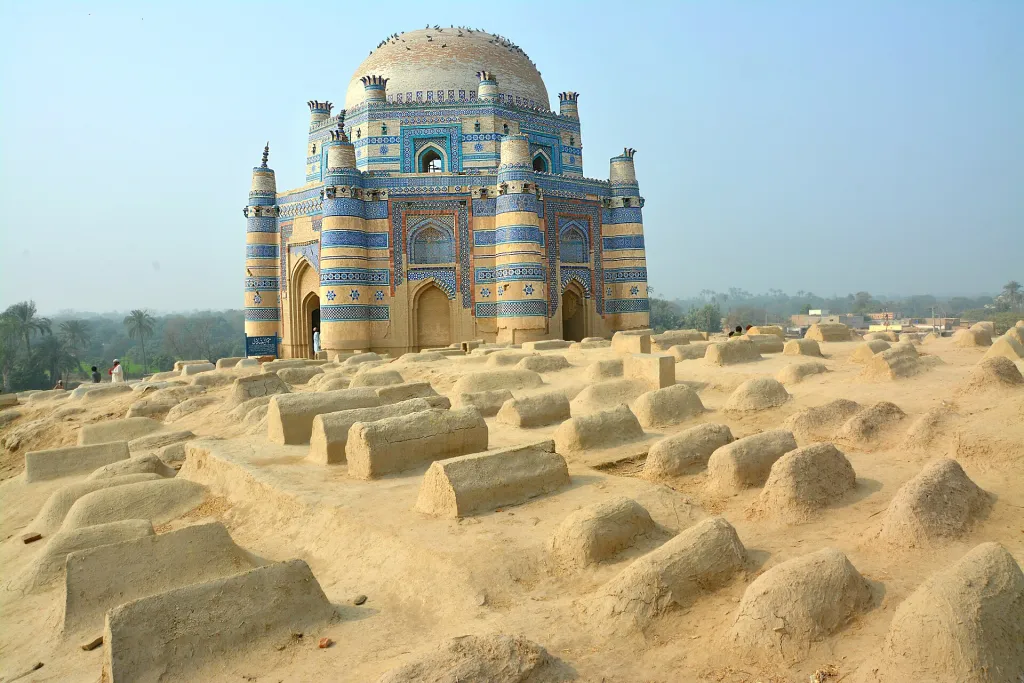
Flood damage is essential context for the partial ruins. The IRCICA architectural inventory associates major losses at Bibi Jawindi’s tomb with the 1817 flood, and later conservation reporting records continuing concern about the tombs’ condition. That background helps explain why some famous views appear to show a building sliced open. It does not establish that every missing tile, crack or displaced brick was caused by the same flood.
From permitted ground, separate observations such as a missing wall section, an exposed core or an interrupted decorative band. Then distinguish a source’s explanation from your own question. Erosion, structural movement, water and past repair can interact, but a visitor’s photograph cannot diagnose the cause of an individual defect. Do not step over a barrier to inspect a crack more closely. If you notice an immediate concern in an open visitor area, give staff its location and a clear description rather than attempting a repair or making a dramatic unsupported claim about imminent collapse.
Make loss visible without treating it as a spectacle
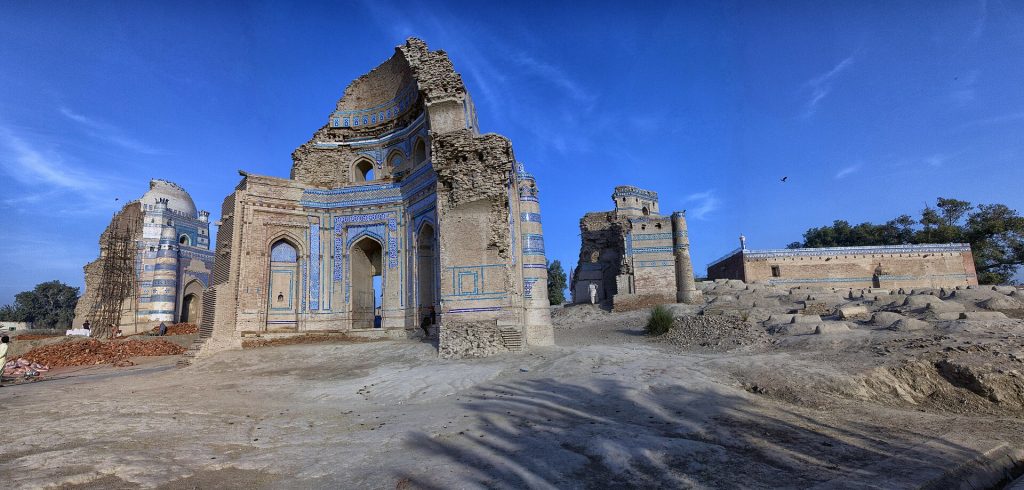
A damaged edge can reveal how decoration, facing and structural masonry relate. It can also be a vulnerable part of the monument. Choose a viewpoint that shows the relationship without entering an unstable area, leaning a bag against the wall or using the ruin as a portrait backdrop. Do not ask another person to stand on masonry to provide scale.
Think about what a caption needs. “Partial remains of the tomb” identifies a condition; “destroyed by one named event” makes a historical causal claim that needs evidence. Similarly, clean-looking joints or brighter tiles may raise a question about recent work but do not prove a restoration date. If a conservation project is signposted, record the responsible organisation and the date shown before discussing its scope. Reports of a project beginning do not establish that every building is now restored, that all routes are open or that the work has finished.
A material comparison can deepen the experience
Here is a hypothetical observation exercise: choose one accessible view where brick, decorated surface and an area of loss can all be seen. Describe the three materials or conditions in ordinary language. Then choose one repeat in the decoration and follow it visually across a band or around an edge. Stop where the surviving pattern stops rather than completing it in your photograph caption from imagination.
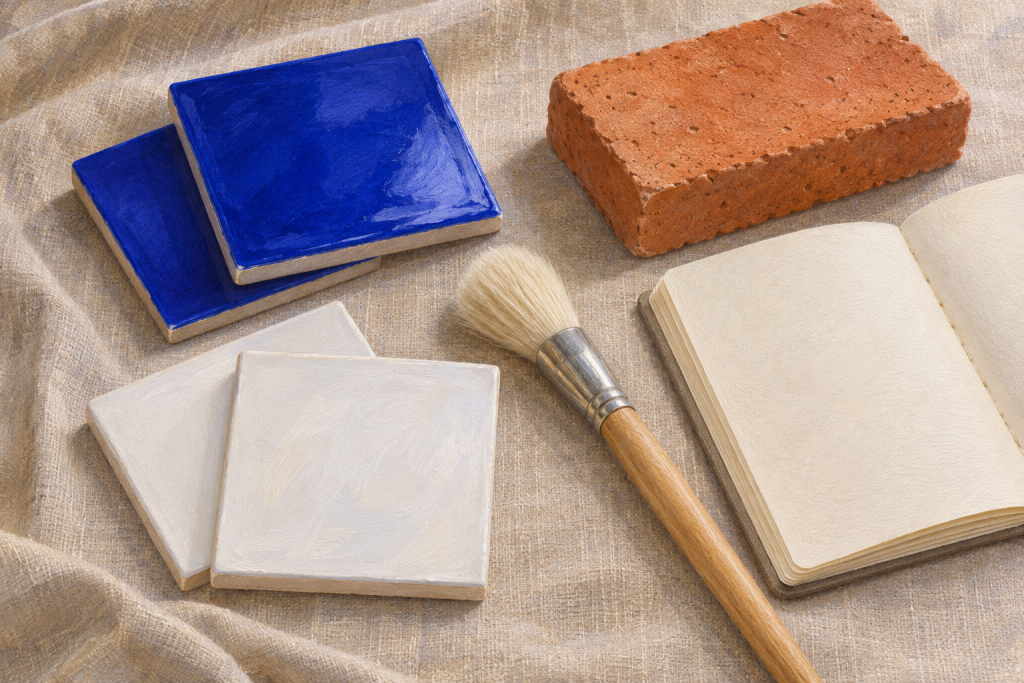
For a family, compare the different ways a surface creates rhythm: a line of bricks, a sequence of colours and the repetition of architectural corners. For someone interested in craft, note the questions that need a specialist answer, such as how pieces were shaped or fixed. Modern ceramic and brick samples can help explain the idea away from the monument; they should never be represented as fragments collected here. These are suggested activities, not a report of a guided visit, and they require no touching, tracing or removal of historic material.
Visit a sacred place with current access confirmed
Uch Sharif is a religious landscape as well as an architectural attraction. Dress and behave respectfully, follow caretakers’ directions and ask before photographing identifiable worshippers or ceremonies. Check which interiors are open, whether shoes should be removed in a particular space, and whether a religious occasion changes visitor movement. Do not assume one rule applies identically across the entire ensemble.
Before departure, contact the relevant archaeology or conservation authority about present access, active works, closures, admission and photography restrictions. No fixed opening hours or ticket price are confirmed here. Check local weather, route conditions and applicable travel advice, and plan for heat and exposed walking. Confirm toilets, drinking water and mobility requirements in advance. If a route is closed for work or safety, an exterior view and a reliable plan may be the appropriate experience. A centuries-old sacred building does not become a publicly accessible interior simply because it is prominent in travel photographs.
Leave with names, materials and uncertainties intact
End by matching your photographs to the correct monument name, the feature shown and the viewpoint. Avoid using a Bibi Jawindi caption beneath a neighbouring tomb merely because the tilework looks similar. If you cannot identify a detail securely, describe it at the cluster level and keep the location note for later checking. This small discipline prevents a visually appealing account from spreading incorrect attributions.
The ensemble’s power comes partly from the coexistence of elaborate craft and visible loss. A good visit can recognise both without turning damage into romance or assuming every gap should be filled. Continue with the official submission and documented conservation material when you want to understand a disputed attribution or intervention. Take notes and permitted photographs; leave tiles, brick fragments and surfaces undisturbed. Uch Sharif becomes more legible when each observation stays attached to its building and each historical explanation stays attached to its source.
Frequently Asked Questions
Is the Uch Sharif tomb cluster a UNESCO World Heritage Site?
The five-monument ensemble is on Pakistan’s Tentative List, submitted in 2004. That is different from World Heritage inscription.
Did one flood cause every visible defect?
No such diagnosis is established. The 1817 flood is associated with major losses, but individual damage and later change require evidence.
Can I touch tiles to study the surface?
Observe and photograph from permitted areas. Do not touch, rub, wet, trace or remove material.
Are all interiors open?
Access differs by building, religious use, safety and conservation work. Confirm present arrangements and follow caretakers’ instructions.
How we know this
- Type Practical guide
- Sources 4 (2 official/academic)
- Reviewed November 2026
- Disputed points None
Rules and fees change, confirm with the official links below before you act.
4 sources
- Tomb of Bibi Jawindi, Baha’al-Halim and Ustead and the Tomb and Mosque of Jalaluddin Bukhari, UNESCO World Heritage Centre
- Tomb of Javindi Bibi, inventory no. 92-6902-1, IRCICA: Research Centre for Islamic History, Art and Culture
- Tomb of Bibi Jawindi, Department of Archaeology and Museums, Pakistan
- WCLA initiates conservation of Shrines at Uch Sharif, 6 March 2025, Associated Press of Pakistan / Walled City of Lahore Authority statement
Photo credits (3)
- Tomb of Bibi Jawindi Uch Sharif.jpg, Israr Syed, CC BY-SA 4.0, via Wikimedia Commons
- Tomb of Bibi Jawindi in Uch Sharif 2015.jpg, Umair, CC BY-SA 4.0, via Wikimedia Commons
- Uch Sharif - Shrine of Baha'al-Halim.jpg, Syed Bilal Javaid, CC BY-SA 4.0, via Wikimedia Commons
