
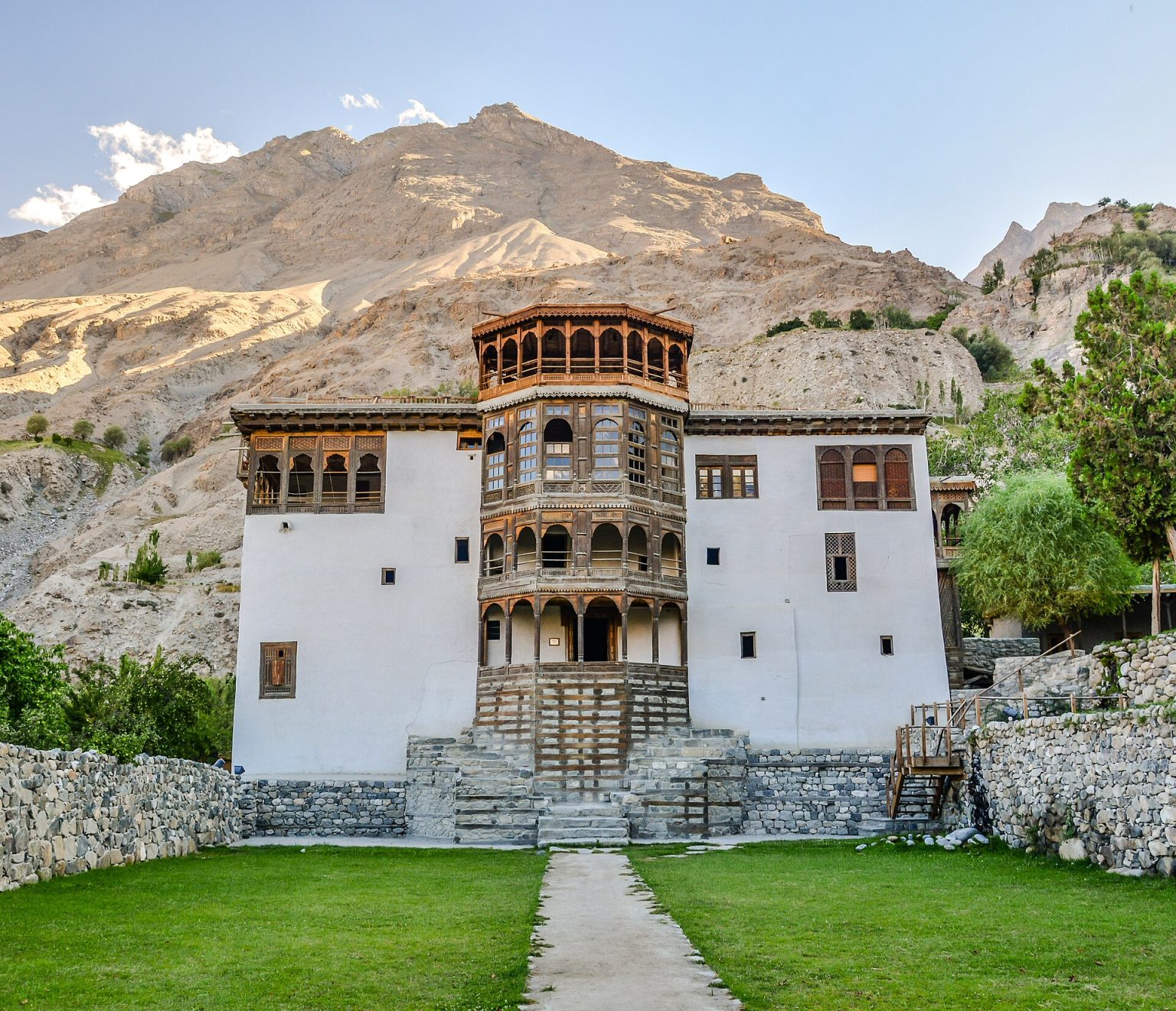
Travel · Attractions
Read Khaplu through timber and light
Look closely at Khaplu Palace’s timber screens, courtyard plan and conservation, while distinguishing the public heritage experience from a working hotel.
- Architecture and context
- Confirm visiting arrangements
- Plan the approach
Khaplu Palace · Gilgit-Baltistan, Pakistan
Start with a palace, not a castle checklist
Khaplu Palace deserves to be read as a residence and seat of authority, rather than visited with a checklist of battlements and weapons. Its most revealing details are often about thresholds, timberwork and the relationship between rooms and open space. Begin by looking at the whole building from an authorised public area, then choose one balcony or entrance detail to follow more closely.
AKDN dates the palace to 1840 and records a major restoration beginning in 2005 and reopening in July 2011. Those dates establish useful reference points, but they do not mean every visible piece of wood belongs to 1840. Ask what is original fabric, what was repaired and what was added for the current use. A conservation story is strongest when attached to a specific material decision rather than a general claim that everything has been returned to its former glory.
Follow the timber around an opening
Archnet describes stone masonry reinforced by timber, lime plaster, carved posts and elaborate door and window surrounds. It also identifies screened verandas and projecting balconies as characteristic features. Read these details slowly: a post supports something, a screen filters a view, and a carved frame marks a transition. Decoration and practical use can occupy the same element.
From a place staff permit, follow one opening from sill to lintel and compare it with the next. Look for differences rather than assuming a perfectly repeated pattern. Ask whether visible repair work belongs to the conservation campaign. Do not press on a screen, lean through a window or test whether a carved component is loose. Close-up photographs, if permitted, can help you look afterwards, but turning every detail into a phone screen may mean missing the way it sits in the larger façade.
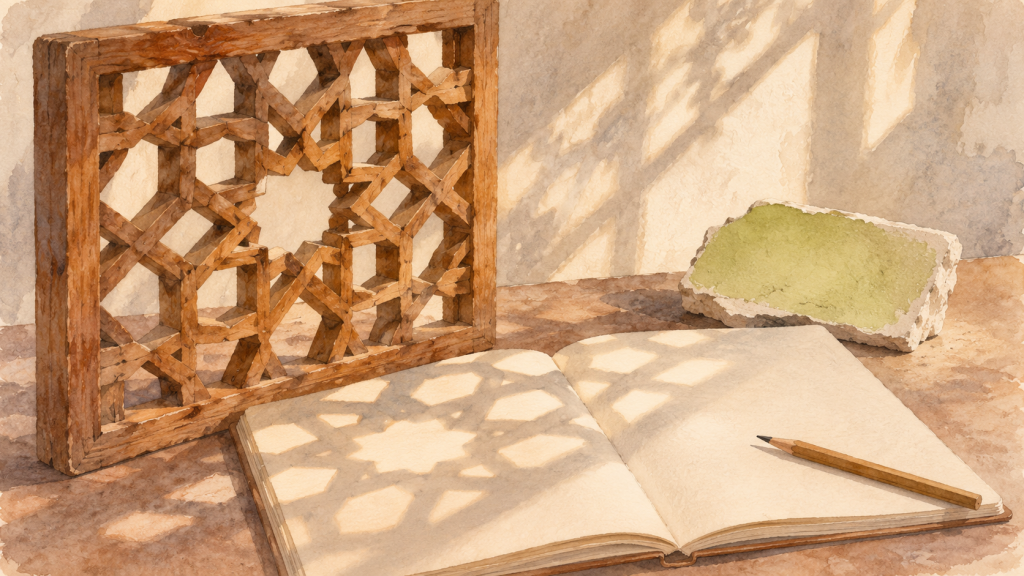
Screens make light part of the visit
A timber screen can be appreciated through the changing light it admits, not only through its pattern. In an accessible room or veranda, pause long enough to notice the difference between the solid frame, the openings and their shadows. This is a present-day observation, not proof of exactly how a nineteenth-century resident experienced the room or which activity took place beneath that patch of light.
The accompanying illustration uses a generic detached lattice and notebook to introduce that act of looking. It does not reproduce a palace screen or document an authentic motif. For a real detail, rely on the building and identified archival photographs. With children, try a hypothetical exercise: compare what can be seen from near a permitted screen with what becomes visible after stepping back. Keep hands and bags clear of timberwork and avoid obstructing a narrow passage while discussing the result.
The courtyard is an organising space
Archnet’s record describes a rectangular arrangement around a central courtyard and relates it to Kashmiri manor-house forms. It also distinguishes the inner court from a larger garden. That is a helpful starting point for reading circulation: rooms are connected not simply by corridors but by open space, changing levels and visible relationships across the court. Do not assume that an apparently convenient doorway is part of the visitor route.
Stand where staff indicate and compare the inward-facing parts of the building with the outer façade. Which feels more enclosed, and which exposes more of the landscape? These are questions for interpretation rather than a claim about a particular historical ceremony. If restoration displays include before-and-after photographs, match one corner of the court with the image. A documented comparison teaches more about survival and change than labelling every picturesque surface as untouched.
Read restoration as a sequence of choices
The palace’s modern history includes the decision to combine conservation with hospitality. AKDN describes traditional carpentry and construction skills as part of the restoration programme, alongside wider community work. This gives the woodwork another layer of meaning: it is both inherited architecture and a place where knowledge had to be exercised again to keep the building usable.
Ask a guide for an example of a component retained after repair and another where replacement was necessary. You do not need to judge the engineering yourself. More useful questions concern what evidence was recorded, how a repair was identified and what ongoing care is needed. Avoid treating fresh plaster as evidence that a room has lost all historic value, or roughness as proof of age. Conservation may preserve old material while renewing sacrificial surfaces, and the explanation should be specific to the feature being discussed.
Public heritage and hotel privacy coexist
Serena’s current description identifies Khaplu Palace as a working boutique heritage hotel. It distinguishes six accommodations in the old palace from rooms in the more contemporary Garden House. This is a crucial practical distinction: a booking at the property does not automatically mean sleeping in the oldest fabric, and a heritage visit does not authorise entering guest accommodation.
Before arrival, ask exactly which interpretation rooms, courtyards, dining areas and exterior viewpoints are available to a day visitor. Confirm whether a guided visit, meal or room reservation is required for your intended activity. Do not photograph into bedroom windows or follow a guest along a corridor to see where it leads. Staff may need to alter access for operations or private events. Respecting those limits lets the heritage experience remain compatible with people using the building as accommodation today.
Use Shigar as a careful comparison
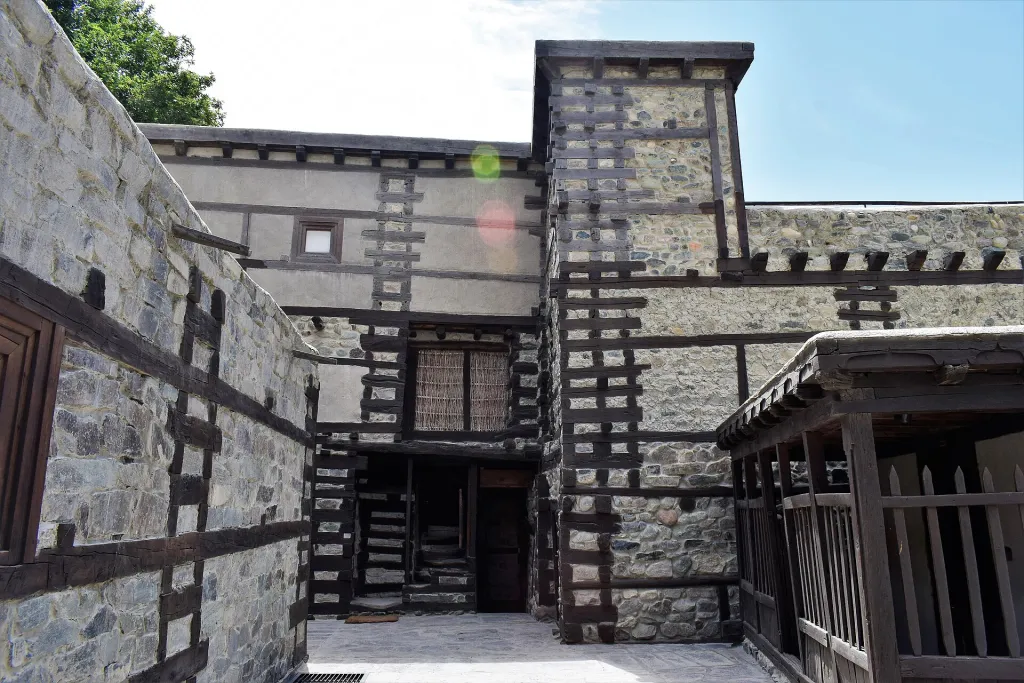
Khaplu and Shigar are often placed together because both are restored historic residences in Baltistan with hotel uses. A comparison can clarify the choices involved, provided it does not erase their differences. The photograph alongside this section shows Shigar Fort, a separate site; it is included to prompt a comparison of building form and reuse, not to suggest that its spaces belong to Khaplu.
If you see both, choose a narrow question: how is public interpretation separated from guest circulation, or how does a garden relate to the main building? Record only what you are permitted to observe. Do not rank authenticity by the number of modern amenities visible. A bathroom, emergency provision or service route may be essential to sustaining occupation; the meaningful question is how the change was integrated and documented, rather than whether the present can be hidden completely.
Make your access enquiry specific
Ask about the route from vehicle drop-off to reception, the public museum areas and any upper balconies you hope to see. Request details of steps, uneven thresholds, handrails, lighting and seating, plus the location and accessibility of toilets. If staying, discuss the actual assigned room category and access route rather than relying on the word hotel. Historic accommodation and Garden House accommodation can present different practical choices.
For a short visit, one well-explained courtyard and an accessible display may be a better plan than trying to cover every floor. Arrange it with staff in advance. Confirm current entry charges, guide availability, photography rules and meal timings directly; no present rate is established here. Avoid scheduling a visit so tightly that a waiting period forces someone to rush stairs. Carry only what you can manage comfortably without knocking a doorframe or carving.
Let the Baltistan journey set the schedule
Plan Khaplu as part of a realistic Baltistan itinerary, with the road journey and the palace visit treated as separate commitments. Confirm local road conditions with your driver or host shortly before travelling. A sunny courtyard photograph says nothing about a road farther along the valley, and a reservation does not guarantee a flight will operate. In colder weather ask about shaded ice, heating and which visitor areas are open.
FCDO regional advice checked on 7 November 2026 warns that northern flights can change at short notice and seasonal weather can restrict road routes. It also advises local security checks and registration for foreign nationals visiting Gilgit-Baltistan. Check current guidance for your nationality and route rather than assuming that an ordinary palace visit follows the same rules as a remote border or trekking itinerary. Leave an uncommitted buffer before an essential onward flight or appointment.
Frequently Asked Questions
Can a day visitor see guest rooms?
Only if the operator explicitly authorises it. Guest accommodation is private, even inside a historic palace.
Does every room booking mean the old palace?
No. Serena distinguishes old-palace accommodation from the more contemporary Garden House; confirm the assigned category.
When was the modern restoration undertaken?
AKDN records work starting in 2005 and the restored residence opening in July 2011.
Are the balconies accessible without stairs?
Do not assume so. Ask for the exact route to your intended public area and discuss alternatives.
How we know this
- Type Practical guide
- Sources 4
- Reviewed November 2026
- Disputed points None
Rules and fees change, confirm with the official links below before you act.
4 sources
- Khaplu Palace Restoration, Archnet / Aga Khan Historic Cities Programme
- Conservation and development in Gilgit-Baltistan, Aga Khan Development Network
- Serena Khaplu Palace, Serena Hotels
- Pakistan travel advice: Regional risks, UK Foreign, Commonwealth & Development Office
Photo credits (2)
- View of main entrance of Khaplu Palace.jpg, Muhammad Ashar, CC BY-SA 3.0, via Wikimedia Commons
- Shigar Fort.jpg, Shahid Rao, CC BY-SA 4.0, via Wikimedia Commons
