
Travel · Attractions
Read the palace, then the exhibition
Look at Mohatta Palace’s contrasting stone and changing role, then plan gallery time around the exhibition actually on view.
- Look closely
- Read the evidence
- Respect conservation
Mohatta Palace Museum · Clifton, Karachi
Give the building and exhibition separate attention
Mohatta Palace rewards two different kinds of looking. From outside, the question is how stone, openings and projecting elements make an imposing house. Inside, the question becomes what a particular exhibition is asking you to understand. Combining the two without distinction can leave visitors remembering a beautiful facade but confusing a temporary display with the permanent identity of the museum.
Make one modest goal for each part. You might observe how the colour of stone changes across the facade, then choose a single gallery theme to follow closely. This is a suggested method, not a fixed route or a claim about which rooms are open. Follow the route offered on the day. A closed room does not mean the building has ceased to be worth examining; an attractive exterior does not establish what is available inside.
Place the house in its changing history
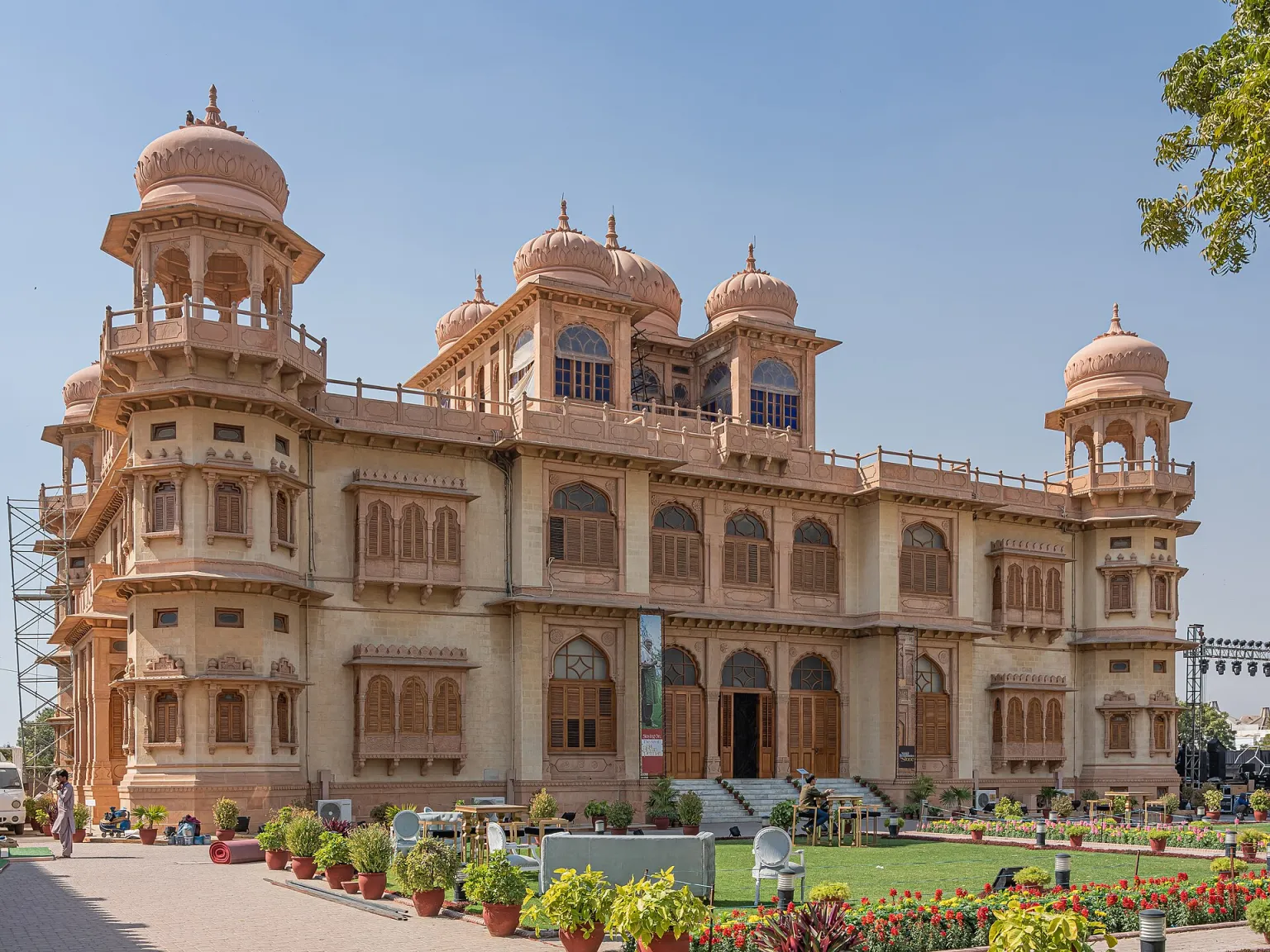
The museum’s history records that Shiv Rattan Mohatta commissioned the house in 1927 and engaged architect Ahmed Hussein Agha. It describes a Mughal revival design combining yellow Gizri stone with pink Jodhpur stone. These named materials give you a specific starting point for observation, beyond calling the whole building simply pink or grand.
After Partition, the building housed Pakistan’s first Ministry of Foreign Affairs and subsequently became Fatima Jinnah’s formal residence. A public trust acquired it in 1995, and the museum opened on 15 September 1999. These are successive uses, not one uninterrupted palace household. When a room feels domestic in scale but contains modern display panels, that tension is part of its present meaning. Do not assign a former occupant’s bedroom, office or private habits to a room unless the museum’s own documentation identifies it.
Look at the stone through colour, edge and shadow
Begin with a view that lets you compare broad areas of the exterior. Look for the relationship between warm yellow and pink rather than trying to name every block from a distance. Light, weathering and camera settings affect apparent colour, so a photograph cannot independently identify the quarry of a particular piece. The documented material palette and your visual observation answer different questions.
Next notice edges: where an opening cuts through a wall, where a projection makes shade, and where decorative detail becomes more visible as the sun moves. A deep shadow can make a small carving read strongly without the carving being large. This is an exercise in looking, not a technical condition survey. Stay on permitted paths and use your eyes or a permitted camera zoom. Do not rub the surface, test loose grains or lean against a carved feature to compare textures.
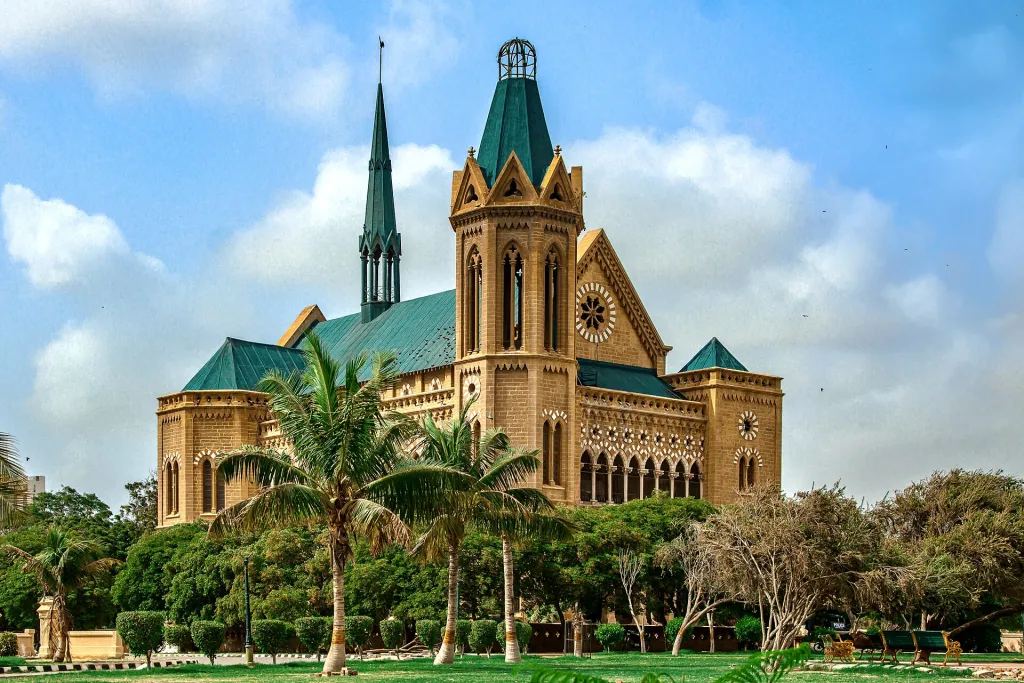
For broader architectural context, the photograph of Frere Hall shows a different Karachi building. Compare the visual rhythm of openings and projections without treating the two places as one estate or using Frere Hall details to identify Mohatta’s stonework.
Use the museum archive to avoid an outdated promise
The official exhibition archive ranges across textiles, ceramics, calligraphy, photography and other subjects. Its record of The Tale of the Tile, for example, describes a thematic treatment of ceramic traditions, while Gaj concerns embroidery associated with blouse fronts. These historical exhibition records show the museum’s curatorial breadth; they do not guarantee that either display remains installed.
Before travelling for a particular artist or collection, check the current exhibition page and ask whether the relevant galleries are open. Check both the opening and closing dates, because a search result may preserve an older announcement. Treat an exhibition title as a lead for preparation, then read the actual introductory panel on arrival. If your purpose is a school assignment, confirm that the assignment’s topic matches the current display rather than assuming every museum visit offers the same material.
Read a temporary display at three scales
At the room scale, read the opening text and establish the central question. At the group scale, ask why several works or objects have been placed together. At the individual scale, choose one item and read its date, maker, medium and lender information where supplied. This sequence prevents labels from becoming a disconnected list of facts.
An object borrowed from a private collection is not automatically part of a permanent museum collection. A modern photograph of an old building is also different from an old photograph of that building. Keep those distinctions in your notes. If the exhibition offers an interpretation, record it as the exhibition’s argument rather than presenting it as the only possible reading. Visitors can disagree thoughtfully while still taking the curators’ evidence seriously and respecting other people’s time in front of the display.
Let a sketchbook organise questions, not collect surfaces
A small written note can separate what you see from what you infer. For the exterior, write an observation such as “a projecting edge casts a deep shadow.” Put a different kind of statement beside it: “perhaps this also changes how enclosed the opening feels.” The first reports a visual relationship; the second proposes an interpretation. Neither requires physical contact with the building.
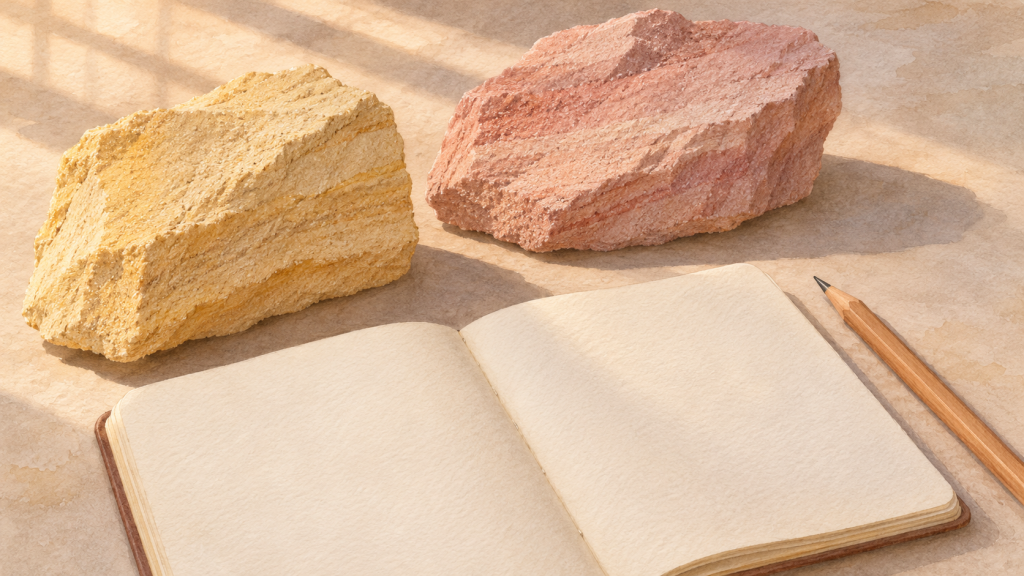
For an exhibition, note the title, date and a question that remains unresolved. Avoid copying every label or blocking the display while photographing an entire wall. Ask about photography, pencils and bags rather than assuming a familiar rule applies everywhere. The material study illustrated here is a separate arrangement of modern samples; it invites attention to texture without implying that visitors should handle the museum’s architectural stone or remove a fragment as a souvenir.
As checked on 7 November 2026, the museum’s published visitor policy says phones are not permitted inside the building and must be deposited at the entrance; visitors may take photographs outside and in the gardens. Plan paper notes for galleries and confirm current arrangements on arrival. The policy sets separate approval requirements for educational or commercial coverage and professional equipment, so an ordinary visit should not be treated as permission for a shoot.
Match the outing to heat, mobility and the group
A Karachi visit can involve time outdoors before or after the galleries. Check the day’s forecast and plan drinking water, transport and the amount of standing around the needs of your group. An indoor destination does not eliminate the exposed parts of the journey. If outdoor conditions are uncomfortable, reduce the exterior observation rather than trying to complete a photograph list.
For a visitor who cannot use stairs comfortably, ask specifically which galleries are reachable, what the step-free route involves, and whether any facilities are unavailable. The statement that a museum welcomes visitors is not a measured accessibility description. Families should also establish where rest stops, toilets and refreshments are permitted. Keep food and drinks out of collection spaces unless staff expressly allow them. A shorter visit with one well-read gallery can be more rewarding than hurriedly trying every room.
Confirm the visit and leave with a precise memory
Use the museum’s own visitor information to confirm admission arrangements, opening days, last entry, current exhibitions and any temporary closure. Recheck close to departure when the exhibition is the main reason for travelling. Ask separately about guided visits or school groups; an ordinary entry arrangement does not guarantee a guide, a workshop or access to every part of the estate.
At the end, give the building and display one sentence each. For example, a hypothetical visitor might remember the contrast of stone and shadow outside, and a photographer’s treatment of urban life inside. This is an imagined reflection, not a report of a tested visit. The exercise keeps the museum’s architecture, institutional history and changing programme connected without collapsing them into a single timeless attraction. Save the exhibition’s actual title with your notes so the memory remains dated and useful.
Frequently Asked Questions
Is every exhibition permanently available?
No. Use the official current programme and confirm gallery availability before travelling for a particular display.
Is the palace entirely pink sandstone?
The museum identifies a combination of yellow Gizri and pink Jodhpur stone; lighting changes how their colours appear.
Can visitors touch exterior carving?
Observe without rubbing, climbing or testing surfaces, and follow staff instructions and viewing boundaries.
Can I assume all galleries are step-free?
No. Ask about the exact route and galleries relevant to your needs before travelling.
How we know this
- Type Practical guide
- Sources 4
- Reviewed November 2026
- Disputed points None
Rules and fees change, confirm with the official links below before you act.
4 sources
- History of the Museum, Mohatta Palace Museum
- About the Museum, Mohatta Palace Museum
- Exhibitions through the years, Mohatta Palace Museum
- Mohatta Palace Museum, Mohatta Palace Museum
Photo credits (2)
- PK Karachi asv2020-02 img17 Mohatta Palace.jpg, A.Savin, FAL, via Wikimedia Commons
- Frere Hall Karachi. Pakistan.jpg, Asim Iftikhar Nagi, CC BY-SA 4.0, via Wikimedia Commons
