
History & heritage · Reading the evidence
Read a Partition Oral History alongside Other Historical Records
Learn to listen to a Partition testimony carefully, preserve the narrator’s perspective and compare specific details with maps, documents and other accounts.
- Read the original source
- Check context and version
- Separate fact and inference
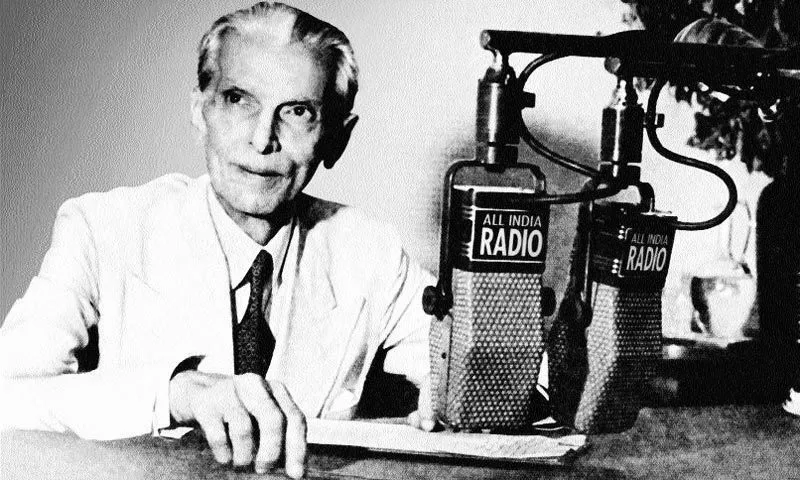
Muhammad Ali Jinnah at All India Radio · 1947
An individual life is not a national average
A Partition oral history can preserve what official paperwork rarely captures: the layout of a lost home, a journey remembered through sounds, or the help of a neighbour. Its power comes from a particular person’s experience. Treating that account as the experience of every family weakens both the testimony and the history.
Partition in 1947 involved independence, new borders, displacement and extensive violence across different regions. Experiences varied by location, age, gender, occupation and community. Begin by asking where the narrator was and what they personally witnessed. A memory of something heard from an adult deserves attention, but it is different from direct observation. Careful listening preserves these distinctions without reducing a human account to a courtroom-style search for mistakes.
Record the interview’s own circumstances
The 1947 Partition Archive provides public excerpts and describes access arrangements for its fuller oral-history collections. A short edited clip and a complete interview offer different contexts. Note which you consulted, its reference, the narrator’s name as published, the interviewer and the interview date when supplied.
Also record the language and whether you are reading subtitles, a translation or a transcript. A translation can clarify meaning while obscuring a regional expression or emotional ambiguity. If a passage is difficult to hear, label it unclear instead of supplying a convenient word. Never imply you interviewed the narrator yourself. Explain that you are analysing a published testimony, and preserve any access or reuse conditions attached to the material.
Build a timeline without forcing exact dates
Create a two-column timeline: the narrator’s sequence of events and independently documented dates. A recollection may organise time around harvest, school holidays, a family wedding or a religious observance. These markers can help contextualise a journey even when no exact departure date is available.
For an illustrative exercise, suppose a narrator remembers leaving after a nearby station closed but before a particular family member arrived. Look for dated transport notices, correspondence or local administrative records that might narrow that interval. This example demonstrates a method, not an actual interview finding. Do not convert a tentative interval into a precise day. A timeline can remain useful with uncertainty clearly shown, especially when traumatic events disrupted ordinary record keeping.

Use maps to clarify place, not to overwrite memory
A place name may have several spellings or may refer to a village, district or neighbourhood. Search variants and check the historical administrative unit. The same familiar name can occur in more than one location. A modern map alone may conceal changed borders, renamed roads or a station that no longer operates.
Mark a reported route only as precisely as the testimony supports. If the narrator remembers a district but not a village, do not place a pin on a guessed house. Distinguish a route described by the narrator from one reconstructed by a researcher. For public presentations, consider whether precise locations or family details could expose living relatives. Historical interest does not remove the need to respect privacy and the narrator’s stated boundaries.
Compare records that were made for different purposes
A government report, a private letter, a newspaper and an oral history were not produced to answer the same questions. An administrative return may count registered people while overlooking those who never reached the reporting office. A family letter may preserve immediate concerns but assume knowledge its recipient already had.
Compare a specific proposition across sources: a journey date, a camp’s name or whether a bridge was open. Avoid using a broad official total to dismiss a personal experience, or one vivid testimony to replace a regional estimate. Record what each source can establish, what it leaves out and who produced it. Agreement is useful, but sources can share an earlier source and therefore fail to provide genuinely independent confirmation.
Read differences with empathy and discipline
Two narrators can remember the same locality differently because they moved through different streets, belonged to different networks or encountered events at different times. Disagreement does not automatically establish dishonesty. Neither does empathy require accepting every remembered detail as independently verified.
Describe the difference precisely and explore possible explanations that the evidence permits. Avoid presenting speculation about trauma, motives or identity as a diagnosis. Accounts of violence deserve careful attribution and should not become a claim about the inherent character of an entire religious community. Including testimony about rescue, solidarity or ordinary coexistence can complicate a simplistic narrative, but do not add comforting episodes that are absent from your sources merely to create a balanced ending.

Turn listening into a transparent research note
A useful note contains a short summary, a few clearly attributed details, the source reference and questions for further research. Separate the narrator’s words from your interpretation. Quote sparingly and accurately, and do not combine sentences from distant moments in a way that changes their meaning.
State which details you could corroborate and which remain unverified. Where evidence is unavailable, an honest unresolved question is preferable to a polished invented answer. If preparing a family interview, discuss consent, recording, public access and sensitive material before beginning. A person may agree to speak privately without agreeing to online publication. The purpose of comparison is to deepen historical understanding while preserving the dignity and particularity of the life being described.
Listen for changes in the narrator’s knowledge
A narrator may move between what they knew as a child and what they learned decades later. Mark those shifts in a transcript. A phrase such as we later discovered signals a different evidential layer from I saw. Family explanations, schooling and subsequent public commemoration can all enter a life narrative without making the testimony worthless. For a practical reading, annotate one passage with three labels: direct experience, information received then and information learned later. Apply the labels only where the narrator provides a basis; do not guess. This exercise helps explain why an interview can preserve immediate sensory memory and later interpretation within the same paragraph. It also makes comparison with contemporaneous letters more precise.
Make an evidence map for a remembered journey
Draw a simple working table rather than a definitive route map. Use rows for each place named in the testimony and columns for the narrator’s wording, possible modern identification, supporting source and confidence. Keep alternative identifications visible when two places share a name. A confident-looking line on a map should not hide uncertainty about the places it connects.
Then compare the order of stops with dated transport information or family correspondence where available. A train journey described in memory may include walking, waiting and transfers that a later summary compresses. Avoid assuming that the most direct modern route was the one used. If the evidence confirms only the starting and ending districts, present that limited geographical result. The exercise can still illuminate distance, interruption and the difference between remembered and documented sequence. For a public presentation, remove unnecessary precise household locations and explain which parts come from the narrator and which are your reconstruction. A research map should make uncertainty easier to understand, rather than using attractive design to transform a partial account into an apparently exact itinerary.
Frequently Asked Questions
Are oral histories less valuable than official records?
They answer different questions and have different limitations. Compare their purposes, circumstances and specific claims rather than assigning one universal hierarchy.
Can I use a short archive clip as a complete life story?
No. Identify it as an excerpt and avoid assuming that omitted topics were absent from the narrator’s experience.
What if dates conflict?
Preserve both versions, check calendars and place names, seek independent evidence and explain any uncertainty that remains.
Does public streaming permit reuse in my video?
Not automatically. Check the archive’s access and reuse conditions and any restrictions associated with the testimony.
How we know this
- Type Historical & cultural research
- Sources 4
- Reviewed November 2026
- Disputed points None
4 sources
- Partition Archive: public collections, 1947partitionarchive.org
- Partition Archive: access conditions, 1947partitionarchive.org
- National Archives of India: public records holdings, nationalarchives.nic.in
- British Library: India Office research datasets, bl.iro.bl.uk
Photo credits (1)
- Jinnah announces the creation of Pakistan over All India Radio.jpg, Unknown authorUnknown author, Public domain, via Wikimedia Commons
