
Kitchen item guide
Insulated hotpot: choosingusing and caring for it
Use the familiar Pakistani insulated casserole warmer for rotis and serving, with clear limits on heat retention, cleaning and food safety.
DailyLife.pk kitchen equipment collection
A serving warmer, not a cooking pot
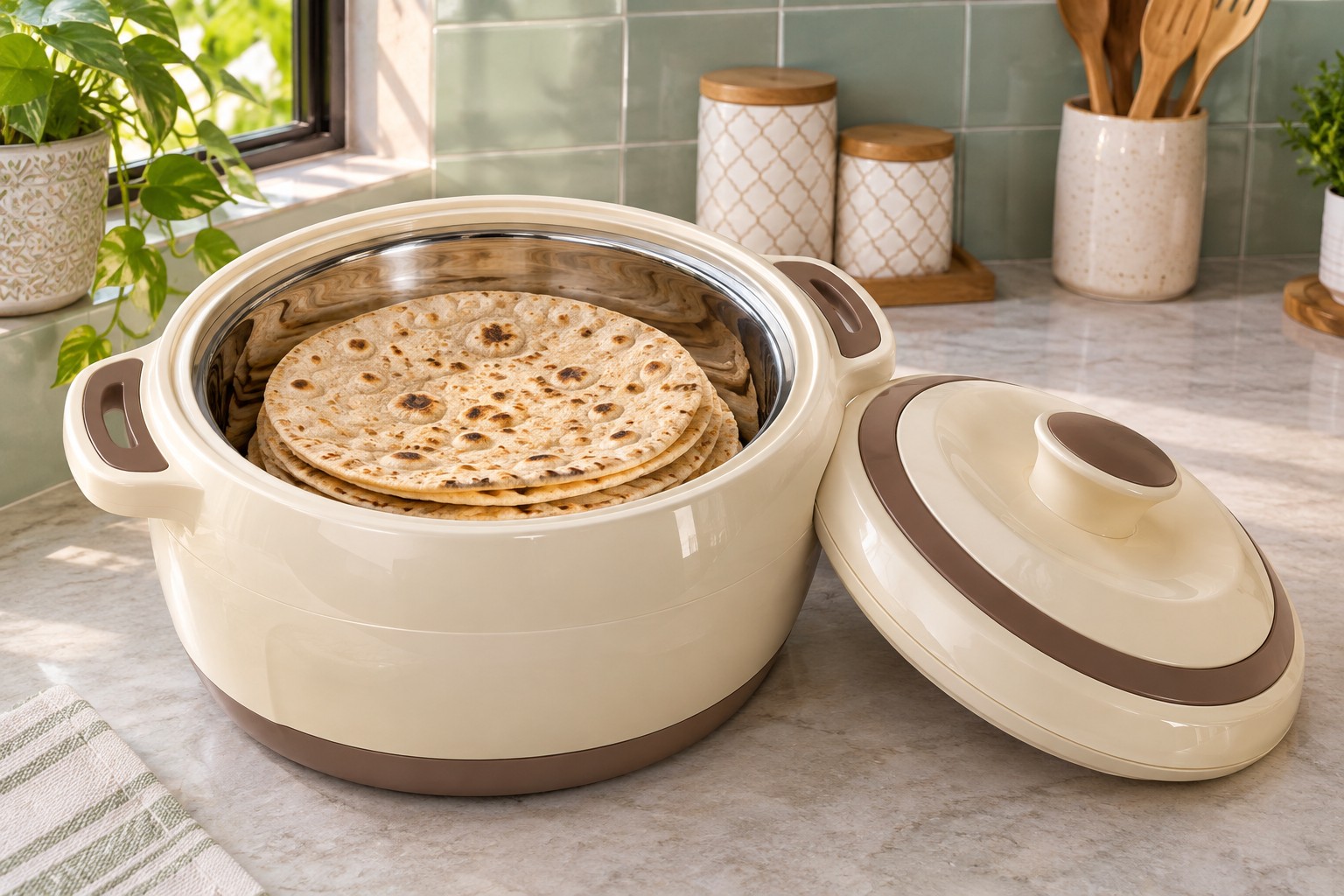
An insulated hotpot is the lidded casserole warmer commonly used in Pakistani homes to hold rotis, rice or a prepared dish before serving. It slows heat loss through an insulated body and lid. It does not supply heat, cook food or reheat a cold curry. Here, hotpot means this serving container, rather than a cooking vessel for a simmering communal meal.
Many models have a stainless steel inner bowl, a plastic outer shell and insulation between them. Others use a metal exterior. A broad mouth makes it easier to lift out rotis or serve biryani, while a close-fitting lid reduces heat escaping. A twist or locking lid can help keep it closed, but it does not necessarily make the container leakproof. Check that claim separately before carrying salan in a vehicle.
Choose for the food and household
For editorial comparison, a shallow container around 2 litres may suit a small stack of rotis, while a deeper 4 litre model may be more useful for serving rice to a family. These are planning examples, not guaranteed portion counts. Measure the internal diameter against your usual roti size. External bulk can be misleading because insulation takes up space; compare stated usable capacity and the actual inner bowl.
Buy from a housewares shop where you can inspect the lid, handles and inner surface. Check for a smooth food-contact bowl, a stable base and a closure that the household can operate without force. A large set is unnecessary if only one size is regularly used. Ask about spare lids or seals where fitted. Look for explicit washing and temperature restrictions rather than assuming all steel-lined containers can go in a dishwasher or microwave.
Fill it close to serving time
Start with a clean container. If the maker permits pre-warming, follow its water temperature and preparation method, then empty and dry it before filling. Put freshly prepared food into the hotpot promptly and close the lid. Open it only as needed. For rotis, use a clean food-contact cloth only where appropriate, and wash that cloth after use rather than letting crumbs and moisture remain inside between meals.
Serve with a clean utensil and keep the lid on a clean surface. Do not place the hotpot on a burner, in an oven or on a hot tawa. A metal lining does not make the insulated shell a cooking utensil. Microwave use is also generally unsuitable for these steel-lined warmers; obey the exact product label. To reheat food, transfer it to cookware designed for the chosen appliance, then return it only for suitable short-term serving.
Warm to touch is not a safety test
Heat retention varies with the amount of food, its starting temperature, room conditions and how often the lid opens. A claim that food stays warm for several hours is not proof that it stays safely hot. For perishable dishes, use a food thermometer rather than judging the outside of the container. FDA home buffet guidance recommends keeping hot food at 60°C or above.
If you cannot maintain safe hot holding, serve promptly and refrigerate leftovers within the relevant time limit. FDA guidance says to discard perishables left at room temperature for more than two hours, reduced to one hour above approximately 32°C. Do not leave leftover biryani or meat curry in a closed hotpot overnight. Divide leftovers into shallow suitable containers for prompt chilling instead of trying to cool a large mass inside its insulation. These food-safety rules matter even when the lid still feels warm.
Cleaning, wear and alternatives
Wash the bowl and lid as the product instructions allow, using mild detergent and a soft sponge. Pay attention to the rim and any removable gasket. Avoid prolonged soaking that could let water enter an insulated cavity. Dry thoroughly and store with the lid loose or open so trapped moisture does not develop a stale smell. Follow the exact model's dishwasher instructions; some insulated casseroles are explicitly hand-wash only.
Replace a cracked inner bowl, damaged food-contact seal or closure that no longer works securely. Loose handles and water trapped within the body need assessment. Useful life depends on handling and construction, without a universal number of years. A covered serving bowl is a simple alternative for immediate meals. An approved powered warmer offers active heat for longer service. The insulated hotpot's advantages are portability and no electricity use; its limitation is steadily declining temperature, which cannot be corrected by closing the lid more tightly.
Frequently Asked Questions
Can I cook directly in an insulated hotpot?
No. It is a serving warmer; use appropriate cookware to cook or reheat food.
Can biryani stay in it overnight?
No. Promptly refrigerate leftovers safely; insulation does not provide indefinite safe hot holding.
Can it go in the microwave?
Do not put a steel-lined insulated hotpot in a microwave. Follow the exact product restrictions.
How we know this
- Type Explainer
- Sources 3 (2 official/academic)
- Reviewed November 2026
- Disputed points None
3 sources
- Insulated casserole construction and restrictions, Milton
- Serving up safe buffets, US Food and Drug Administration
- Buffet holding guidance, USDA Food Safety and Inspection Service
Photo credits (1)
- One traditional Pakistani insulated serving hotpot casserole warmer with a rounded thick cream plastic outer shell, two short carrying handles, polished stainless steel inner bowl containing a neat stack of chapati rotis, thick insulated matching lid with a knob placed beside it, clearly a portable serving warmer, no burner or cooking apparatus., DailyLife.pk, All rights reserved
