
Kitchen item guide
Tiered steamer: ChoosingUsing and Caring for It
Choose a tiered steamer by tier clearance, base-water access and how you will remove hot food safely.
DailyLife.pk kitchen equipment collection
A stack with separate jobs
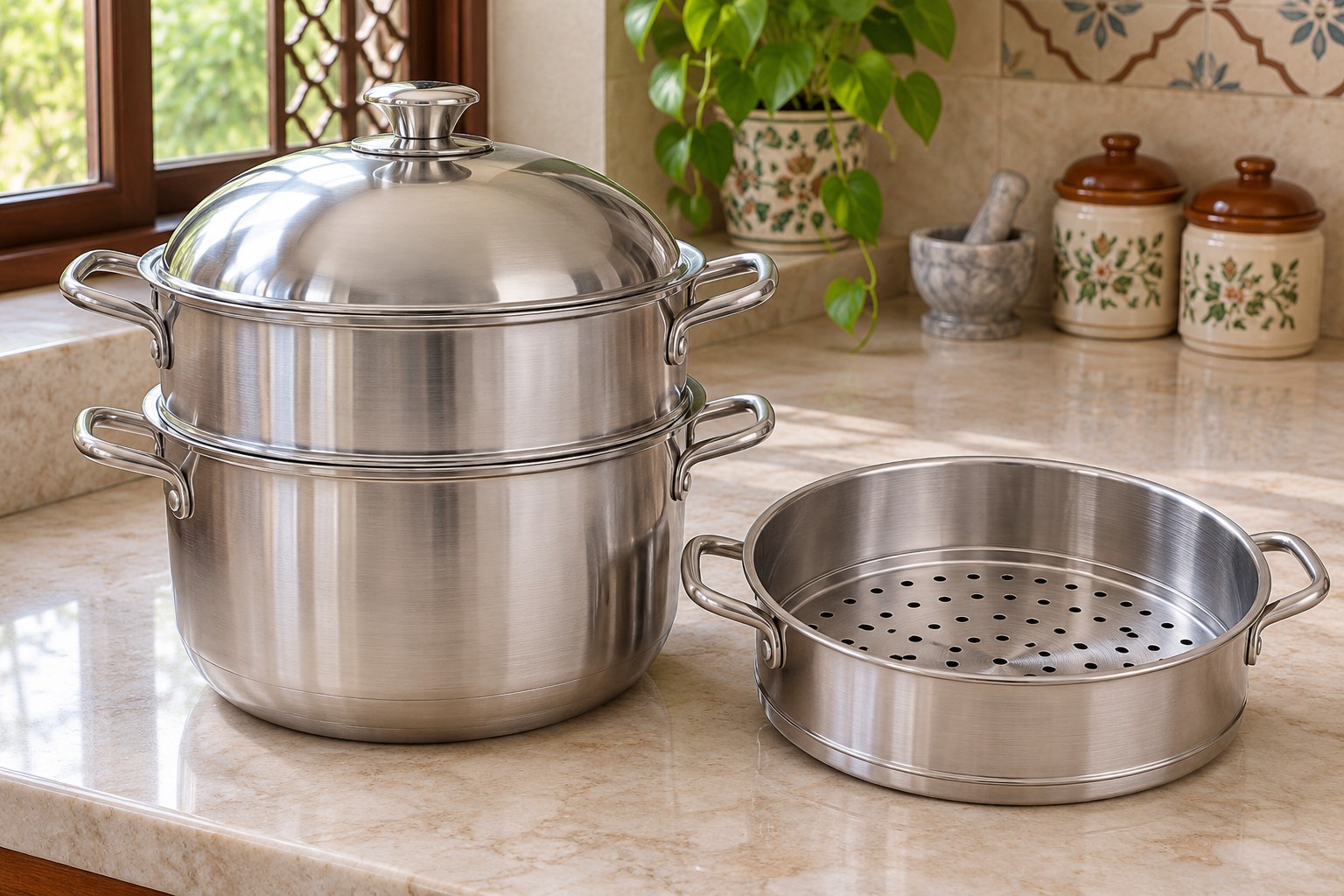
A tiered steamer combines a bottom water vessel with perforated food trays stacked above it and a lid. It can handle a larger batch of vegetables, momos or suitable steamed snacks than a small collapsible basket. In a Pakistani kitchen it is useful when several trays of one food are needed for a family meal. Its extra capacity is vertical, so you need headroom above the hob as well as cupboard space. More trays do not guarantee even cooking if the food blocks steam paths or the base pot runs low on water.
Compare complete systems
Stainless steel and aluminium versions differ in weight and food-contact care. Some tiers are shallow perforated trays; others are deeper baskets that can hold upright vegetables or small approved bowls. Check whether every tray belongs to the same system and nests securely without wobble. A lid should close on the assembled stack with no need for added weights. The base must be suitable for your gas, electric or induction hob. If the maker allows the base to work separately as a pot, that can improve usefulness; do not assume it from the shape alone.
Measure a realistic load
For an editorial comparison, look at a 24 cm two-tier unit and a 28 cm three-tier unit, then sketch your usual momo batch on paper circles of those sizes. These dimensions are shopping examples, not cooking capacities. Leave gaps around food and room above anything that expands. Measure the complete height including lid and handles against the hood. Try separating cold tiers while wearing dry mitts. You should be able to grasp them without putting your wrists over the steam opening, and a stable heat-resistant place must be available for each removed tray.
Build the steaming session
Add the specified water to the base and arrange food in the trays without covering the perforations more than the recipe requires. Stack tiers in the sequence given by the maker and bring the water to steaming. Lower the heat to maintain the intended steam output. Use recipe guidance to decide when to check food; do not assume identical timing across several heavily loaded tiers. When opening, turn heat down or off as appropriate and lift the lid away from you. Put each tier on a prepared stable support and keep condensed water from dripping onto hands or nearby flames.
Check water and separation
Plan water checks and any permitted top-up before starting, because lifting a full hot stack mid-cook can be awkward. Never let the base boil dry. Separate foods whose juices must not contaminate one another, and do not put ready-to-eat food beneath raw meat simply because there is a spare tray. FoodSafety.gov guidance describes separation and safe cooking checks. Food thickness and starting temperature affect completion, so use an appropriate thermometer where required. A steamer lid is not a pressure seal: never clamp tiers together or cover vents in an attempt to speed cooking.
Wash the rims and holes
Once cool, dismantle the complete stack. Remove dough fragments from perforations, wash the underside where condensed juices collect and clean the seating rims. Follow the metal-specific instructions rather than treating aluminium exactly like stainless steel; Health Canada guidance explains why intended use and care matter. Dry each tier before nesting and avoid forcing a dented rim into place. Stop using trays with sharp tears, unstable joints or handle attachments that cannot be properly repaired. If the base is damaged, the good trays do not make the assembled system safe to keep using.
When an insert is sufficient
A basket inside a sound lidded pot is simpler for small vegetable quantities, while a tiered steamer earns its space through repeated larger batches. An idli stand holds shaped batter in moulds and is a different accessory. Shop in person to assess stack stability, or request full assembled dimensions and photographs of the tray undersides online. Check whether replacement trays and handles exist. The practical advantages are organised batch space and separation; the costs are cleaning more components, planning water access and handling several hot wet pieces. Choose the number of tiers you can actually use and remove comfortably.
Frequently Asked Questions
Will every tier cook at the same speed?
Do not assume so. Follow the recipe and check completion for the load.
Can I clamp it to create pressure?
No. A normal tiered steamer is not a pressure vessel.
Can I use only one tier?
Only in an arrangement the maker permits with the correct lid and base.
How we know this
- Type Explainer
- Sources 3 (1 official/academic)
- Reviewed November 2026
- Disputed points None
3 sources
- Safe use of cookware and bakeware, Health Canada
- Four steps to food safety, FoodSafety.gov
- Idli stand instruction manual, Hawkins
Photo credits (1)
- a three-tier stainless steel food steamer, bottom water pot, two perforated stackable steamer tiers and a domed lid, one upper tier set to the side to reveal holes, DailyLife.pk, All rights reserved
