
Kitchen item guide
Oven-safe probe thermometer: BuyingUse and Care for a Pakistani Kitchen
Monitor a roast with a leave-in probe while keeping the cable and display within their stated heat limits.
DailyLife.pk kitchen equipment collection
Follow the food while it cooks
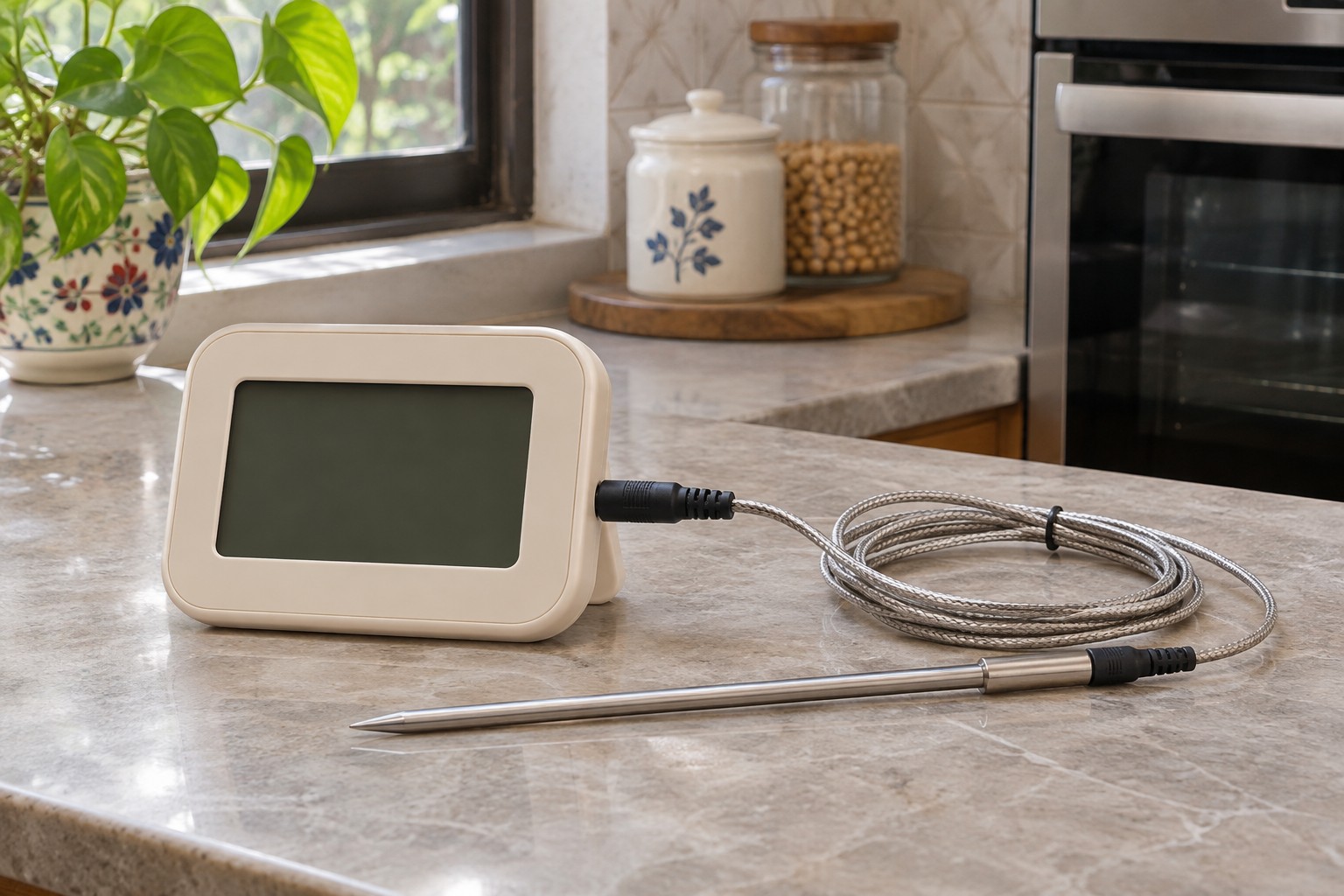
An oven-safe probe thermometer is designed to remain in the food during cooking under its stated operating conditions. A wired model typically leaves the metal probe in the food and keeps the display outside the oven; other designs integrate the display or use a wireless system with specific limits. It can help monitor a whole chicken, roast meat or a large baked dish in a Pakistani kitchen. It reduces repeated opening for checks, but one probe reading still represents one location. Position and product compatibility matter as much as the convenience of an alarm.
Probe, cable and receiver have separate limits
Do not assume a probe is safe for all ovens, direct flame, grills or microwaves. The cable, connector, transmitter and receiver may have different temperature and moisture limits. A product labelled oven-safe needs instructions that explain the exact permitted use. KitchenAid distinguishes leave-in meat thermometers from instant-read and oven-air thermometers. A dial leave-in tool may need more insertion depth than a thin digital probe. Choose around the food thickness, oven space and temperature range you require, rather than expecting every probe to serve every cooking method.
Check replacement probes and clear instructions
As an editorial comparison, a basic single-probe model may suit one roast, while multiple channels are useful only when you genuinely need several simultaneous readings. Check stated accuracy, sensing depth, alarm operation, cable length, replacement-probe availability and locally usable batteries or charging arrangements. A specialist kitchenware or instrument supplier should provide the complete model details. Confirm that a wire can pass through your oven door as instructed without being crushed or touching a heating element. Avoid buying solely for phone connectivity if a simple readable display would do the job.
Insert before cooking and route the cable safely
Clean the probe, place its sensing area in the thickest appropriate part of the food and avoid bone, large fat pockets or the tray. Route the cable only as permitted, clear of elements, flame and hot surfaces beyond its rating. Put the display outside heat and steam unless specifically designed otherwise. Set an appropriate food target and check the unit selection. FoodSafety.gov gives poultry a 74°C minimum and distinguishes other meat categories and required rest periods. An alarm is a prompt to assess the food, not proof that every part has reached the same temperature.
Check other places before serving
At the end, use an appropriate clean thermometer to verify additional thick locations or differently sized pieces. A probe that has slipped toward the surface can give an unrepresentative result. Do not use a food probe to infer oven air temperature unless it is designed for that purpose and mounted as instructed. Treat the metal stem and lead as hot when removing them, and set them on a suitable heat-resistant surface. Never pull a probe out by its cable, immerse its connector casually or shut a damaged cable in the oven door.
Protect seals, connectors and storage bends
Disconnect and clean according to the product manual. USDA recommends washing the food-contact thermometer surface with hot soapy water; whether the lead, connector or body may be submerged is model-specific. Dry connectors before use and coil the cable loosely without tight kinks. A cracked insulation sheath, damaged seal, loose connector or erratic reading is a reason to stop relying on the probe. Replace it with a component approved for the unit, because similar connectors do not establish sensor compatibility. A handheld instant-read thermometer remains a useful alternative when monitoring throughout cooking is unnecessary.
Frequently Asked Questions
Can the whole display go inside the oven?
Only if explicitly rated for that environment. Many wired systems keep their display outside the oven.
Does the alarm guarantee the entire roast is safe?
No. Correct probe placement and checks at additional relevant locations remain necessary.
Can I replace the probe with any one that plugs in?
No. Match the replacement to the manufacturer's compatible sensor specification.
How we know this
- Type Explainer
- Sources 4 (3 official/academic)
- Reviewed November 2026
- Disputed points None
4 sources
- Use and Care of KitchenAid Thermometers, KitchenAid
- How to use a food thermometer, USDA FSIS
- Cook to a Safe Minimum Internal Temperature, FoodSafety.gov
- Proper thermometer cleaning, USDA FSIS
Photo credits (1)
- Wired oven-safe food probe thermometer with a separate display and loosely coiled lead., DailyLife.pk, All rights reserved
