
Kitchen item guide
Karchhi Ladle for DaalSalan and Serving
Choose a karchhi by bowl depth, reach and pouring control, with care for hot liquids and handle joins.
DailyLife.pk kitchen equipment collection
A bowl for lifting liquid
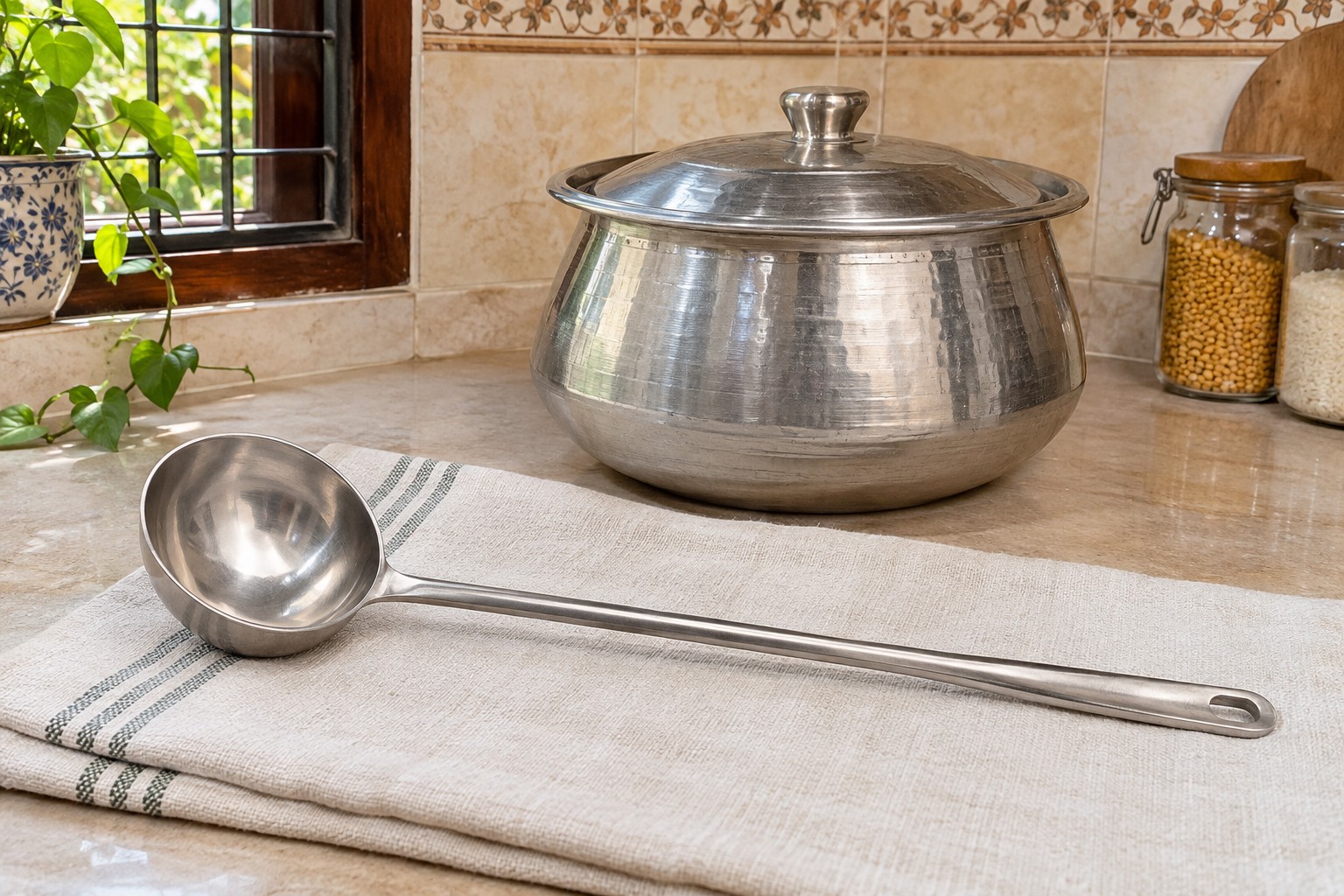
A karchhi is a ladle: a deep-bowled utensil on a long handle for moving liquids and foods carried in liquid. It serves daal, salan, yakhni and soup more effectively than a flat spoon. It can also help distribute gravy over portions during serving. Its usefulness depends on how the bowl sits in your pot and how easily you can pour it into the receiving dish. A very large bowl can be awkward for a small katori.
Depth, spouts and handle angles
Round deep bowls favour scooping, while shallower serving ladles may pour differently. Some have a defined spout or a lip on either side. Stainless steel is common; coated or nonmetallic versions need material and temperature information. OXO’s ladle design illustrates dual-sided pouring features. As editorial comparisons, consider a smaller bowl for a saucepan of daal and a larger one for serving a family degchi, then check the handle reaches the bottom comfortably.
Fill and transfer with control
Stir the dish as appropriate before serving so solids and gravy are distributed as intended. Dip the bowl slowly, lift without overfilling and keep it level while travelling to a nearby receiving dish. Pour from the edge or designated spout with a small controlled tilt. Work around the pot’s steam rather than holding your wrist over the centre. For thick haleem or a heavy mixture, test whether the ladle can bear the load without the handle flexing or the bowl rotating.
Hot handles and clean serving
An all-metal handle can become hot if left in a simmering pot, and a short handle can disappear beneath the rim. Use a suitable rest rather than leaving a ladle balanced where it can fall. Do not taste from the serving ladle and return it to food being served to others. If it contacts raw ingredients, clean it before using it on ready-to-eat food; FDA food-handling principles apply to utensils as well as boards. Match metal contact to the cookware maker’s instructions.
Buying for the pot you own
Bring the pot’s depth and rim width to mind when shopping in Pakistan, or measure them before ordering online. Check bowl capacity if you need consistent serving portions; do not assume that every karchhi equals one recipe cup. Inspect welds, rolled rims and handle seams, and reject sharp unfinished edges. Ask whether dishwasher use is allowed for the complete tool. Buy a second ladle for a recurring separate dish if it simplifies serving, rather than alternating one utensil between different foods.
Remove residue from the bowl join
Wash promptly so thick daal and gravy do not dry into the neck or hollow grip opening. Use a suitable brush around seams without damaging any coating. Rinse, dry and hang or store with air space around the bowl. A loosening joint, rough corrosion, cracked covering or trapped residue that cannot be removed is a reason to retire it. A deep serving spoon is a substitute for small amounts, but spills more easily. The ladle’s strength is liquid transfer, while storage bulk is its usual compromise.
Frequently Asked Questions
Is a ladle a measuring cup?
Only if its capacity is stated and suitable for the recipe. Bowl sizes differ.
Can it stay in the pot while cooking?
Follow the tool’s instructions. Handles can heat up and short ladles can fall in.
Can I use one for daal and dessert?
Wash it thoroughly between foods, or use separate clean utensils during a shared meal.
How we know this
- Type Explainer
- Sources 2 (1 official/academic)
- Reviewed November 2026
- Disputed points None
2 sources
- Stainless Steel Ladle, OXO
- Safe Food Handling, FDA
Photo credits (1)
- Karchhi ladle displayed on a Pakistani kitchen counter in natural light., DailyLife.pk, All rights reserved
