
Kitchen item guide
OTG countertop oven: choosingusing and caring for it
Choose a countertop oven by usable tray space, heating controls and safe counter clearance rather than litre capacity alone.
DailyLife.pk kitchen equipment collection
An oven, toaster and grill arrangement
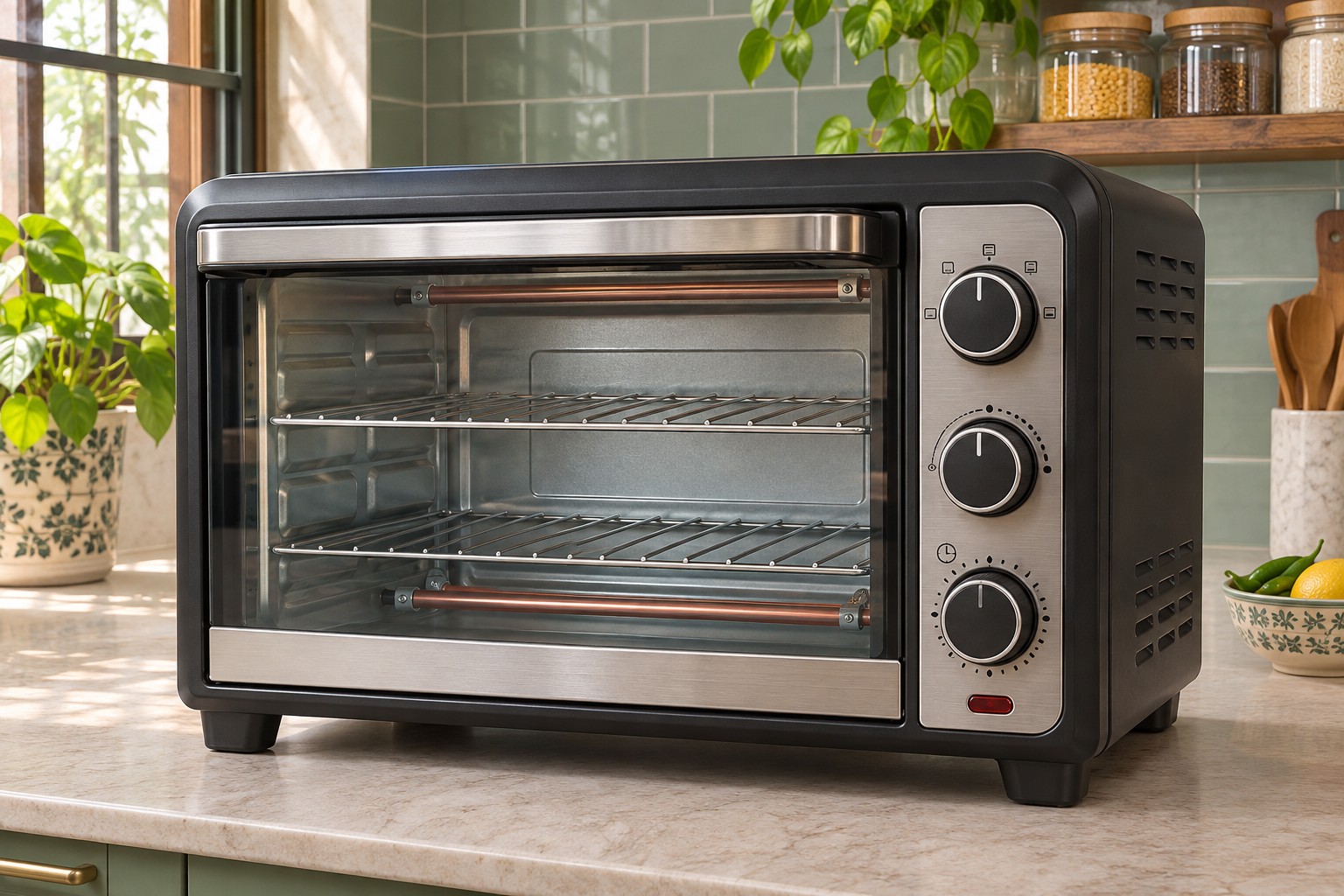
OTG commonly describes a countertop oven with oven, toast and grill functions. It uses electric heating elements, often above and below the food; some models also have a convection fan. It is not a microwave. A small OTG can bake biscuits, toast bread, brown a topping or roast a modest tray of food when the model and recipe support those tasks.
In a Pakistani kitchen it can be useful for small cakes, patties, buns and a limited batch of marinated chicken. Its compact cavity places food closer to heating elements than many full-size ovens. That can make browning fast, but does not guarantee even baking or safe internal doneness. A first batch should be treated as learning the appliance rather than proof that every recipe transfers unchanged.
Start with your tin and tray
Measure the actual internal rack space and door opening. As an editorial buying exercise, check a regular cake tin and baking tray including their handles, not just their base diameter. Leave the airflow and element clearance required by the manual. A tray that barely slides in may obstruct circulation or come too close to the glass. Nominal litres cannot answer that fit question.
Compare top-and-bottom element selection, thermostat controls, timer behaviour and rack positions. A convection fan can change browning and timing, so confirm whether it can be selected separately. Inspect the stability of racks and how the supplied tray is removed. Consider the hot door's swing and where a removed pan can rest safely. Confirm replacement trays, crumb trays, elements and service support before choosing an unfamiliar imported unit.
Create a permanent safe landing place
Use a dry, level, heat-resistant counter with the specified side, rear and overhead clearances. Do not install a freestanding countertop oven in a tight cabinet unless the maker specifically approves that installation. Keep cords away from the hot casing and door, and place the appliance where a child cannot pull the cable. Electrical Safety First's kitchen guidance explains the combined risks from heat, water and high-power appliances.
Check the voltage, rated input and required supply connection. Running an oven beside a kettle and hotplate on a casual extension board can overload an unsuitable arrangement. Ask an electrician about the actual installation where necessary. Remove packaging, wash permitted accessories and perform the first-use procedure in the manual before cooking food.
Bake with observation and correct placement
Preheat when the recipe and manual require it, select the appropriate element arrangement and place the tin at the recommended rack level. Leave space around the pan rather than filling every gap with foil or another tray. Use a separate oven thermometer if you need to investigate a repeated temperature mismatch, remembering that opening the door repeatedly changes the cooking conditions.
For chicken, colour on the outside is insufficient; follow a safe recipe and check the food's internal temperature against authoritative food-safety guidance. Use dry oven gloves and withdraw a rack only as designed. Never rest a heavy casserole on an open door. Do not line the oven floor, crumb tray or elements with foil unless expressly permitted. Oster's countertop-oven guidance addresses foil and cleaning as model-specific operating matters.
Clean the crumb and grease collection areas
Turn off, unplug and cool fully before cleaning. Remove the crumb tray and other permitted accessories, wash by the approved method and dry before refitting. Wipe the cavity and glass gently without wetting heating elements, sockets or controls. Do not use abrasive tools that damage coatings. Grease and crumbs left for repeated heating can smoke, so cleaning access is part of the purchasing decision.
Stop for a cracked door, damaged cord, failing thermostat, sparking or an element that has visibly deteriorated, and arrange qualified assessment. A countertop OTG offers small-batch oven cooking without a fitted installation, but consumes counter space, gets hot externally and may require several batches for a family gathering. A built-in oven handles larger trays; a grill microwave adds reheating convenience but brings mode-specific dish rules. Choose the OTG when its measured working space matches the food you prepare often enough to justify leaving it safely accessible.
Frequently Asked Questions
Does OTG mean microwave?
No. It generally refers to an electric oven with toast and grill capabilities.
Can I put it inside a cupboard?
Only if the appliance is specifically approved for that installation and all required clearances are met.
Should I cover the base with foil?
Follow the exact manual. Foil can interfere with heat and airflow and may be prohibited.
How we know this
- Type Explainer
- Sources 3 (1 official/academic)
- Reviewed November 2026
- Disputed points None
3 sources
- Countertop oven care and use, Oster
- Electrical safety in the kitchen, Electrical Safety First
- Safe food handling, US Food and Drug Administration
Photo credits (1)
- Compact countertop oven toaster grill with closed glass door showing two racks and upper lower heating rods, knobs on side, empty and off., DailyLife.pk, All rights reserved
