
Kitchen item guide
Parchment paper: ChoosingUsing and Caring for It
Use baking parchment within its stated heat limit to line trays and release cakes cleanly.
DailyLife.pk kitchen equipment collection
A liner with a specific job
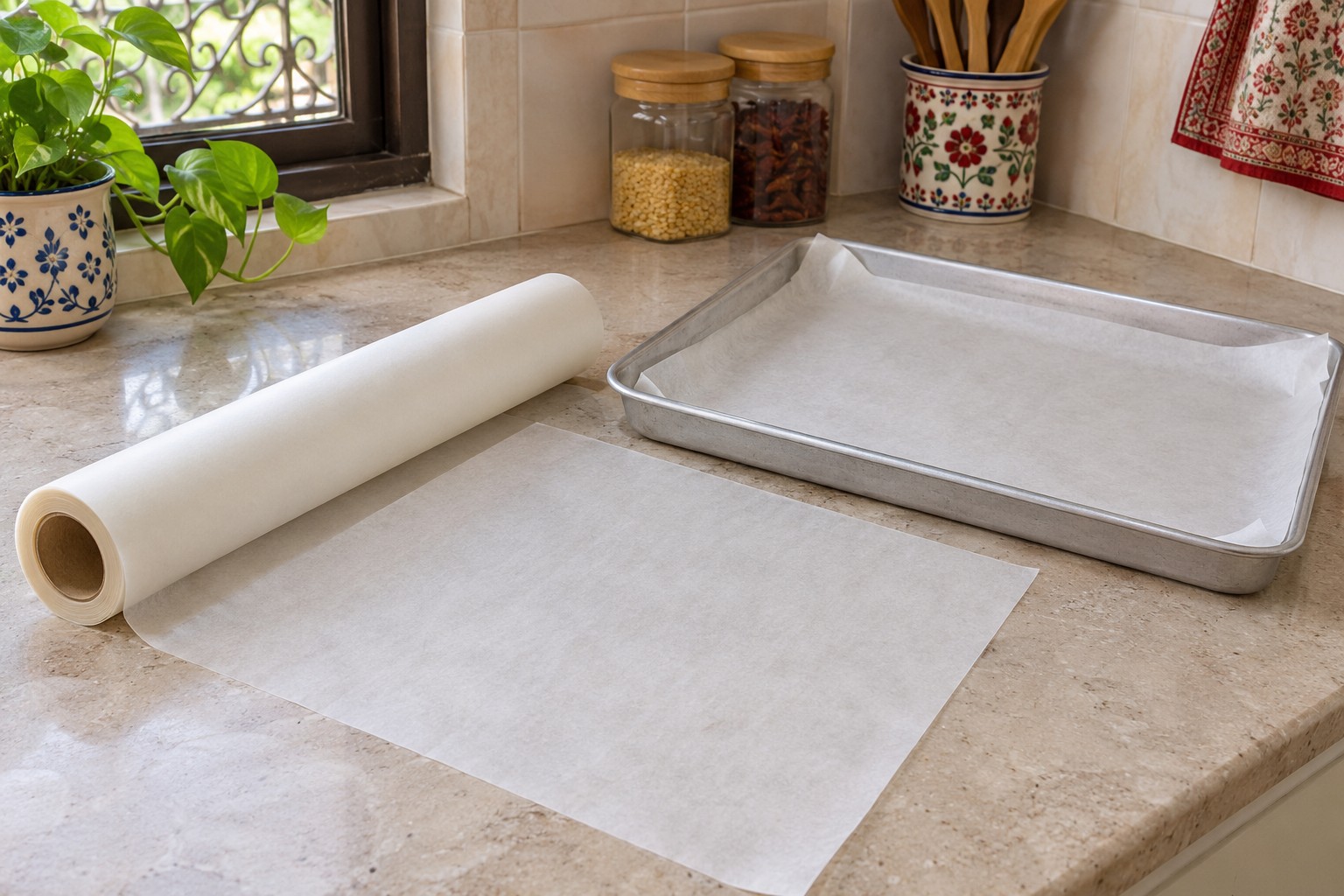
Parchment paper is a baking liner that reduces sticking and separates food from a pan. It is useful under nankhatai and biscuits, beneath cake layers and as a sling for lifting bar cakes. It is not a replacement for a rigid tray and does not turn an unsuitable dish into ovenware. The paper has to be supported and kept clear of a heat source.
In shops, the terms baking paper, greaseproof paper and butter paper are sometimes used loosely. Read the packaging rather than assuming that a translucent sheet has the properties needed for your recipe.
Rolls, sheets and temperature labels
Rolls can be cut to an unusual tin; pre-cut sheets lie conveniently on regular trays. White and brown appearance alone does not identify temperature tolerance or food-contact suitability. Check the manufacturer’s intended uses. Reynolds’ parchment guidance gives a product-specific conventional-oven limit of 425°F, about 218°C, and excludes broiler use. This is not a universal limit for every brand sold in Pakistan.
Waxed paper is a different material and should not be casually substituted under exposed biscuits in the oven. For everyday shopping, ask explicitly for oven baking parchment and keep the original wrapper so its warnings remain available.
Cut and support the liner
Trace a cake-pan base and cut a flat circle, or trim a sheet to the baking tray. For a lifting sling, leave only enough supported overhang to grip later and prevent it from reaching an oven wall or element. Grease the pan or paper only when the recipe calls for it. A little suitable grease beneath a sheet can stop it sliding during loading.
Preheat the oven, load food onto the supported paper and keep it away from open flames. Reynolds specifically warns against contact with the oven sides or bottom, and its product guidance excludes toaster ovens. Check your own paper and appliance instructions. Do not leave loose empty sheets to blow around in a fan oven or air fryer.
What to buy and where to check
Buy sealed food-use paper from a grocery, baking supplier or clearly identified online seller. Compare roll width with your trays: a narrow roll may require overlapping strips, which can shift under batter. Pre-cut rounds are convenient only if they actually match your cake pan. A large multipack is worthwhile when you bake regularly and can keep it dry.
Avoid unlabelled industrial paper, printed wrapping and sheets of unknown coating. A seller’s word “nonstick” does not replace oven-use directions. Check temperature, appliance exclusions and whether the producer permits repeated baking.
Reuse and disposal decisions
Paper is a consumable liner, not a washable mat. After cooling, discard it if it is brittle, scorched, greasy, torn or contaminated by raw-food juices. Any permitted reuse depends on its product instructions and the food involved. Reynolds describes limited batch-baking reuse for its own parchment; do not extend that claim to every paper or to mixed raw and ready-to-eat jobs.
Store unused sheets flat or in their roll box away from sink splashes and pests. Do not scrape crumbs off a burned sheet and assume it has regained heat resistance. Keep a fresh supply for delicate cakes where a torn liner can spoil release.
Benefits and practical alternatives
Parchment speeds portion removal and can reduce pan scrubbing, but it adds recurring waste and has heat restrictions. A recipe-appropriate greased and floured tin may suffice for a cake. A correctly sized, labelled silicone mat can serve certain biscuit recipes, though it can change baking behaviour. Foil is a different surface and may need greasing; neither foil nor waxed paper is an automatic one-for-one substitute.
Frequently Asked Questions
Is butter paper always oven-safe?
No. Check the actual material and labelled baking directions.
Can parchment touch a gas flame?
No. Keep it clear of flame and heating elements.
Must I grease parchment?
Follow the recipe. Some cake recipes specify it; others do not.
How we know this
- Type Explainer
- Sources 3
- Reviewed November 2026
- Disputed points None
3 sources
- Tips for baking with parchment paper, Reynolds Brands
- Recipe Success Guide, King Arthur Baking
- Your complete guide to baking pans, King Arthur Baking
Photo credits (1)
- Roll and sheet of parchment paper beside a lined baking tray., DailyLife.pk, All rights reserved
