
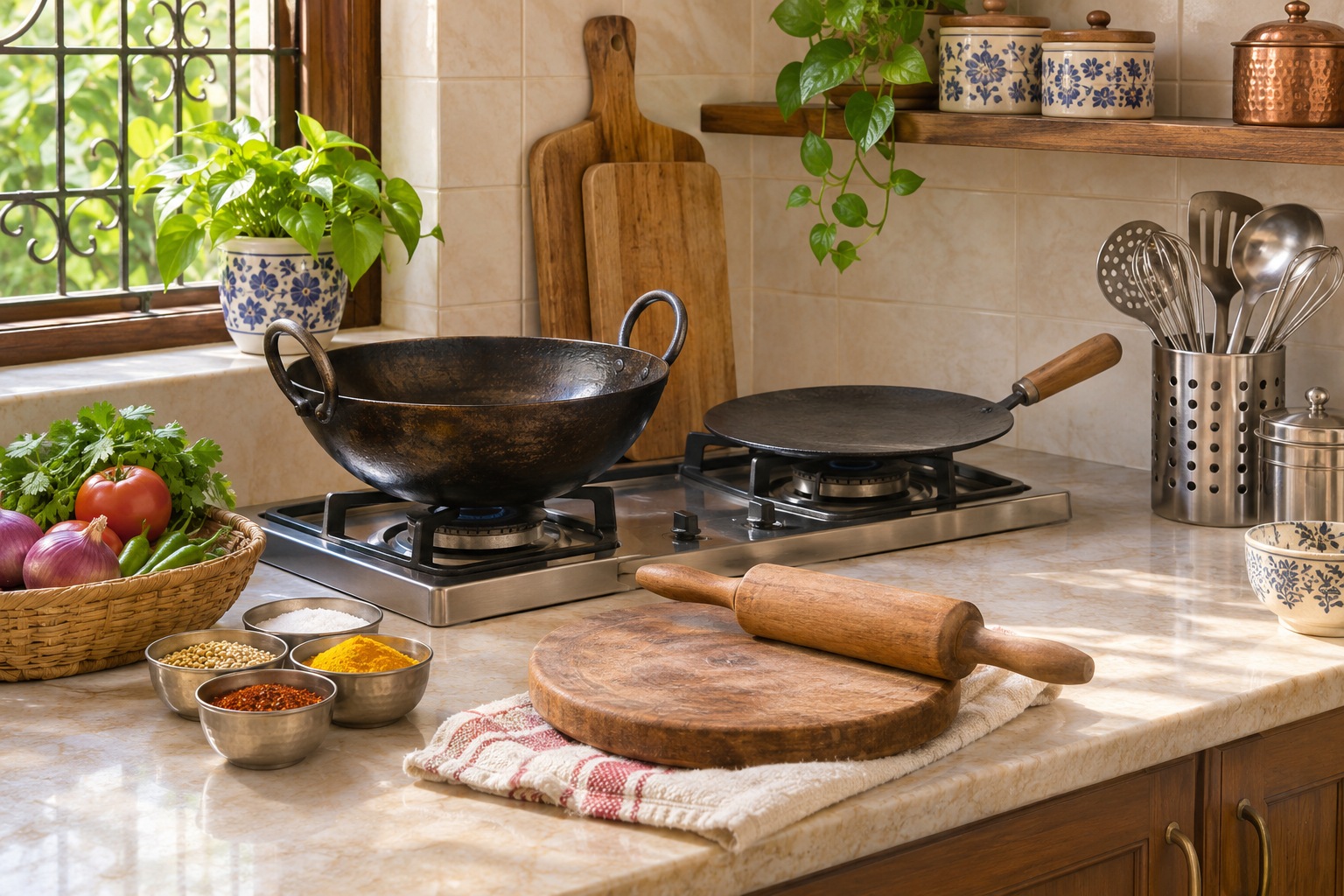
Kitchen equipment guide
A Complete Pakistani Kitchen Starter Kit: BuyReuse and Repair
Build a practical Pakistani kitchen starter kit around daily meals, then prioritise cookware, preparation, storage and cleaning while planning repairs and upgrades.
DailyLife.pk kitchen equipment collection
Start with a week of meals
A starter kitchen should let you prepare the meals you eat, serve them, store the leftovers and clean up. Begin with a realistic week: roti or rice, daal, vegetables, eggs, tea and whichever meat dishes you actually cook. Add baking or special sweets only if they belong in that routine. This is an editorial checklist, not a fixed wedding-shopping list or a minimum spending requirement.
Before buying, inventory what is already available. Check whether a family saucepan has a secure handle, whether the inherited plates fit the shelf and whether a usable knife can be sharpened. Record each item as ready to use, needs a specific repair, or unsuitable. The resulting gaps should drive your shopping list.
The core equipment checklist
| Job | Practical starting equipment | Upgrade only when needed |
|---|---|---|
| Roti and dough | Mixing bowl or parat, belan, suitable board and tawa. | Dough box, extra rolling board or mixer. |
| Rice, daal and curry | Lidded pot, saucepan, stable frying pan and stirring spoon. | Larger deg or pressure cooker for actual batch needs. |
| Preparation | Comfortable knife, separate suitable boards, peeler, colander and grater. | Food processor, chopper or mandoline. |
| Tea and serving | Tea pan or suitable kettle, strainer, cups, plates, bowls and cutlery. | Large tea tray or insulated flask. |
| Storage | Dry-food jars, shallow leftovers boxes and labels. | Bulk bins, freezer boxes and specialist organizers. |
| Washing and handling | Detergent, brushes, clean cloths, drying space, dry mitts and trivet. | Additional rack or specialist cleaning tools. |
For a two-person starting household, a smaller saucepan and a medium lidded pot can cover different cooking jobs more conveniently than one very large vessel. Compare the recipe quantities you actually cook rather than accepting a seller’s generic “family size.” A broad kadai and a deep stockpot may share a stated capacity while handling very differently on the burner.
Check every pot on the actual hob support where possible. A rounded base needs appropriate support; an induction hob needs cookware its instructions identify as compatible. Measure oven and cupboard openings before buying larger pieces. The ability to lift and wash a filled pot matters as much as whether it fits on the shelf.
Include the unglamorous essentials
Provide enough preparation surfaces to separate raw meat from ready-to-eat foods, and include a suitable food thermometer if your cooking requires doneness checks. FoodSafety.gov’s core guidance covers cleaning, separation, cooking and chilling. Equipment should make those steps possible: a collection of decorative jars does not replace a usable chopping board or reliable cold storage.
Choose bowls and plates explicitly intended for food. The FDA warns that some traditional pottery is unsuitable for food contact; do not treat an unlabelled inherited decorative bowl as verified cookware. Give display pieces a display role and put known suitable vessels into daily use. Inspect glass rims and ceramic surfaces before placing them in the starter inventory.
A stable trivet, comfortable dry mitts and a clear place to set a hot lid deserve space from the beginning. Keep knife storage away from loose searching hands, and choose a drying arrangement that does not require stacking wet dishes precariously. These small working arrangements can be planned without buying an entire matching accessory range.
Budget by priority and total cost
Make three columns: essential for this week, useful within the next few months, and occasional. Buy the first column against a written spending limit, then review real use before moving to the next. Allocate money by the current gap rather than using an arbitrary percentage for appliances. Keep a small reserve for a missing lid, appropriate plug or replacement seal that a purchase may require.
Compare item price, delivery, included accessories, consumables and likely repair access. For an electrical appliance, read the rating plate and check compatibility with your household supply before buying an import. Ask which service centre handles that exact model and whether the jar, coupler, gasket or blade assembly can be replaced. A seller’s broad claim that “parts are available” needs a model-specific answer.
For example, if making chutney is your main appliance task, compare a small suitable grinder against a large processor with many attachments. If you rarely bake, spend first on a reliable pot and knife. Do not buy a pressure cooker until you have read its manual and confirmed access to its correct gasket and safety components.
Repair and reuse with clear limits
Reuse sound food jars for appropriate dry ingredients after thorough cleaning and drying. Keep the original label information where it matters and add a clear contents label. Match lids before discarding containers, and consider buying one replacement lid instead of another entire set. Avoid repurposing containers that previously held chemicals.
Seasoned cast iron is one example of equipment with a defined care routine: Lodge describes washing, drying and lightly oiling its seasoned cookware. Follow the actual maker’s process when restoring a pan. Do not apply cast-iron treatment to a coated nonstick pan simply because both look dark.
Useful repair candidates include a knife needing professional sharpening or a pot needing its correct handle hardware. Electrical faults, pressure-cooker safety parts and damaged vessel structures require appropriate qualified attention or replacement. Do not defeat a safety device to keep an appliance running. Ask for a written repair estimate and compare it with replacing the useful item alone.
Add specialist equipment after the kitchen works
After several weeks, list the tasks that remain slow or awkward. A masala dabba may organise frequently used spices; a hand blender may suit soups; a cake tin may support a new baking habit. A sev sancha, jalebi dispenser or decorating turntable belongs on the list when the recipe becomes part of life, not because the starter checklist has empty space.
Keep model numbers, manuals, receipts and a short parts list together. Mark what is borrowed so it can be returned, and measure storage space before the next upgrade. A complete starter kitchen is complete when its daily routine works comfortably, with clear room for the next useful addition.
Keep building your kitchen
Return to the Pakistani kitchen equipment directory for related tools, cookware, appliances and practical buying guides. Then choose a dish from the recipe collection and check its equipment list before buying another gadget.
Frequently Asked Questions
Must I buy everything at once?
No. Start with the equipment needed for your first week of meals and cleaning. Add specialist tools after using the basic kitchen and identifying an actual gap.
Is a second-hand appliance always better value?
Value depends on its condition, correct electrical specification, missing accessories and repair support. Compare the full usable cost with a suitable alternative before buying.
How we know this
- Type Explainer
- Sources 3 (2 official/academic)
- Reviewed November 2026
- Disputed points None
3 sources
- 4 Steps to Food Safety, FoodSafety.gov
- Questions and Answers on Lead-Glazed Traditional Pottery, US Food and Drug Administration
- How to Clean, Lodge Cast Iron
Photo credits (1)
- Pakistani kitchen counter with karahi, tawa, chakla, belan, spices and utensils in warm window light., DailyLife.pk, All rights reserved
