
Kitchen equipment guide
BlendersGrinders, Food Processors and Mixers: Build a Useful Prep Kit
Choose tools for chutney, masala, lassi, dough and juice by task, jar size and cleaning effort, with practical advice on motor ratings, parts and safety.
DailyLife.pk kitchen equipment collection
Choose the task before the motor
A useful preparation kit handles the texture you want. Smooth lassi, coarse chutney, sliced onions, powdered spices and kneaded atta require different actions. Buying a machine because it has many attachments can leave you with a crowded cupboard and no attachment that does your main job well. List the three tasks you repeat most often and compare tools against those tasks.
Try to separate wet and dry preparation in your plan. A grinder used for roasted cumin should not retain moisture from yesterday's chutney. A jar that smells of garlic can also be disappointing for a fruit drink. Dedicated jars are often more useful than extra speed settings, provided they are clearly approved for the intended ingredients.
Compare preparation tools
| Tool | Typical job | Buying question |
|---|---|---|
| Jug blender | Lassi, smoothies, liquid sauces | Can it blend your smallest normal portion? |
| Dry grinder or mill | Spice powders and approved dry ingredients | Are hard spices and batch sizes permitted? |
| Food processor | Chopping, slicing, shredding and some dough tasks | Which blades and dough limits are documented? |
| Hand blender | Blending directly in a suitable vessel | Is the shaft removable, and what vessel depth is needed? |
| Hand or stand mixer | Whipping, beating and approved kneading | Which attachment and dough quantity are allowed? |
| Juicer | Separating juice from pulp | How much cleaning follows one serving? |
KitchenAid’s comparison distinguishes liquid-oriented blending from food-processor tasks. That helps explain why adding water to make a processor behave like a blender may change the recipe. For coarse onion pieces, controlled pulses can matter more than an extremely smooth puree setting.
Read capacity and ratings carefully
Use illustrative trial portions: one small bowl of green chutney, two glasses of lassi or the atta for one meal. These are comparison tasks, not guaranteed capacities. A large jar may leave a tiny batch below effective blade circulation. Conversely, its nominal volume is not necessarily the safe working volume for foaming liquids. Read minimum and maximum fill guidance rather than filling to the rim.
For a verified Pakistan-market example, Dawlance lists its DWTB 520 B at 400 W with a dry mill, two speeds and 220–240 V, 50 Hz supply. Its listed dimensions are 17 cm wide, 20.4 cm deep and 38 cm high. This is an example specification, not a claim that all locally sold blenders share those ratings. Check height under your cabinets with room to remove the lid.
Motor wattage alone does not tell you texture, allowed run time or kneading ability. Ask for maximum continuous operation and required cooling intervals from the exact manual. For a mixer, check the specified flour or dough quantity and hydration limitations. Do not translate a large bowl volume into permission to mix a bowl full of stiff dough.
Respect heat, blades and feed openings
Hot blending requires explicit permission. For example, KitchenAid’s K150 instructions restrict hot ingredients to its full-size jar and a specified speed. That rule belongs to that product family; it is not a safe procedure for an unvented personal blender cup or another brand. If your manual does not authorise hot liquids, cool the food appropriately or choose a tool documented for the job.
Disconnect power before handling blades, clearing jams or changing attachments. Wait for the blade to stop completely. Use the supplied pusher for a processor or juicer feed chute; hands, spoons and improvised tools do not belong there. Keep the motor base and electrical connections out of washing water. Check whether a hand-blender shaft is allowed to touch a hot pan and whether the pan coating needs protection.
For dense mixtures, follow the manufacturer's ingredient order and loading limits. Stop if the machine stalls rather than repeatedly forcing it through a blockage. A burning smell, damaged cable, cracked jar or unreliable lid lock needs assessment. An interlock should never be bypassed to make a mismatched lid operate.
Budget for cleaning and replacement parts
Before buying, count the removable pieces you will wash after a normal recipe. Juicers can add a pulp container and fine mesh to the routine; processors add discs and spindles. Consider where those sharp components will dry and be stored. Removable blades may simplify cleaning but introduce handling risk, so use the manual's disassembly sequence.
Wash food-contact parts promptly using approved methods, especially around seals and threads. Let dry-grinding jars dry fully before storage. Do not assume glass tolerates sudden temperature changes or that every plastic attachment is dishwasher safe. Keep a simple inventory of seals, couplers, jars, lids, whisk assemblies and blades, and ask the authorised service channel which replacements are actually orderable.
Compare cost with simpler alternatives
Electricity cost is measured kWh per batch multiplied by your applicable energy rate. Illustrative arithmetic: a 400 W input used continuously for three minutes consumes 0.02 kWh; real operation and ratings may differ. Add purchase price, replacement jars and maintenance to compare ownership costs. Short motor operation means cleaning time and repairability may matter more to your decision than a small claimed power difference.
A mortar and pestle can make a small chutney without a large machine's minimum-load problem. A hand whisk suits occasional beating, and a simple citrus press may suit someone who only wants lemon or orange juice. Choose a stand mixer when its approved dough work is frequent enough to justify its counter space. A compact, well-supported blender and separate spice mill can be a sensible staged purchase instead of one complex bundle.
Keep building your kitchen
Return to the Pakistani kitchen equipment directory for related tools, cookware, appliances and practical buying guides. Then choose a dish from the recipe collection and check its equipment list before buying another gadget.
Frequently Asked Questions
Can I grind dry spices in any blender?
Only when the jar and manual authorise dry grinding. Check the ingredient restrictions and batch size, particularly for hard whole spices.
Is a juicer the same as a blender?
No. A juicer generally separates pulp; a blender processes the ingredients together. Choose for the drink and cleanup you actually want.
How we know this
- Type Explainer
- Sources 3
- Reviewed November 2026
- Disputed points None
3 sources
- DWTB 520 B specifications, Dawlance Pakistan
- Food processor versus blender, KitchenAid
- K150 blender operation, KitchenAid
Photo credits (1)
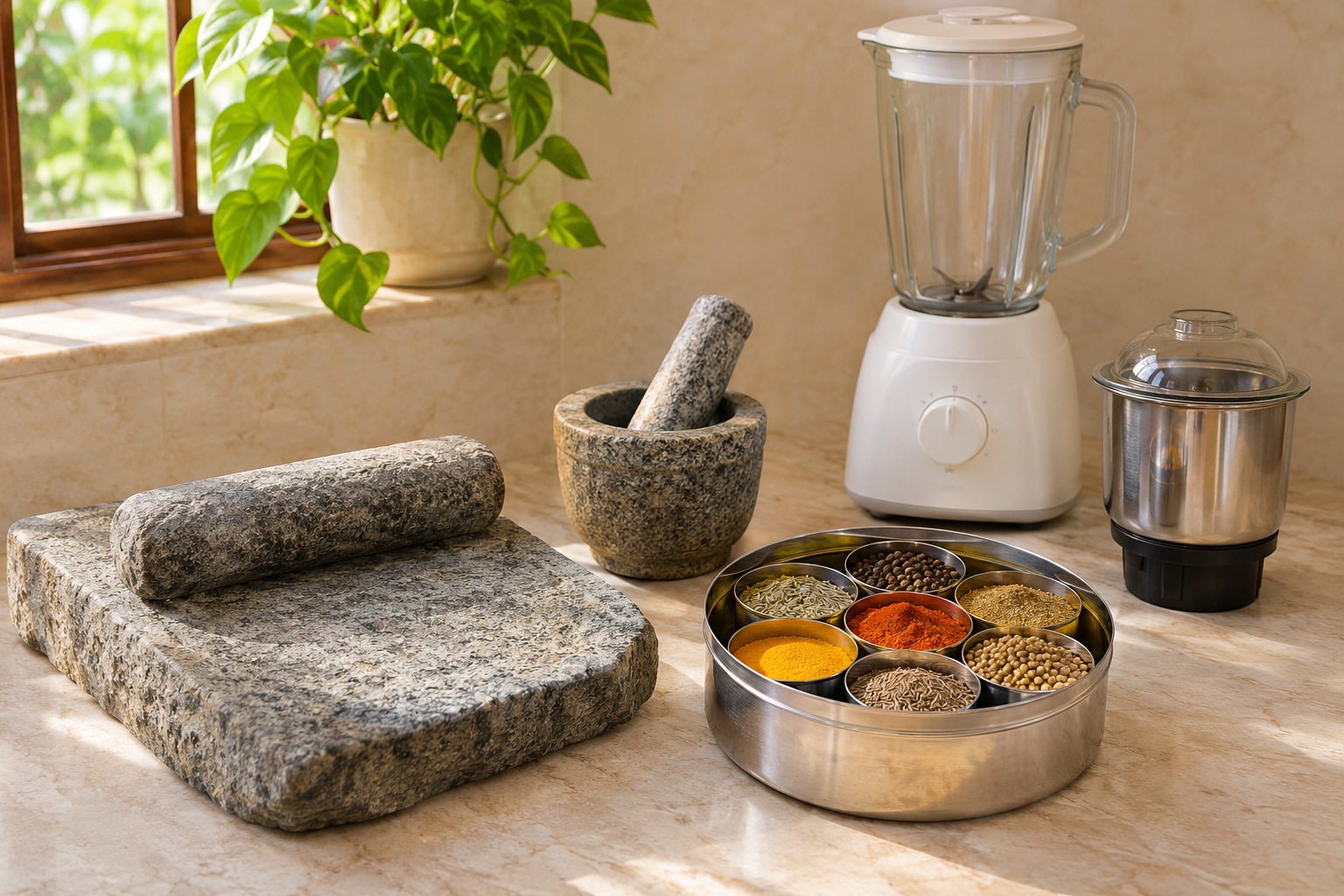
- Traditional sil-batta and mortar with masala dabba, blender and dry grinder., DailyLife.pk, All rights reserved
