
Kitchen item guide
Karahi: ChoosingUsing and Caring for It
Choose a karahi around bhunai, burner support, usable cooking space and the care its material needs.
DailyLife.pk kitchen equipment collection
Why the bowl matters
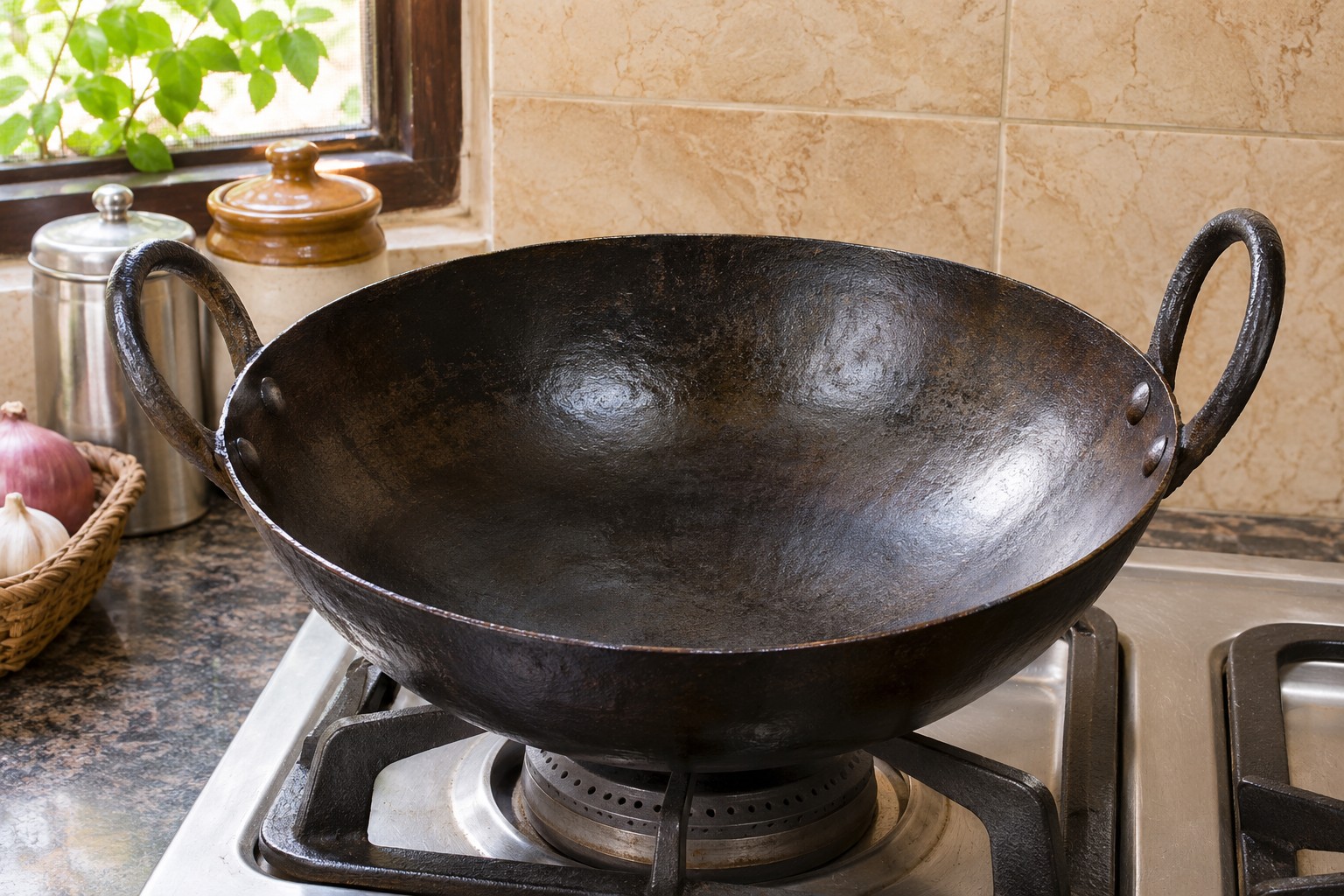
A karahi is a deep, open cooking vessel whose sloping sides let you stir a masala, turn pieces of meat and reduce a gravy without working through a narrow neck. In Pakistani kitchens it suits chicken karahi, keema, bhindi and shallow batches of pakora. Its shape does not guarantee restaurant results: a small domestic burner, wet ingredients and an overcrowded bowl can still produce a watery dish. Decide whether your main job is fast reduction or a longer covered curry before buying. The two jobs ask for different working space and lid arrangements.
Compare constructions
Seasoned iron and carbon steel need deliberate drying; stainless steel offers a bright cooking surface and is convenient for changing between dishes. Cast iron feels different from thin pressed steel: lift both with two hands and imagine the weight of food added. Aluminium, hard-anodised aluminium and coated versions are separate constructions, even when the outside colour looks similar. Ask what the food-contact surface actually is. A flat-bottom karahi usually fits a domestic hob more conveniently than a fully round-bottom vessel; a round bowl requires a manufacturer-approved stable support. Do not improvise a balancing arrangement over a flame.
Size for your burner
As editorial shopping examples, compare a roughly 26 cm bowl for smaller batches with a 32 cm bowl when you regularly need more turning room. These are comparison points, not serving guarantees. Measure the flat contact area as well as the mouth diameter, and allow space for both handles between neighbouring pots. A very wide bowl over a tiny heat source can cook unevenly. Check induction compatibility on the particular product rather than assuming all metal works. Take your spatula or note its width: you should be able to sweep the base and turn food without hitting the handles.
Cook a manageable batch
Prepare chopped ingredients before heating. Set the dry karahi securely, add the cooking fat and warm it at the heat level permitted for its surface. Add aromatics and stir across the bottom rather than only around the rim. Add meat or vegetables in a quantity that leaves access for turning; work in batches if the bowl becomes crowded. Add liquid as the recipe needs, then reduce heat for any covered simmer. Finish a gravy by removing the lid and stirring as moisture leaves. Never lean into the bowl while adding wet ingredients to fat, and keep a dry place ready for a hot lid.
Handle heat and food contact
Both loop handles can become hot, including the handle furthest from the burner. Use dry heat protection and move the vessel only along a clear route. Never carry it by one loop when full. For a tomato-heavy karahi, choose a surface whose maker permits that cooking use; Health Canada guidance advises against long cooking or storage of acidic foods in uncoated iron. Transfer leftovers rather than treating the cooking bowl as a storage container. A nonstick karahi needs the maker's heat and utensil limits, so it is a poor purchase if you intend aggressive empty preheating.
Clean and judge wear
Let the bowl become safe to handle, loosen stuck masala with a suitable nonabrasive method and clean beneath the handle fittings. With seasoned iron, wash, dry thoroughly and apply only a thin protective oil film; Lodge Cast Iron guidance explains this sequence. Do not leave a thick sticky layer of oil in the bowl. On stainless steel, distinguish removable cooking marks from deep pits or a separated base. Retire a cracked body, a handle attachment that cannot be repaired properly, or a badly deteriorated coating. Store dry, with a separator if another pot rests inside.
Buy for actual frequency
A local cookware shop lets you check balance, rim finish and the lid fit directly; an online listing should show the inside, underside and handle joints. Ask about returns before choosing a heavy piece whose balance you cannot feel. Buy a dedicated karahi when its open shape solves a recurring cooking problem. A wide sauté pan or a broad heavy pot can make a good curry when you adjust batch size and evaporation. The karahi's advantage is access for stirring; its costs are shelf space, hot exposed sides and, for iron, a continuing care routine.
Frequently Asked Questions
Is a black karahi always iron?
No. Identify the material and coating in the specification; colour alone cannot tell you.
Can I cook a large chicken batch in a small karahi?
Use smaller batches if you cannot turn pieces and stir the base comfortably.
Does it need a lid?
A lid helps covered simmering; an open finish helps reduction. Choose according to your dishes.
How we know this
- Type Explainer
- Sources 3
- Reviewed November 2026
- Disputed points None
3 sources
- Safe use of cookware and bakeware, Health Canada
- How to clean seasoned cast iron, Lodge Cast Iron
- Stainless steel tri-ply cookware manual, Hawkins
Photo credits (1)
- a seasoned black iron Pakistani karahi, deep hemispherical bowl with two opposite loop handles, empty interior visible, on a stable cold gas hob, DailyLife.pk, All rights reserved
