
Ingredients & Spices · The complete guide
Coconut milk
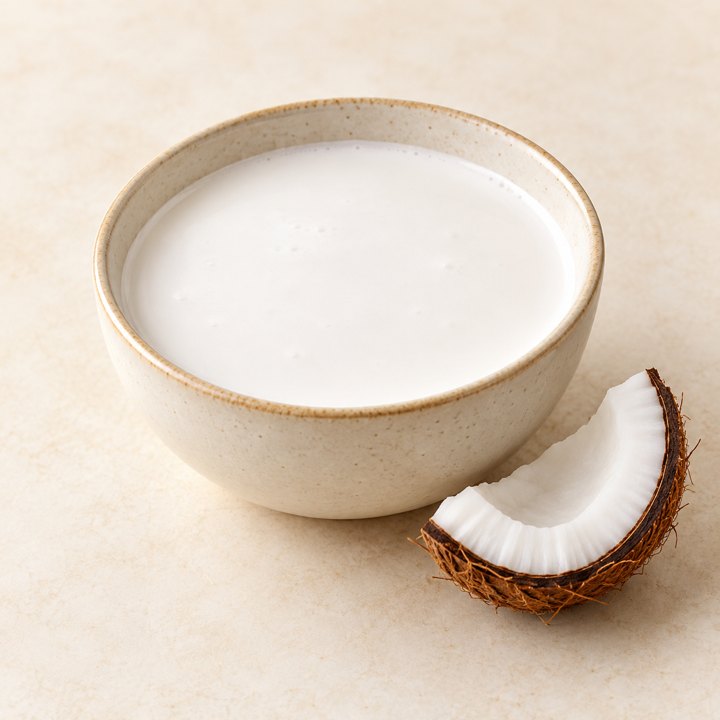
Coconut milk is an emulsion extracted from grated mature coconut flesh and water. Nariyal ka doodh is different from the clear liquid inside a young coconut.
What it is and names used in Pakistan
Coconut milk is an emulsion extracted from grated mature coconut flesh and water. Nariyal ka doodh is different from the clear liquid inside a young coconut.
Origin and historical context
It has longstanding uses across tropical Asian cuisines; a single country or discovery date would misrepresent this shared culinary development.
Types, manufacture and buying
Grated flesh is pressed with water, then filtered. First-press and diluted milk differ in richness; commercial cans, cartons, powders and light versions have different fat contents.
Choose unsweetened cooking coconut milk rather than a sweetened coconut drink when the recipe needs a rich sauce. Compare fat content because light milk, ordinary milk and coconut cream give different body. Stabilisers may keep a uniform emulsion, while simpler formulas can separate naturally. Coconut powder may include milk-derived ingredients, so check rather than assuming it is dairy-free. Check can integrity and the opening date. The percentage of coconut and the nutrition panel are more useful than an image of a coconut on the front.
Production, trade and the Pakistani pantry
Thailand, Indonesia, the Philippines and Sri Lanka have coconut-processing industries; Pakistani kitchens commonly use imported cans or powders.
Reference: CBI: Coconut milk market and producer context.
Cooking uses and practical substitutions
Use unsweetened milk in fish curry, Thai curry and appam. Stir gently after opening because natural fat separation is normal. Diluted coconut cream can replace it; dairy milk gives neither the same fat behaviour nor flavour.
Stir or shake a sound unopened container as directed, then stir after opening to redistribute separated fat. Use gentle heat when a smooth sauce is desired and avoid vigorous prolonged boiling that can separate the emulsion. Some recipes intentionally cook thick coconut cream until oil separates for frying curry paste; that is a different technique from accidental splitting. Dilute gradually when making a lighter broth. Sweetened products alter both flavour and browning, so do not treat them as a direct replacement in a savoury curry.
Nutrition, benefits and limitations
Cooking coconut milk provides fat and energy, often with a substantial saturated-fat component. It contains much less protein than cow’s milk and is not automatically fortified with calcium or vitamins. It should not be used as a nutritionally equivalent infant or child milk replacement. Small culinary amounts can fit into varied meals, but claims that coconut fat uniquely burns body fat or protects against disease are not justified by the ingredient name. A coconut allergy is possible; dairy or other allergens can also arise from additives or shared processing.
It is often rich in saturated fat and is not nutritionally equivalent to cow’s milk or a fortified drinking beverage.
Practical notes and common mistakes
In a can of full-fat coconut milk, a thick pale upper layer and thinner liquid beneath can be a normal result of separation. Stir them together for an even soup, or use the thick portion only when the recipe calls for that technique. If a curry is too rich, dilute the cooking batch with water or stock rather than adding more strong acid indiscriminately. A coconut beverage designed for drinking is generally much thinner, and its possible sweetening or fortification may make it a poor cooking substitute.
Storage and safe handling
Follow the package before opening; cans, shelf-stable cartons and refrigerated products have different requirements. Once opened, refrigerate promptly in a covered food-safe container and follow the stated use-within period. Freeze measured portions if suitable, expecting possible separation after thawing. Homemade extracted coconut milk is particularly perishable and should be used promptly. Normal separation alone is not spoilage, but a sour off-odour, unexpected gas, mould or prolonged temperature abuse is reason to discard it. Do not taste a suspicious swollen can or leaking carton to investigate.
Recipes and related pantry reading
Use the form and quantity specified in each recipe, then adjust for the concentration, salt and moisture of the product you have bought. These dishes show where the ingredient fits in a complete preparation.
For related local names and pantry ingredients, see the Pakistani ingredients and spices guide.
Names and forms used in our recipes
View the recipe names covered by this guide
- coconut milk
- full-fat unsweetened coconut milk
- thin coconut milk
- unsweetened coconut milk
Frequently Asked Questions
Is coconut milk the liquid inside a coconut?
No. It is extracted from the flesh with water; the clear liquid is coconut water.
Does separated coconut milk always mean spoilage?
No. Natural fat separation is common, but damaged packaging, mould or an off odour needs attention.
Keep Exploring
Related places and stories on DailyLife.pk

How we know this
- Type Explainer
- Sources 4 (1 official/academic)
- Reviewed November 2026
- Disputed points None
