
Life in Pakistan
Prayer Times in Pakistan: How They Are Worked Out
Why Fajr in Karachi differs from Fajr in Peshawar, what the 'Karachi method' and Hanafi Asr mean, how sehri and iftar times are set in Ramadan, and where to find reliable timings for your city.
- Five daily prayers
- Set by the sun's position
- One time zone: UTC+5
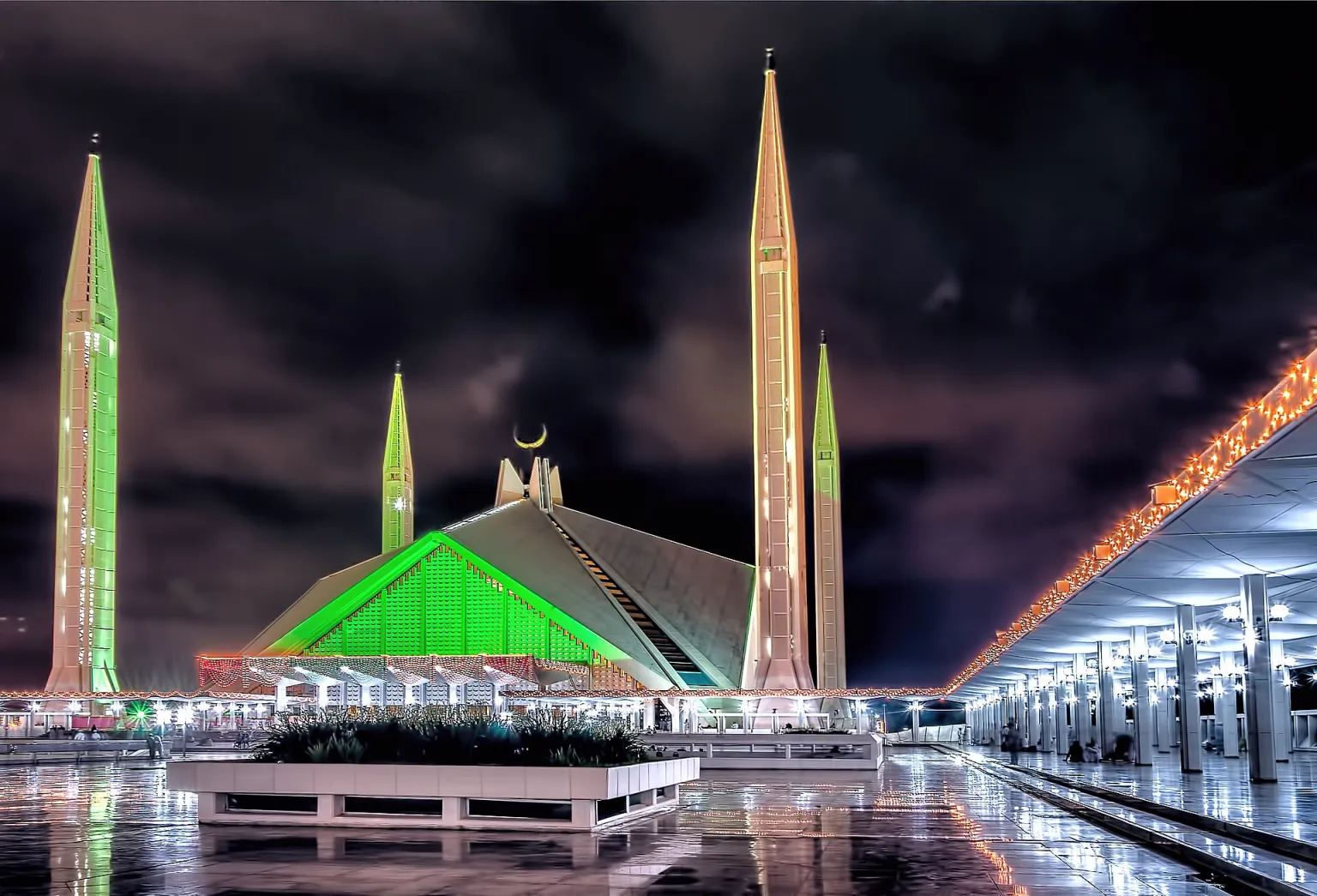
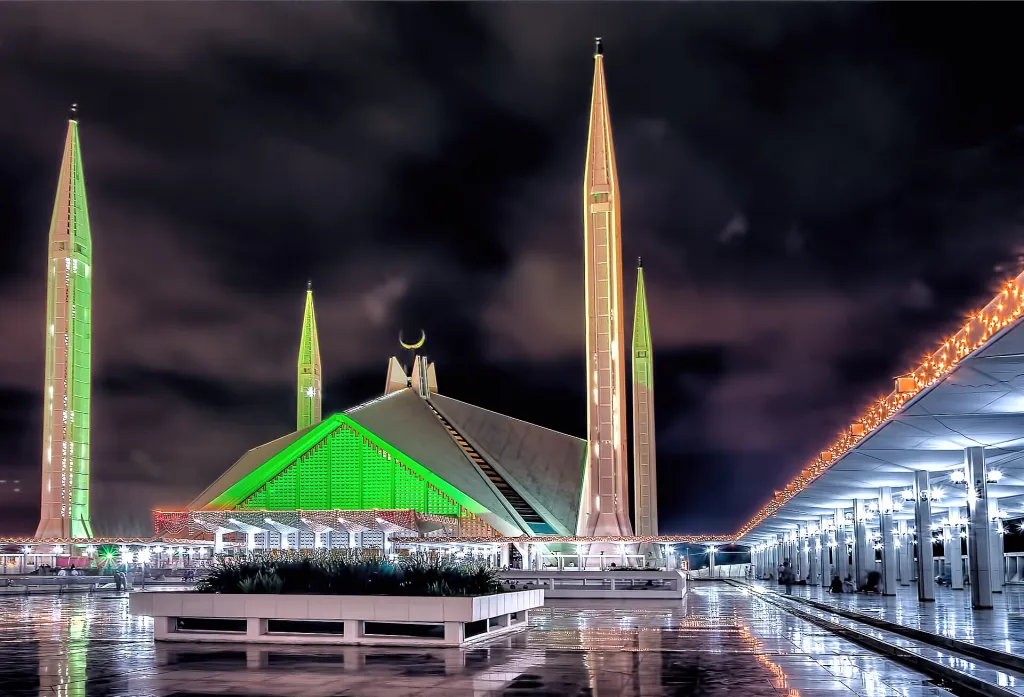
Faisal Mosque, Islamabad
Prayer Times Follow the Sun
The five daily prayers, Fajr, Zuhr, Asr, Maghrib and Isha, are tied to the position of the sun, not to the clock. That is why timings shift a little every day through the year, and why they differ from city to city even though all of Pakistan uses a single clock time, Pakistan Standard Time (UTC+5).
Timetables you see on mosque boards, calendars and apps are calculated from a city's latitude and longitude using a set of conventions. In Pakistan the most widely used is the University of Islamic Sciences, Karachi method, together with the Hanafi rule for Asr, reflecting the Hanafi school followed by most Sunni Muslims in the country. Other communities, Ahl-e-Hadith congregations and Shia (Jafari) mosques among them, use different conventions for some prayers, so two mosques in the same street can legitimately show different times.
Two numbers appear for each prayer in practice: the start time (when the prayer becomes due) and the jamaat time (when a mosque holds the congregation), which is set by each mosque. This page explains the start times; check your local mosque for jamaat.
Today's Prayer Times
Choose your city, Asr school and date. Times are calculated live for Pakistan Standard Time.
| Prayer | Time (PKT) |
|---|---|
| Loading… | |
Times are calculated with the University of Islamic Sciences, Karachi method, the convention most mosques in Pakistan use, via the free AlAdhan prayer-times service. Your local mosque may differ by a few minutes; for Ramadan sehri and iftar, follow your local mosque or official timetable.
How Each Prayer Time Is Defined
| Prayer | Begins | Notes |
|---|---|---|
| Fajr | True dawn, sun 18° below the horizon (Karachi method) | Ends at sunrise. Sehri in Ramadan ends at this time |
| Zuhr | Just after solar noon, when the sun begins to decline | A few minutes are usually added for safety |
| Asr | Hanafi: when an object's shadow equals twice its height plus its noon shadow. Standard (Shafi'i, Maliki, Hanbali): once its height plus noon shadow | Hanafi Asr is noticeably later; the gap varies with season and latitude |
| Maghrib | Sunset | Sunni timetables add 1–3 minutes of precaution; Jafari practice waits until the eastern redness has passed (about 4° below the horizon). Iftar is at Maghrib |
| Isha | Sun 18° below the horizon (Karachi method) | Jafari timetables commonly use a different angle |
Definitions summarised from the calculation conventions documented by PrayTimes.org. Individual mosques and scholars may apply their own precautionary margins.
Sehri and Iftar in Ramadan
- 1
Ramadan begins with the moon
The start of Ramadan and the Eids depends on sighting the new crescent. In Pakistan the official announcement is made by the central Ruet-e-Hilal Committee, whose role Parliament has moved to formalise in law; follow its announcement rather than social-media claims.
- 2
Sehri ends at Fajr
The pre-dawn meal must finish by the start of Fajr (true dawn). Many printed calendars show a sehri end time a few minutes earlier as a precaution, follow the calendar your mosque uses.
- 3
Iftar is at sunset
The fast is broken at Maghrib. Calendars may add a minute or two after astronomical sunset.
- 4
Use a calendar for your own city
Mosques, Islamic centres and newspapers publish city-specific Ramadan calendars. A Lahore calendar is wrong for Quetta or Gwadar by several minutes or more.
- 5
Choose the right Asr setting in apps
If you use an app, set the calculation to University of Islamic Sciences, Karachi, and choose Hanafi or standard Asr according to your practice.
Finding Reliable Timings
Your local mosque
The best reference
Mosque timetables reflect the convention followed by that congregation and show jamaat times.
Prayer-time apps
Check the settings
Set location, the Karachi method and your Asr school. Wrong settings are the most common reason apps 'disagree' with the mosque.
Newspapers and calendars
Especially in Ramadan
Daily papers print city timings; Ramadan calendars are widely distributed.
Travelling
Update your location
On long road trips, especially east–west across Sindh and Balochistan, update the city in your app.
Notes for Visitors
- Shops and offices may pause briefly for Friday Zuhr (Jumu'ah), the week's main congregational prayer.
- Dress modestly and remove shoes when visiting a mosque; avoid walking in front of people praying.
- During Ramadan, avoid eating, drinking or smoking in public during fasting hours as a courtesy.
- Iftar time is busy, roads empty just before Maghrib and markets fill afterwards.
Frequently Asked Questions
Which calculation method is used in Pakistan?
Most timetables use the University of Islamic Sciences, Karachi method, with Fajr and Isha at 18° below the horizon, combined with the Hanafi rule for Asr.
Why is Asr later at my mosque than in my app?
Your mosque probably follows the Hanafi Asr (shadow twice an object's length), while your app may be set to the standard (shadow once its length). Change the Asr setting in the app.
When does sehri end?
At the start of Fajr (true dawn). Many calendars stop a few minutes earlier as a precaution, so follow the calendar your mosque uses.
Why are prayer times in Quetta later than in Lahore?
Quetta lies farther west. All of Pakistan uses the same clock time, so the sun rises, peaks and sets later on the clock in western cities.
Who announces the start of Ramadan in Pakistan?
The central Ruet-e-Hilal Committee announces the moon sighting for Ramadan, the Eids and other Islamic months.
Keep Exploring
Related places and stories on DailyLife.pk
 LahoreLahore travel guide: Badshahi Mosque, Lahore Fort, Shalimar Gardens, the Walled City, food streets, neighbourhoods, metro
 KarachiKarachi travel guide: Mazar-e-Quaid, Mohatta Palace, Clifton, Burns Road, bazaars, neighbourhoods, Green Line BRT
 QuettaQuetta city guide: Hanna Lake, Urak Valley, bazaars, sajji and dry fruit
 GwadarGwadar city guide: the Hammerhead and Koh-e-Batil, Marine Drive, the deep-sea port, fish harbour
 GilgitGilgit city guide: Kargah Buddha, bazaars, polo, 1947 history, Naltar and Rakaposhi day trips
 Public Holidays in PakistanPakistan public holidays 2026: fixed national days plus Eid
How we know this
- Type Practical guide
- Sources 5
- Reviewed October 2026
- Disputed points None
Rules and fees change, confirm with the official links below before you act.
5 sources
- Prayer times calculation, PrayTimes.org
- NA passes bill to regulate moon sighting (Pakistan Ruet-e-Hilal Bill), Dawn
- 3-year jail term on false moon-sighting as NA passes bill, ARY News
- Ruet-e-Hilal Committee to meet in Peshawar to sight Ramadan moon, Geo News
- Ruet-e-Hilal Committee meeting date for Ramadan moon sighting announced, ProPakistani
Photo credits (8)
- Faisal mosque on the eve of 27th Ramadan.jpg, Alighazanfarz, CC BY-SA 3.0, via Wikimedia Commons
- Gwadar City from the mountain.jpg, Madihasalam, CC BY-SA 4.0, via Wikimedia Commons
- A view of Gilgit City from Jutial Nala.jpg, Kskhh, CC BY-SA 4.0, via Wikimedia Commons
- Karachi Skyline 1.jpg, Ktownboy103, CC0, via Wikimedia Commons
- Minar-e-Pakistan with waving national flags.JPG, Susmanhamza, CC BY-SA 3.0, via Wikimedia Commons
- The Badshahi in all its glory during the Eid Prayers.JPG, Bilalhassan88, CC BY-SA 3.0, via Wikimedia Commons
- Badshahi Mosque front picture.jpg, Romero Maia, CC BY-SA 4.0, via Wikimedia Commons
- Eid prayers at the Badshahi Mosque.JPG, Bilalhassan88, CC BY-SA 3.0, via Wikimedia Commons
