Gulab Jamun
گلاب جامن
Milk-powder dumplings fried slow and soaked in rose-cardamom syrup.
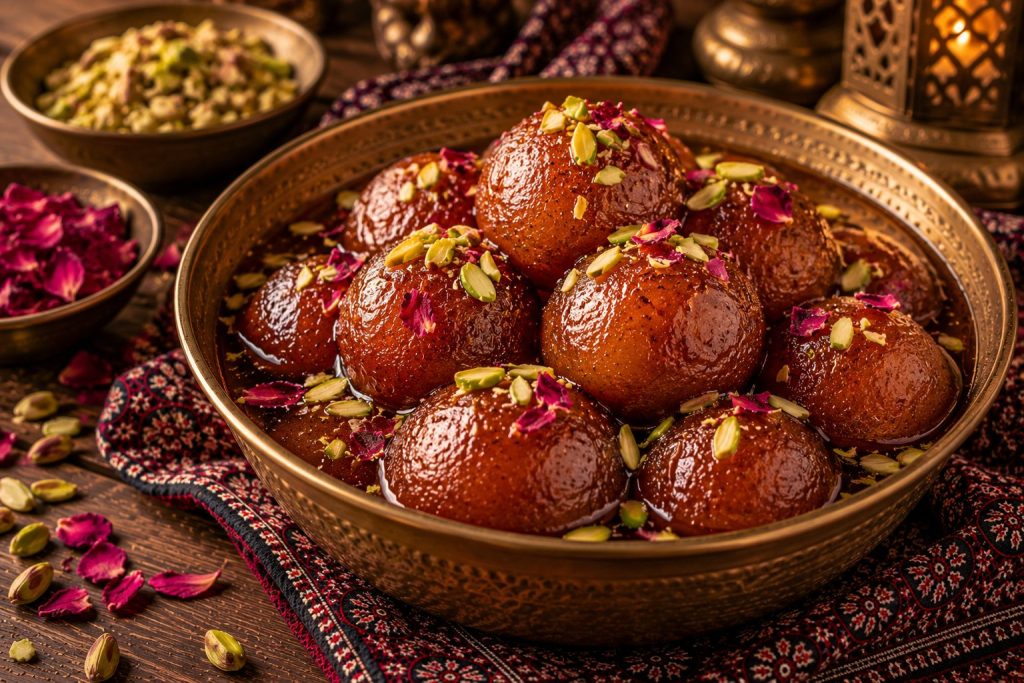
The everyday Pakistani home version: a soft dough of full-fat milk powder, egg and ghee, rolled into balls, fried low and slow to a deep brown and soaked in a light cardamom and rose syrup.
Allow about 130 minutes for the original eight servings, including at least 1 hour soaking in syrup. A 2–3-hour soak takes longer and should continue under refrigeration once the dessert has cooled promptly. The dough’s 10-minute chilled rest can overlap preparing the frying station. Fry larger batches in several rounds; do not multiply the heat. This version uses milk powder, not khoya. One tablespoon = 15 ml; one teaspoon = 5 ml.
About Gulab Jamun
Gulab jamun are soft, spongy dumplings of milk solids, fried until dark golden brown and soaked in syrup. The name joins gulab, rose, for the rose-scented syrup, with jamun, the small dark purple fruit they resemble in size and colour. Their exact origin is debated: they are often linked to Persian and Central Asian fried sweets soaked in syrup and to Mughal-era kitchens, but no single story is settled. What is certain is their place at the centre of Pakistani celebrations, from weddings and Eid to exam results and new babies, usually bought by the box from the mithai shop.
Sweet shops traditionally make them with khoya, milk slowly reduced to a dense solid. At home in Pakistan, the most common version uses full-fat milk powder instead, bound with a little flour, ghee and egg. It is far quicker, needs no special ingredients, and, fried patiently, gives jamun that are tender and evenly soaked right to the centre. This recipe is the milk-powder version; a khoya method is outlined in the variations.
The two things that make or break gulab jamun are a light hand with the dough and low, steady frying heat. Hot oil browns the outside before the centre cooks, leaving a raw, dense core that will not soak up syrup. The syrup itself stays light: just thick enough to feel faintly sticky, nowhere near the thread stage used for jalebi or barfi, so it can seep all the way in.
Personally cooked and tested by Zohair Fakhar for DailyLife.pk. Cooking times can vary with your stove, cookware and batch size; follow the texture and doneness cues in the method.
Make it work for your kitchen
Also known as gulab jaman, gulaab jamun, milk powder gulab jamun, sheera jamun, گلاب جامن.
Original quantities serve 8. Cooking times, pan size and frying-oil depth do not scale, cook in extra batches instead.
Before you start
Make the syrup first
Make the syrup in the first cooking step before mixing the dough. It needs to be ready and warm when the fried jamun leave the oil; keep it on the lowest heat while frying.
Low heat · 10 minMeasure, then sift
Weigh the milk powder and sift it with the flour, semolina, baking powder and ground cardamom. Lumps of milk powder or baking powder show up as hard spots or cracks later.
Heat off · 5 minGrease your palms
Set aside a little clean, unheated frying oil or ghee in a saucer for your hands. Lightly greased palms help you roll the soft dough into smooth, crack-free balls. Keep this separate from the hot frying pot.
Heat off · 1 minSet up the equipment
Have the following tools ready before starting: Sieve; mixing bowl; flexible spatula; wide pan for syrup; small heavy-based saucepan or karahi for frying; slotted spoon or skimmer; kitchen thermometer (optional).
Clean workspace
Step-by-step cooking method
1 Make a light syrup
Put the sugar, water and crushed cardamom in a wide pan over medium heat and stir until the sugar has completely dissolved. Bring to a boil, then simmer for 5 minutes. To check, cool a drop on a spoon and press it between finger and thumb: it should feel faintly sticky but must not form a thread when you pull your fingers apart. Stir in the rose water, then keep the syrup warm on the lowest heat.
2 Mix the dough
Rub the softened ghee into the sifted dry ingredients with your fingertips until it looks like coarse crumbs. Add the beaten egg and fold together with a spatula just until a soft, slightly sticky dough forms. If dry patches remain, add the milk a teaspoon at a time. Do not knead. Cover and chill for 10 minutes so it firms slightly.
3 Shape the balls
With lightly greased palms, shape the dough into equal small balls about 2.5 cm across. Roll gently until smooth with no cracks or seams, which can open in the oil. The number of balls depends on the selected batch size. Keep them covered while you work and set aside a tiny portion of the same dough for the frying check.
4 Set the frying heat
Add enough of the frying oil or ghee for at least 4 cm depth in a stable heavy pot, leaving the pot no more than half full. Warm over medium-low heat, then reduce to low. Lower in the small test portion carefully: it should sink, then rise slowly with tiny steady bubbles and take several minutes to colour. If it rises immediately and darkens within a minute, take the pot off the heat briefly to cool before trying again. Keep water and wet utensils away from the oil.
5 Fry low and slow
Fry only as many balls as can float freely with room to swell. Do not touch them until they float; move the oil gently with the spoon so they turn. Once floating, turn them carefully until evenly deep golden brown. Check the test piece is cooked through with no wet raw dough; the egg-containing centre should reach 71°C (160°F). If it colours before the middle cooks, lower the heat and allow more time.
6 Into the warm syrup
Lift each batch out with a slotted spoon, let the oil drip off for a few seconds, and drop the hot jamun straight into the warm syrup. Hot jamun in warm (not boiling, not cold) syrup absorb it best. Repeat with the remaining balls.
7 Simmer gently
When all the jamun are in, raise the heat until the syrup just begins to bubble, then cover and simmer very gently, without stirring, until they have swollen further and look plump and glossy. Shake the pan occasionally rather than stirring, to avoid breaking them.
8 Soak and serve
Turn off the heat and let the jamun absorb the syrup for at least 1 hour. For a longer 2–3-hour soak, transfer to shallow containers and refrigerate promptly, keeping them in the syrup. Do not leave the milk-and-egg dessert at room temperature for more than 2 hours, or more than 1 hour above 32°C. A cut jamun should be soft and syrup-soaked to the centre. Serve with a little syrup and the pistachios.
Chef’s tips
- Use full-fat milk powder; low-fat powders give firm, chewy jamun.
- Weigh the milk powder. Cup measures vary widely, and too much powder makes a dry, crack-prone dough.
- Keep the oil gently bubbling throughout. If the jamun colour in under 3 minutes, the heat is too high.
- Shape all the balls before you start frying, and keep them covered so they don't dry and crack.
- Expect the jamun to grow considerably in the syrup, so roll them smaller than you want them to end up.
Common mistakes & quick fixes
- Jamun are hard or rubbery
- The dough was overworked or had too much flour or milk powder. Mix only until combined, and weigh ingredients next time. Simmering longer in syrup can soften them a little.
- Dark outside, raw or dense in the middle
- The oil was too hot. Fry on low so they take 6–8 minutes to colour and cook through.
- Jamun cracked or fell apart in the oil
- The dough was too dry, the balls had cracks, or there was too much baking powder. Add a little milk, roll until perfectly smooth and measure the baking powder exactly.
- Jamun dissolved or turned mushy in the syrup
- Too little binding or the syrup was boiling hard. Keep the dough soft but cohesive, and simmer the syrup gently.
- Syrup won't soak in
- Syrup was too thick or cold. Keep it light (no thread) and warm, and add the jamun while they are still hot.
Variations & serving ideas
Khoya gulab jamun: The sweet-shop method: crumble 250 g soft khoya with 2 tbsp plain flour and a pinch of baking soda, mash until smooth, then shape and fry exactly as above. Khoya dough needs no egg.
Eggless: Replace the egg with 2–3 tbsp thick, cold yoghurt or cream, adding it gradually until a soft dough forms.
Saffron syrup: Add a pinch of saffron to the syrup with the cardamom for a golden colour and deeper aroma.
Stuffed: Press a small piece of pistachio or a few grains of cardamom sugar into the centre of each ball before rolling it smooth.
Kala jamun: Add 1 tbsp sugar to the dough and fry a little longer until very dark brown for the caramelised, almost black kala jamun.
Perfect result check
| Colour | Even deep golden to reddish brown, without black spots. |
|---|---|
| Texture | Soft and spongy; a spoon cuts through easily with no dense or dry core. |
| Soaking | Syrup has seeped right to the centre when cut. |
| Syrup | Light, fragrant and pourable, not thick or crystallised. |
Storage & reheating
| Room temperature | Up to 2 hours | Gulab jamun contain milk and egg. Don't leave them out longer than 2 hours (1 hour above 32°C), following USDA guidance for perishable cooked foods. |
|---|---|---|
| Fridge | 3–4 days | Transfer to shallow containers, refrigerate promptly at 4°C or colder and keep covered in the syrup. Use within 3–4 days. The soaking time does not remove the need for refrigeration. |
| Freezer | Not recommended | Freezing and thawing tends to make them watery; they are best made fresh. |
| Reheating | Heat thoroughly | Reheat only the portion you will eat, gently in syrup over low heat or in a covered microwave, until 74°C (165°F) throughout. Let it cool enough to eat safely; hot syrup can burn. |
Know when to change the heat
| Stage | Heat | What to look for |
|---|---|---|
| Syrup | Medium, then lowest | Sugar dissolved; faintly sticky, no thread; kept warm |
| Test ball | Medium-low then low heat | Sinks, rises slowly after a few seconds with tiny bubbles |
| Frying | Low heat | Balls swell and brown evenly over 6–8 minutes |
| Simmering in syrup | Low, covered | Jamun plump and glossy, syrup barely bubbling |
Helpful answers before you cook
Is this recipe made with khoya or milk powder?
This version uses full-fat milk powder, not khoya. Keep to the listed milk-powder dough quantities; khoya has a different moisture content and needs its own ingredient balance.
How thick should the syrup be?
Keep it light and pourable rather than thick or thread-forming. After the sugar dissolves, simmer briefly as directed and cool a drop fully before touching it. Thick syrup does not soak readily into the centre.
Why do my gulab jamun turn out hard?
Usually overworked dough, too much milk powder or flour, low-fat milk powder, or oil hot enough to seal the outside before the centre cooks. Mix gently, weigh ingredients and fry low and slow.
Why add egg?
The beaten egg helps bind this milk-powder dough. If the serving control gives a fractional egg, beat a whole egg until uniform and measure the required fraction of that mixture. Eggless dough needs a different moisture balance, so use an eggless recipe with its own quantities.
Should the syrup be hot or cold when I add the jamun?
Warm syrup and hot jamun. Very hot, boiling syrup can break them, and cold syrup soaks in slowly. The gentle simmer afterwards helps the syrup penetrate.
Why semolina?
A spoonful of fine semolina gives the dough a little structure and a light, slightly grainy texture, helping the jamun hold their shape while soaking.