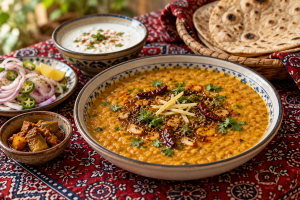
Daal Makhani
دال مکھنی
Stovetop only, cooking durations provisional
A rich Punjabi-style black urad dal with fully cooked red kidney beans, tomato, butter and cream; its character comes from slow simmering and mashing part of the beans. Regional and restaurant preparations vary.
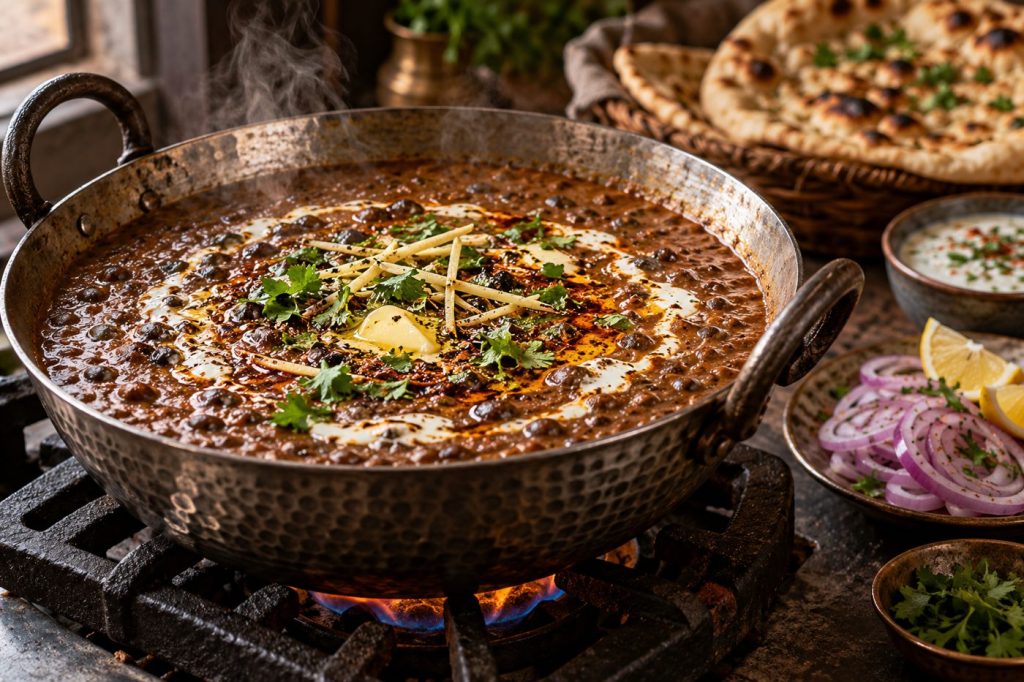
Total includes a 12-hour soak and a 10-minute rest. Cook the two pulses in parallel where possible; allow longer until both are fully tender. One tablespoon = 15 ml; one teaspoon = 5 ml.
About Daal Makhani
A rich Punjabi-style black urad dal with fully cooked red kidney beans, tomato, butter and cream; its character comes from slow simmering and mashing part of the beans. Regional and restaurant preparations vary.
Personally cooked and tested by Zohair Fakhar for DailyLife.pk. Cooking times can vary with your stove, cookware and batch size; follow the texture and doneness cues in the method.
Make it work for your kitchen
Also known as Dal Makhani, Creamy Black Urad Dal, Maa Ki Dal.
Original quantities serve 4. Cooking times, pan size and frying-oil depth do not scale, cook in extra batches instead.
Before you start
Before you start
Measure the selected dry legumes before soaking. Rinse and soak the whole black urad and red kidney beans in separate bowls with plenty of water for 12 hours, then drain and discard the soaking liquid. Prepare the onion, aromatics and measured masala ingredients while the pulses cook.
Set up the equipment
Have the following tools ready before starting: Large soak bowl plus colander; Large heavy-bottomed cooking pot with lid (at least 4 litres); Separately controlled saucepan for the bean boil; Spatula or potato masher.
Clean workspaceMeasure the ingredients
Measure the ingredient quantities for your selected servings before applying heat. Keep separately listed groups, such as dough, filling, sauce or garnish, in separate containers; keep any optional additions separate.
Use the ingredient list aboveCheck allergens and substitutions
Check ingredient labels and any substitutions against these notes: Contains dairy (butter, cream).
Before cooking
Step-by-step cooking method
1 Boil the red kidney beans safely
Set out fresh cooking water as a shared initial supply for both pots, adding more if needed to keep the pulses covered. In the kidney-bean pot, cover all the soaked red kidney beans with a portion of that fresh supply. Bring to a vigorous rolling boil and maintain it for at least 30 minutes. Keep the boil vigorous throughout this stage.
2 Boil the red kidney beans safely (continued)
Do not use a slow cooker for raw beans. Continue cooking until fully tender; reserve any clean cooking liquid.
3 Cook whole black urad
In a separate pot, cover all the soaked whole black urad with enough of the fresh supply. Bring to a boil, skim foam, then simmer partly covered until completely soft, approximately 90–150 minutes. Replenish carefully from a boiling kettle if needed.
4 Start the onion and tomato masala
Melt unsalted butter in a heavy pan over medium-low heat.
5 Start the onion and tomato masala (continued)
Cook finely chopped onion for 7–9 minutes until golden. Stir in crushed garlic and grated ginger for 1 minute, then tomato puree and Kashmiri chilli powder. Cook for 8–10 minutes until thickened, stirring so the base does not catch.
6 Combine fully cooked beans
Combine the entire cooked contents of both pulse pots with the masala, adding enough reserved cooking liquid for a loose stew. The legumes must be fully tender before this stage; do not reweigh them to the dry ingredient amounts. Mash a ladleful against the pan, then simmer gently for 30–40 minutes, stirring from the bottom frequently.
7 Finish with cream and spices
Stir in fine salt, garam masala, dried fenugreek leaves and heavy cream. Simmer gently for another 5–8 minutes until velvety. Loosen with a little hot water only if too thick.
8 Rest then serve
Turn off heat; rest covered 10 minutes. Check beans: they must mash easily with no hard centre. Serve in bowls, with roti separately if desired.
Chef’s tips
- Older black urad may need significantly longer than the estimate; tenderness decides, not a clock.
- Mash a little cooked urad to develop body before adding more cream.
Common mistakes & quick fixes
- Kidney beans are hard
- Do not eat; return to a vigorous boil and cook through.
- Sauce catches on the bottom
- Move to a clean pan without scraping burnt sediment; add hot water and lower heat.
- Dal seems watery
- Simmer uncovered and mash soft urad, rather than thickening with flour.
Variations & serving ideas
No cream: Reduce the butter or omit cream only as a separate, leaner variant; recalculate texture and nutrition.
Use canned rajma: Swap dry 65 only after documenting drained canned weight equivalence; canned beans are pre-cooked.
Serve with: Naan, plain roti or rice prepared separately.
Perfect result check
| Check | Urad and red kidney beans fully tender Use this as the final sensory check; if not achieved, correct before serving. |
|---|---|
| Check | Creamy thick but pourable sauce Use this as the final sensory check; if not achieved, correct before serving. |
| Check | No burnt bottom and no raw bean texture Use this as the final sensory check; if not achieved, correct before serving. |
Storage & reheating
| Fridge | 3–4 days | Move cooked portions promptly into shallow containers and refrigerate within 2 hours, or within 1 hour above 32°C. Keep at or below 4°C and use within 3–4 days. |
|---|---|---|
| Freezer | Freeze promptly | Freeze after prompt chilling in sealed portions. The cream sauce may change texture after thawing. Thaw in the fridge. |
| Reheating | Until hot throughout | Reheat to 74°C (165°F) throughout, stirring for even heating and loosening with a little water if needed. Reheat only the portion you need. |
Know when to change the heat
| Stage | Heat | What to look for |
|---|---|---|
| Boil red kidney beans | High, vigorous boil | Maintain a true rolling boil for at least 30 minutes after soaking and changing the water. Continue cooking until the beans have no hard centre; a gentle slow-cooker simmer is insufficient for the initial stage. |
| Soften urad and finish curry | Low after initial boiling | The urad should crush completely before combining. Stir the combined curry frequently as it thickens, then keep the cream stage gentle so it stays smooth. |
Helpful answers before you cook
Can I put raw red kidney beans in a slow cooker?
Use the vigorous bean-boiling stage on the stovetop. After the overnight soak, drain and use fresh water, then maintain a rolling boil for at least 30 minutes and continue until tender. A low-temperature slow cooker is unsuitable for cooking raw red kidney beans.
Is Daal Makhani the same as Daal Mash?
No. This recipe uses whole black urad and kidney beans, while Daal Mash uses split white urad.
Are the urad and kidney-bean weights dry or cooked?
The ingredient quantities are dry weights measured before soaking. After soaking and fully cooking both pulses, add all of their cooked contents to the masala. Do not take only the dry-weight amount from the cooked beans: they absorb water and become heavier.